Skip to Content Facebook Feature Image

Frequent wild panda appearances reflect habitat improvement in China's Sichuan

China

China

China

Frequent wild panda appearances reflect habitat improvement in China's Sichuan

2026-06-15 18:00 Last Updated At:20:37

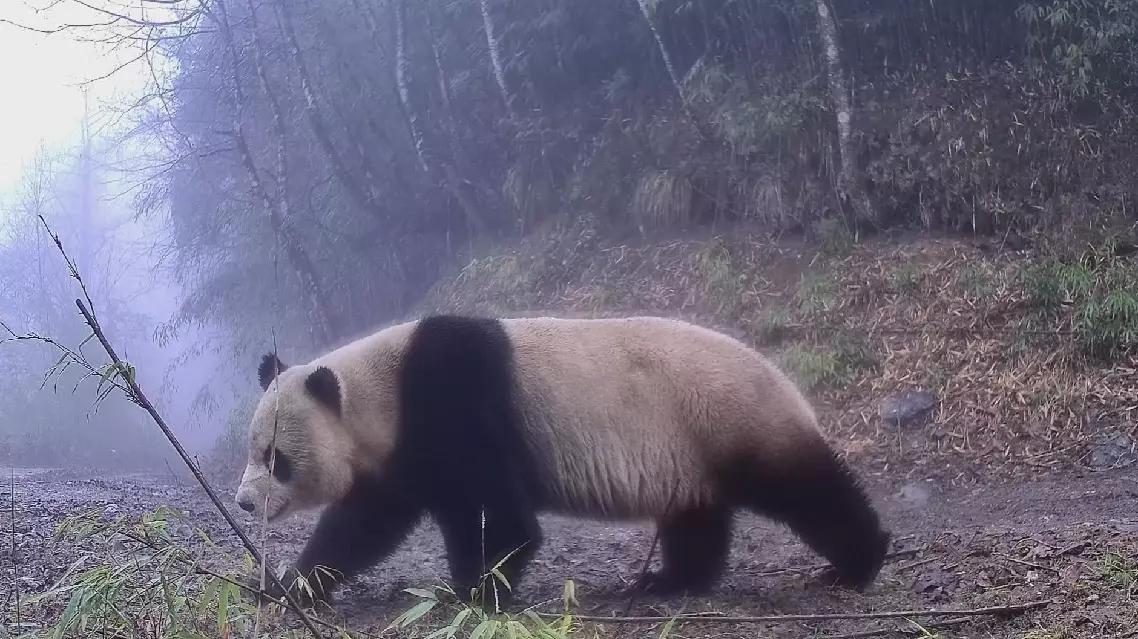
The Meishan Area of the Giant Panda National Park in southwest China's Sichuan Province has recorded frequent appearances of wild giant pandas in recent months, reflecting the growing vitality of the local panda population and the ongoing improvement of their habitat.

The latest footage, captured by infrared cameras in the park from mid-March to mid-May of this year, recorded the pandas' daytime and nighttime activities on five separate occasions. Some of the pandas were seen roaming alone in the forest, while others were seen foraging and resting.

According to monitoring data, the frequency of wild giant panda sightings in the area has increased significantly this year, and the population has become increasingly active, fully confirming that the giant pandas in the region enjoy excellent habitat conditions and are growing steadily.

Thanks to habitat restoration efforts by local authorities in recent years, the area has witnessed steady improvements in ecological quality, continued expansion of high-quality habitats, and significant increases in the vitality and activity range of wild giant pandas.

The monitoring system has also repeatedly recorded the activities of rare wildlife such as red pandas and markhor, indicating an increasingly diverse biological community and fully demonstrating the remarkable achievements in biodiversity conservation in this area.

"Moving forward, we will continue to leverage the smart monitoring system to further strengthen the protection of giant panda habitats, improve the construction of ecological corridors, conduct precise monitoring of wild populations, and elevate biodiversity conservation efforts in the Wawushan area to new heights," said Yan Fuquan, head of the education and protection office of at the Meishan management bureau of Giant Panda National Park.

The Giant Panda National Park was officially established in 2021, spanning the three provinces of Sichuan, Shaanxi and Gansu and covering about 22,000 square km.

Since its establishment, about 72 percent of wild giant pandas have been placed under strict protection. The protected area for the panda habitat has increased from 1.39 million hectares to 2.58 million hectares. The park has integrated 73 nature reserves across the three provinces, connecting the habitats of 13 local panda populations. In addition, six ecological corridors have been built to allow pandas to move freely within the region.

Thanks to China's systematic action to better protect its national treasure, the wild giant panda population in the country has grown from about 1,100 in the 1980s to nearly 1,900, according to the 2025 data from the National Forestry and Grassland Administration.
Frequent wild panda appearances reflect habitat improvement in China's Sichuan


Frequent wild panda appearances reflect habitat improvement in China's Sichuan

A leading Japanese economist has warned that the Bank of Japan's anticipated interest rate hike will not address the country's fundamental economic problems, calling instead for structural reforms and stronger support for small and medium-sized enterprises.

The economist's comments come as the yen exchange rate continues to hover near 160 yen per U.S. dollar, with Japanese media and financial markets widely expecting the Bank of Japan to announce a rate hike at its monetary policy meeting on June 15 and 16.

"Japanese political and economic scholar Hamada Kazuyuki said: "The future trend of the Japanese economy is also affected by factors such as rising crude oil prices and inflation, and there are no signs of these problems being resolved anytime soon. If left unchecked, they will develop into a serious inflationary trend. This will not only affect enterprises but also the daily lives of ordinary people. Therefore, in order to curb these impacts, the Bank of Japan is taking countermeasures and adjusting toward the direction of raising interest rates. However, whether these measures can truly be effective still remains highly uncertain," he said.

He also noted that the operations of small and medium-sized enterprises in Japan continue to face pressure, and the overall recovery of the Japanese economy is filled with uncertainty. The Japanese government's model of relying on debt to rescue the market only addresses symptoms rather than root causes and cannot solve the fundamental problems of the Japanese economy, he added.

"More than 80 percent, or even 90 percent, of Japanese enterprises are small and medium-sized enterprises. Only a small number of large enterprises have gained profits from exchange rate fluctuations. The vast majority of small and medium-sized enterprises are already on the edge of life and death. Therefore, without more adequate support policies for small and medium-sized enterprises, it will be very difficult for the Japanese economy to achieve recovery or restoration. The current government is in a rather difficult situation. Originally, it said no supplementary budget was needed, but as the economy deteriorates, it has no choice but to rely on supplementary budgets and deficit financing to barely cope. But this is not a fundamental solution. Continuing down this path will only make Japan's situation further deteriorate. Therefore, if the government truly wants to improve the economy, it must cut waste within the existing fiscal scope and concentrate resources into truly effective areas. This is the necessary direction," he said.

Japanese economist warns rate hike inadequate, urges structural reform

Japanese economist warns rate hike inadequate, urges structural reform

Recommended Articles