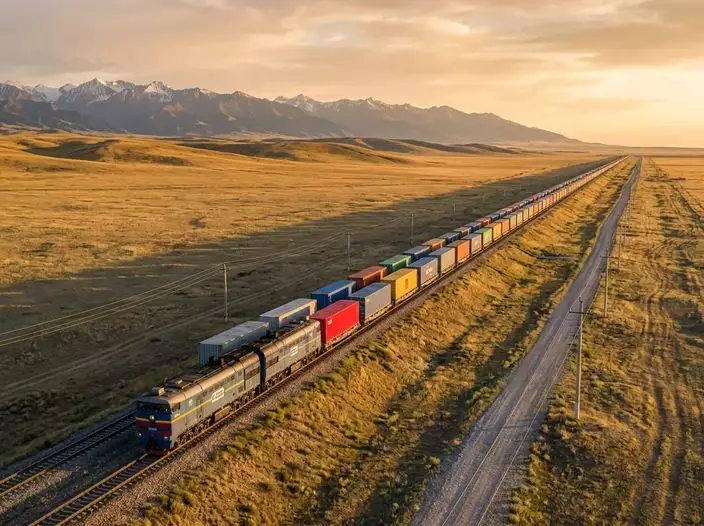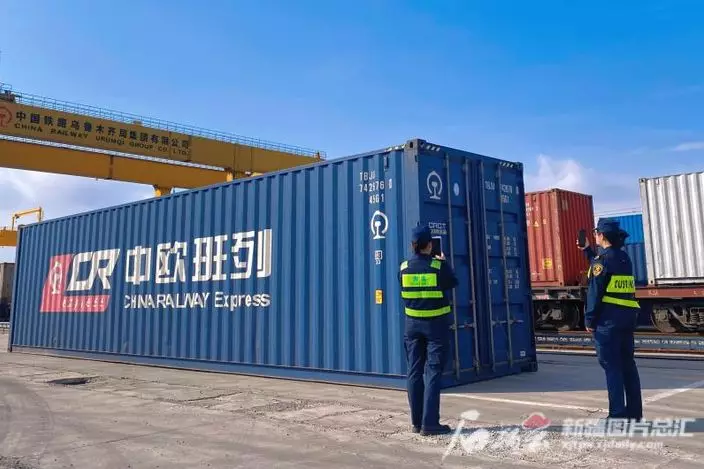

Ten years ago, fewer than five trains a day rolled out of China toward Europe. Today, more than 55 depart every 24 hours. The Iron Silk Road has quietly redrawn the trade map of the entire Eurasian continent.
From Barren Platforms to Tens of Thousands of Trains
In June 2016, the China-Europe Railway Express unified its brand and officially launched. The first batch of trains departed simultaneously from eight cities — Chongqing, Chengdu, Zhengzhou, Wuhan, and Yiwu among them. That year, a grand total of 1,702 trains hit the rails, averaging fewer than five a day.
Ten years on, the picture is completely different. According to data released by the China State Railway Group on June 19, annual traffic reached 20,022 trains in 2025 — a 10.8-fold increase over a decade, at an average annual growth rate of 31.5%.
By June 10, 2026, the Express had already surpassed 10,000 trains and one million TEUs for the year-to-date period, setting a new historical high for the same period.
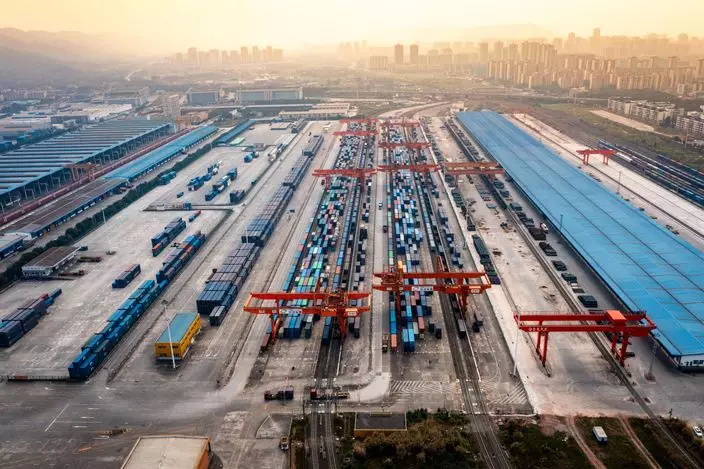
On June 22, the whistle sounded at Chongqing's Tuanjiecun Central Station. Train X8013 of the China-Europe Railway Express (Chengdu-Chongqing) — fully loaded with 182 "Made in Chongqing" vehicles — set off for Russia's Vorsino station. The first time an entire train used the new 40-foot, 35-ton general-purpose car containers, sized precisely to fit the railway clearance limits of major countries along the route, enabling seamless integration with rail, road, and maritime transport.
"Made in Chongqing" Cars Reach Europe in Two Weeks
This railway line means far more to China's manufacturing sector than a logistics channel. For Chongqing's auto exporters, the old route forced goods down the Yangtze River to eastern coastal ports — a lengthy and costly detour. The Express cuts that journey to an average of two weeks, delivering cargo straight to the European hinterland.
Yu Qinghua, general manager of overseas marketing for Deepal — the new-energy vehicle brand under Changan Automobile — revealed that the Express provides priority marshaling, shipping, and guaranteed space for new-energy vehicles. Thanks to those advantages, Deepal's overseas orders hit 13,500 units in the first quarter of this year, up 85.4% year-on-year.
The variety of freight has changed beyond recognition. When the service launched in 2016, it primarily carried mobile phones and computers. Today, freight categories have expanded to 53 sectors and over 50,000 types of goods — clothing, footwear, automobile parts, grain, wine, coffee beans, and timber among them.
Total cargo value reached US$67.7 billion (approximately HK$527 billion) in 2025. The Express has become the fast track for "Made in China" products going overseas, and for European agricultural products and chemical raw materials entering China.
Three Maritime Crises, Three Times Stepping Up
Three separate maritime crises have exposed the true strategic value of this steel corridor. In 2021, the Ever Given ran aground in the Suez Canal, briefly paralyzing global shipping and triggering a surge of Express orders. When the Red Sea crisis erupted in 2023, sustained Houthi attacks on commercial vessels pushed European buyers toward land transport.
Then in 2026, Iran's blockade of the Strait of Hormuz during the US-Iran war placed renewed pressure on global energy shipping. Each time, the Express's "all-weather, blockade-proof" characteristics drove the international shipping industry to a deeper recognition of its value as a strategic backup.
Make no mistake: this is no coincidence. It is the result of Beijing's systematic planning over two decades.
A Network Spreading Across Eurasia
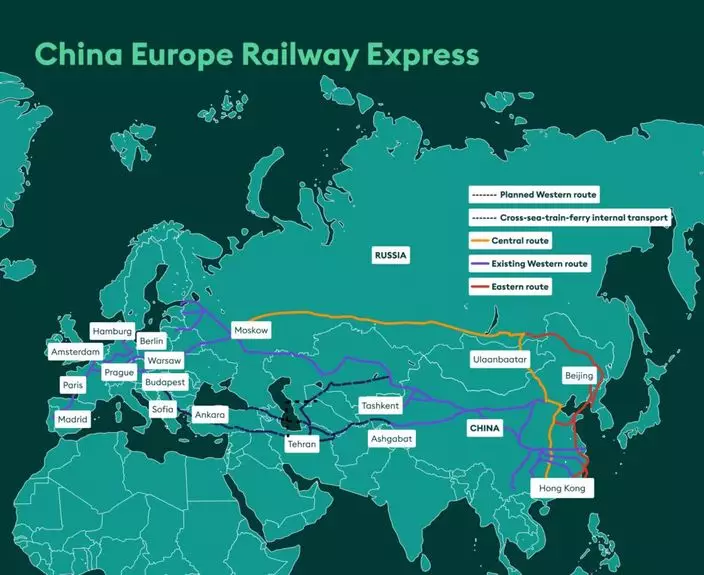
Today, 129 cities in China have opened routes for the China-Europe Railway Express, reaching 236 cities in 26 European countries. At the Khorgos railway port in Xinjiang, annual train traffic to Europe and Central Asia skyrocketed from fewer than 400 in 2016 to 9,882 in 2025.
After Urumqi Customs and State Railway jointly implemented the "smart railway port plus local rapid customs clearance" reform, port clearance time for imported goods dropped from two to three days to under 16 hours — a 70% reduction. Processing time for exported goods shrank from six hours to just one hour, an 80% decrease.
Routes connecting Central Asia are expanding, too. In Zhengzhou, a train loaded with 1,700 tons of textiles recently departed for Hairatan, Afghanistan. In Xi'an, the first dedicated rapeseed oil train from Krasnoyarsk arrived on May 2. Sixty-two containers carrying over 1,500 tons of Russian rapeseed oil completed the cross-border direct run in 11 days. Unloading and warehousing took just 1.5 hours — nearly half the time required under traditional models.
Behind every single train lies a restructuring of the entire logistics order across the Eurasian continent. Whoever controls the land routes holds the leverage in the trade contests of the next era.
Mao Paishou
** 博客文章文責自負,不代表本公司立場 **

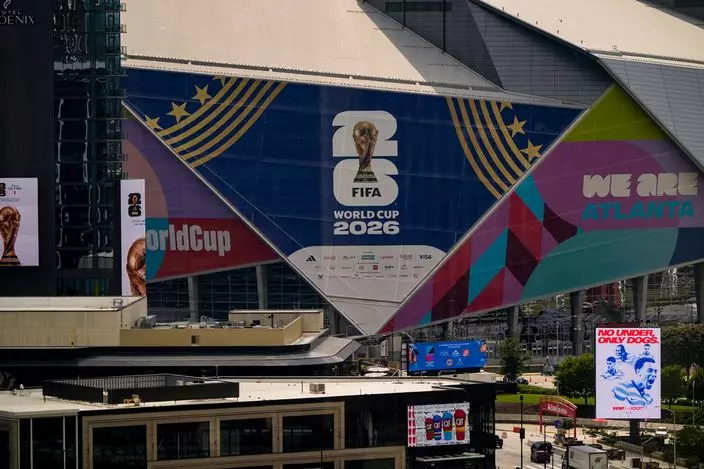
Despite years of US government efforts to contain and suppress Chinese tech companies under the banner of "national security," the 2026 FIFA World Cup – hosted across the United States, Canada, and Mexico – tells a very different story. Chinese enterprises are omnipresent at the world's most prestigious football tournament, from broadcast technology to commercial sponsorship, playing an indispensable role both on and off the pitch.
Chinese brands are "everywhere" at the World Cup, playing a key role. (AP Photo)
China's Men's Team Absent, Yet Chinese Brands Steal the Show
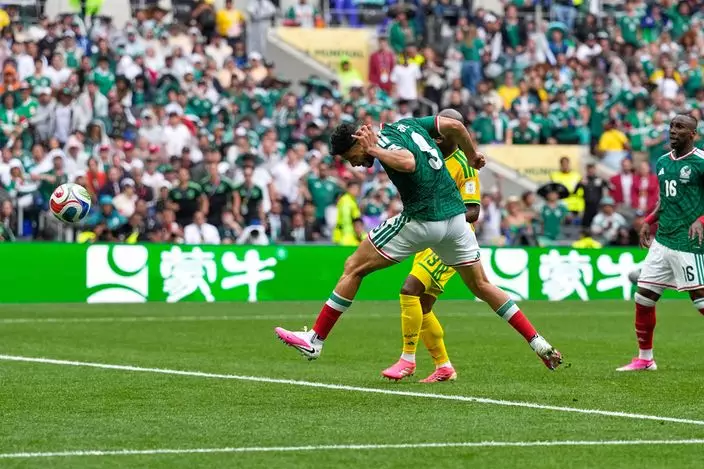
China's national men's team has been absent from the World Cup since 2002 – but Chinese brands have not missed their moment in the global spotlight. As the South China Morning Post reported on June 13, analysts note that the central role Chinese enterprises play at this World Cup lays bare a reality often obscured by Sino-American geopolitical tensions. Despite US policymakers pushing so-called "de-risking" under the guise of "security," Chinese companies remain deeply embedded in the global commercial ecosystem – including at the most high-profile international sporting event ever held in North America.
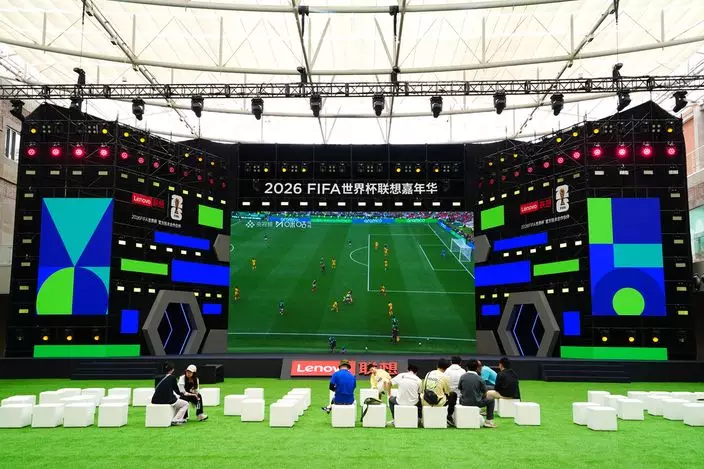
Lenovo has become one of the technological pillars of this World Cup. (AP Photo)
Chinese companies hold some of FIFA's most prominent commercial positions. Lenovo is an official FIFA Partner. Hisense is a World Cup sponsor and technology provider. Mengniu has maintained a long-standing partnership with the tournament. FIFA expects to generate between US$2.5 billion and US$3 billion in sponsorship revenue from the 2026 World Cup, making it one of the most commercially valuable sporting events in history.
LABUBU Makes History – First Chinese Original IP at a World Cup Opening Ceremony
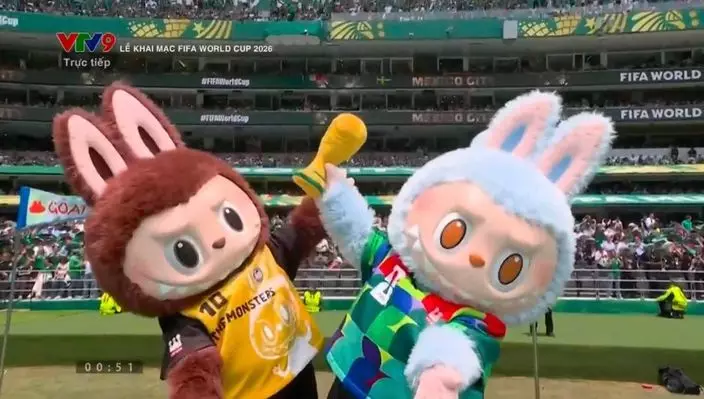
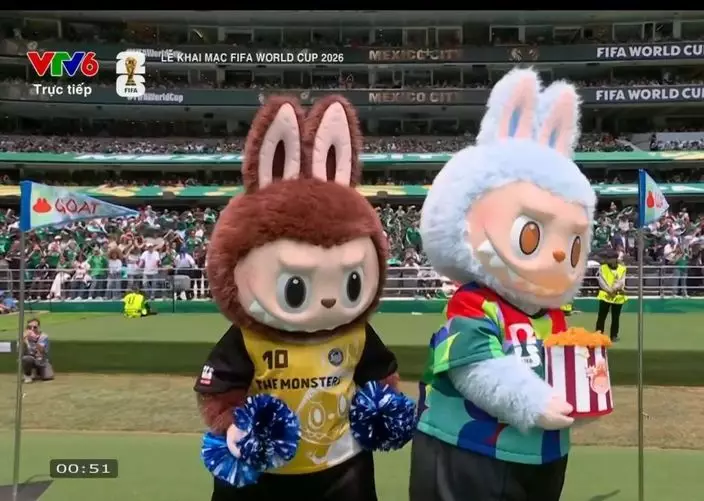
In the early hours of June 12 (Beijing time), the 2026 FIFA World Cup officially kicked off. The opening ceremony was star-studded, as football fans around the world came together to celebrate the sport's greatest festival. LABUBU – the wildly popular intellectual property under Pop Mart – made a stunning appearance as a special guest, becoming the first Chinese original IP ever invited to a World Cup opening ceremony, witnessing this historic moment alongside the world.
LABUBU makes history – the first Chinese original IP to appear at a World Cup opening ceremony. (Screenshot via CCTV)
Beyond the spectacle of the opening, thousands of Lenovo devices are operating inside the International Broadcast Centre. They help FIFA manage and distribute content from stadiums across the United States, Canada, and Mexico, making Lenovo one of the technological pillars of this World Cup.
A US-Hosted Event That Keeps Opening Doors for Chinese Brands
You can say the 2026 World Cup is "the coming out party for Chinese global brands". That assessment comes from Craig Allen – former US Ambassador and Senior Fellow at the Asia Society, an American think tank. The high-profile presence of Chinese enterprises at a World Cup hosted in North America underscores the complex interplay between geopolitical rivalry and commercial integration. Even as the United States continues to provoke tensions with China over trade, technology, and so-called "national security" concerns, the global sporting events it hosts continue to offer Chinese brands unparalleled worldwide exposure.
From Sponsorship to Tech Support – Chinese Firms Demonstrate Global Aspiration
Scott Kennedy, a researcher at the Center for Strategic and International Studies (CSIS), put it plainly: "The World Cup is a global event with billions of fans from around the world watching, What this shows is that Chinese consumer-facing firms are pursuing a global strategy for fans around the world, an effort which continues regardless of any government-level tensions."
Lenovo has become one of the technological pillars of this World Cup. (AP Photo)
Lenovo's role at the tournament is a prime example of that global strategy at work. Lenovo's Chief Communications Officer, Jeff Shafer, stated: "If people come away from the Fifa World Cup only knowing that Lenovo sponsored the tournament, not what we have delivered from a technology and innovation standpoint, then we have failed." Lenovo's technology is powering the FIFA Smart Command Centre – a real-time operations hub designed to support match management before, during, and after games.
Lenovo is also providing all 48 participating teams with AI-powered analytics tools and fan-facing applications. It has additionally developed digital player models designed to assist match officials in making offside decisions.
Hisense has served as a World Cup sponsor for several years, providing technology related to video replay systems and other match operations. Mengniu, meanwhile, has maintained a long-standing partnership with FIFA.
Mengniu has maintained a long-standing partnership with the tournament. (AP Photo)
Some experts argue that the growing role of companies such as Lenovo, Hisense, and Mengniu demonstrates that "China, arguably, through its commercial activities, has become a leading Fifa nation." Others suggest it reflects, more broadly, the global ambitions of Chinese enterprises. As Chinese firms go head-to-head with Western rivals in consumer electronics, home appliances, and other global markets, this mega sporting event provides a platform to build brand recognition on a worldwide scale.
Simon Chadwick, Professor at the Skema Business School in Canada, noted that many European and North American companies have shifted toward more targeted forms of marketing – but Chinese firms continue to see value in global sporting events. Not just at the World Cup, but across the Olympics, the UEFA European Championship, and sporting events in Africa and other emerging markets, the presence and influence of Chinese enterprises is growing steadily. China's men's team may be absent from the World Cup pitch. Off it, Chinese brands are winning one victory after another.