Washington constantly agonizes over China's technological ambitions. Politicians used to worry about merely being overtaken. Now, they face a much bigger headache: China is sprinting far ahead on key tracks.
The US-China tech rivalry has profoundly flipped. The New York Times bluntly detailed this shift in a recent deep dive. In crucial sectors like batteries, solar energy, rare earths, and biomedicine, China is no longer the head-down student playing catch-up. It now reigns as a major exporter of the world’s most advanced technologies. This leaves the US in a dilemma. America craves access to China's mature and cheaper technologies, but fears over-reliance will trigger strategic risks.

Contemporary Amperex Technology Co. Limited (CATL)
Take a look inside the factories of Contemporary Amperex Technology Co. Limited (CATL). As the world’s largest and most advanced battery manufacturer, its robotic arms move with the precision of ballet dancers. Long metal strips wound into rolls and shaped into blocks. These battery bricks will soon come to life to power electric vehicles and data centers globally.
Within the walls of this factory, the power dynamic between China and the US is quietly reversing.
American companies maintained a massive technological edge over their Chinese competitors for decades. US firms set up manufacturing plants in China merely to cut production costs. Through joint ventures, Chinese enterprises learned and absorbed these advanced technologies.
The game has now completely flipped in several sectors. China is developing the world’s most advanced technologies in fields spanning batteries, solar panels, rare earths, and life sciences. The country is actively deploying plans to monopolize more markets.
The 15-year-old CATL perfectly epitomizes this shift. It introduced a battery delivering a 250-mile range on a sub-10-minute charge, outpacing rivals threefold. These batteries now power massive volumes of Chinese new energy vehicles exported worldwide.
CATL operates over 20 global factories, commanding 40 percent of the EV battery market and 30 percent of energy storage. "Of course if there’s an opportunity in the U.S., we wish to pursue it," said a CATL spokesman.
The US has grown increasingly concerned about China’s rapid progress in critical technologies. Politicians fear this could trap America in a new dependency. The situation draws direct comparisons to past reliance on Middle Eastern oil.
Some politicians argue China established dominance in critical industries like batteries through massive subsidies and industrial policies. They believe Beijing uses this to weaken other nations' industrial bases and expand its influence. US Representative John Moolenaar, Republican chairman of the House Select Committee on the Chinese Communist Party, echoed this fear. He claimed entrusting critical industries to Chinese companies would be "a grave error".
But the real issue is that refusing to cooperate with China carries its own massive risks. Doing so may cause domestic companies to fall further behind in future competition. Shutting out the world’s most dynamic economy will only slow technological progress.
"For decades now, we’ve been used to a world where the technology and innovation comes out of the West,” said Kyle Chan, a fellow at the Brookings Institution, a Washington think tank. “The tables are turning."
This contradiction is glaringly evident among American businesses. General Motors is attempting to partner with South Korean companies to build a non-Chinese supply chain. Ford has taken a different route by embracing CATL as a vital partner. The automaker licenses CATL technology for domestic US production while carefully dodging political red lines.
The New York Times attributes CATL’s success to sustained, high-intensity research investments. The company boasts 22,000 research and development personnel and over 700 PhDs. This success also stems from China's long-term strategic layout in new energy vehicle industrial policies over the past decade. From subsidies and industrial planning to talent development, China has built a comprehensive scientific and industrial system.
Albert Bourla, chairman and CEO of US pharmaceutical giant Pfizer, hit the nail on the head this past March. He noted: "They built their science. So this is where we need to become better".
The robotic arms keep spinning at breakneck speed. The days of America leading and China chasing are strictly history. Today, the rivalry is boiling over, with each side wielding its own distinct advantages. Make no mistake: this is no longer a do-or-die, zero-sum clash. The technological race has officially entered a new era.
Mao Paishou
** 博客文章文責自負,不代表本公司立場 **
Bloomberg reported on October 14 local time that the EU is negotiating with China. Brussels hopes Beijing will lift sanctions on the small German company Sindlhauser Materials GmbH. That small firm supplies the Dutch ASML, the world's most important chip equipment manufacturer. The sanctions now threaten its survival.
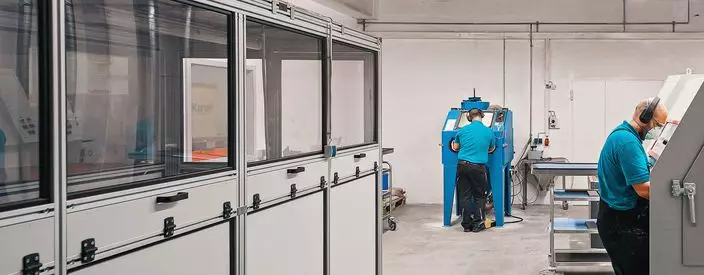
EU seeks China deal to free ASML supplier Sindlhauser.
The Deal on the Table
Bloomberg cited people in the know as saying the EU will remove trade restrictions on an unnamed Chinese company in exchange. That company is accused of assisting Russia in launching war against Ukraine.
In July this year, China imposed sanctions on Sindlhauser and 13 other European companies. The move retaliated for the EU's 21st round of sanctions against Russia. Sindlhauser is a small German company specializing in precision manufacturing and advanced coating technology for semiconductors and other industries.
In that round of sanctions, the EU listed several Chinese entities as sanctions targets. The EU said they were suspected of providing Russia with key components that could be used to manufacture weapons. Companies placed on the relevant EU and Chinese lists are subject to export controls.
People familiar with the matter said Sindlhauser relies on Chinese supplies of rare earths and critical minerals. If China's sanctions continue, the company will face the risk of bankruptcy within the coming months. It was also said this German company is part of ASML's supply chain.
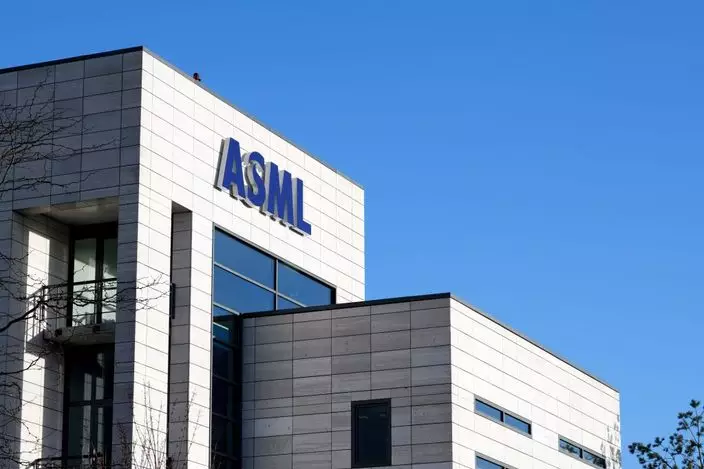
ASML, Dutch semiconductor equipment giant.
Berlin and Brussels Race to Rescue Sindlhauser
Bloomberg sees a message in China's choice of target. Imposing controls on such an obscure company, the report argues, shows China knows exactly where Europe's economic bottlenecks sit.
An EU official says the European Union has begun discussions with China on whether each side would remove the entities from its own list. That means China's export control framework on one side, and the entities the EU has listed under its own regulations on the other.
The official added that any removal decision on the EU side would require unanimous support from all member states.
The trouble began in July when China's Ministry of Commerce put Sindlhauser on its export control list, and the company's first reaction was panic.
For weeks after the announcement, Sindlhauser had no clear view of whether, or how, it could keep operating.
Help came quickly. According to the people who knows what’s happening, the German government and the Bavarian state government, where Sindlhauser is headquartered, stepped in immediately to help the company find alternative suppliers wherever possible.
The two governments also explored other workarounds, such as recycling existing materials and seeking whatever financial support was available.
Brussels was watching too. Some officials there understood the company's plight and raised the matter with the Chinese side for several weeks.
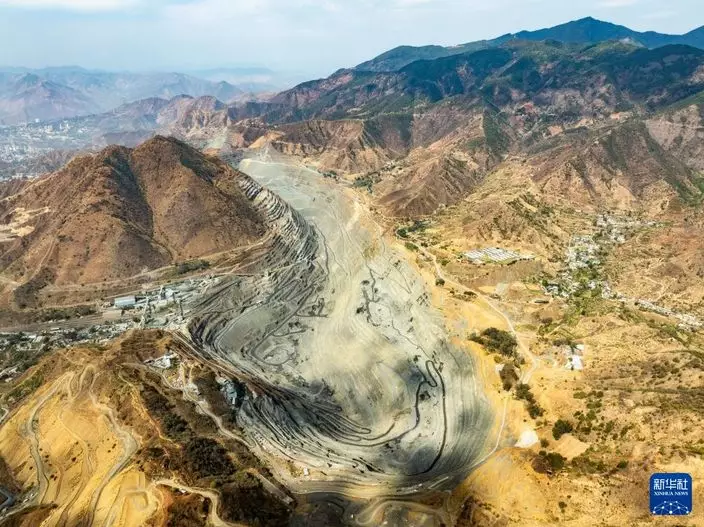
Sindlhauser's rare earth supply nearly all Chinese.
A Policy Dilemma, an Intelligence Blind Spot
Sindlhauser sits squarely inside China's rare earth grip. According to the report, the company relies almost entirely on Chinese rare earths, and its placement on the export control list dealt a direct blow to its supply chain.
The company had previously taken almost no measures to diversify its supply sources or reduce its dependence on Chinese raw materials.
Some officials see a problem with the rescue. Removing companies such as Sindlhauser from the sanctions list, they worry, could once again weaken the urgency for these European companies to build supply chain networks outside China.
That leaves the German government and EU officials in a bind. Deciding through negotiations which companies go onto or come off trade restriction lists could set a bad precedent for other companies also hoping for sanctions exemptions. It would also mean the EU must make concessions on the question of certain Chinese entities.
But officials involved in handling the matter see a deeper problem. The situation behind the case, they argue, is more concerning, though not surprising.
The explanation: over the past year and a half, China has been collecting information on global supply chains as much as it possibly can. That is how China identified a small company in Bavaria as a supplier to the world's most important chip equipment manufacturer.
Beijing's map of global supply chains runs remarkably deep. The report credits that insight to the licensing system China has built for exports of critical minerals and rare earths.
The system requires foreign companies to submit detailed information, including their customers, how and where Chinese raw materials are used, and photos of the final products.
Germany shows the cost. Some companies have been leaking business secrets to China, while the German government remained completely unaware and unable to obtain the same or even similar information.
More important, the German government still has not formulated any strategy to address its shortcomings in economic intelligence.
A Possible Template, and China's Stated Position
The talks went straight to the top. According to the report, EU Trade Commissioner Maroš Šefčovič visited Beijing last week and met with Chinese Commerce Minister Wang Wentao. The two sides discussed lifting restrictions on Sindlhauser in exchange for relief for a Chinese company.
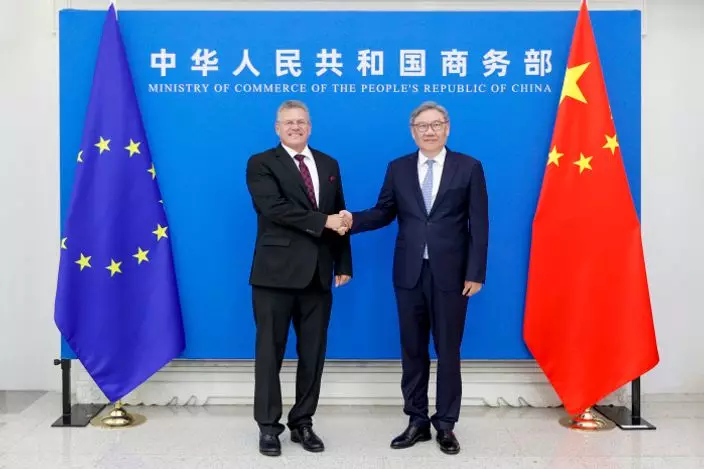
EU trade chief Šefčovič met Wang Wentao in Beijing.
The backdrop is stark. The EU is hunting for a fix to a massive trade deficit that exceeds $1 billion every single day.
People familiar with the matter say the two sides agreed in Beijing to strengthen information sharing and to give each other advance notice of export restriction measures.
The "one-for-one" arrangement around Sindlhauser, in which each side takes the other's company off its restriction list, could become a template for similar moves in the future. The EU is expected to act first. Only then would China lift its restrictions on the German company.
China's message has stayed consistent. The Chinese side has repeatedly stressed that China holds an objective and impartial position on the Ukraine crisis, stays committed to promoting peace talks, and plays a constructive role in advancing a political resolution of the crisis.
The opposition is just as firm. China firmly rejects the EU's blame-shifting, smears and denigration over the Ukraine crisis. It equally and firmly opposes the EU's unjustified listing and sanctions against Chinese companies and citizens.