China's investment in rural road construction totaled 144.3 billion yuan (around 21.31 billion U.S. dollars) in the first half of this year, said the Ministry of Transport on Wednesday.
The investment is part of broader efforts to expand and upgrade the rural road network, as China is pushing to transit rural roads from "accessibility" to "quality improvement."
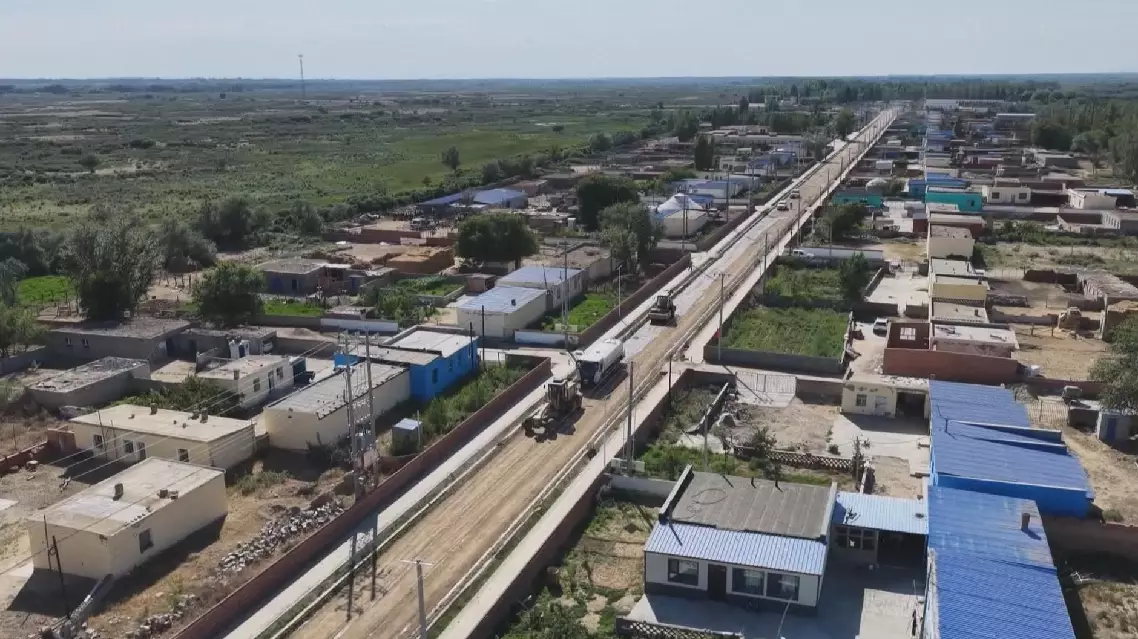
In northwest China's Qinghai Province, a highway project connecting Daotanghe Town in Gonghe County to the Qinghai Lake scenic area is nearing completion, with workers racing to finish road markings and install traffic signs.
The new highway, which is set to open by the end of this month, will link two towns and three villages along the way, benefiting more than 6,000 residents.
"The road will fill the gaps in the county's rural transport network and ease traffic pressure around the Qinghai Lake. It will also boost rural tourism along the route, including homestays and farm-stay businesses, expanding the channels for local farmers' and herders to earn more," said Li Debiao, deputy head of the Gonghe County Transport Bureau.
In Tongjiang County, southwest China's Sichuan Province, construction workers are repairing damaged road surfaces and clogged drainage systems, while improving guardrails and traffic signs.
The 130-kilometer upgrade project in Tongjiang is expected to be fully finished by the end of November.
"The road used to be out of repair for years and full of potholes, especially in rainy days. It was hard for us even to go to the market. Now with the road fixed, it will be much easier for us to travel and sell our local products. It has really solved a big problem in our daily life and production," said Fu Deliang, a villager of Longzhuanping in the county.
Official data showed that in the first half of the year, China built or upgraded 34,000 kilometers of rural roads, carried out safety barrier projects on 21,000 kilometers of rural roads, and renovated over 1,570 dilapidated bridges.
The ministry also promoted work-relief programs in rural road projects, creating jobs for local residents.
A total of 806 such projects were carried out across the country in the first half of the year, generating 120 million yuan (around 17.72 million U.S. dollars) in labor income and employing 14,000 rural workers, including over 3,000 people who have been lifted out of poverty.
Investment in rural roads totals 144.3 bln yuan in H1
Three weeks after deadly back-to-back earthquakes devastated Venezuela's coastal regions, reconstruction is slowly beginning as families struggle to salvage what remains of their homes while engineers work around the clock to determine which buildings are safe enough to re-enter.
The twin quakes, which struck in late June, have left more than 4,700 people dead, over 16,700 injured and nearly 18,000 homeless, according to official figures. In La Guaira state, one of the hardest-hit areas, the road to recovery is fraught with uncertainty.
Tairo Leal, a mechanic, is among those trying to rebuild. His family survived the quake, but he lost friends. Using salvaged materials, he is attempting to reinforce his home's structure.
"We are shoring this up and trying to recover this part of the structure as best we as can. I know it's not ideal, but what little we have left, we have to somehow preserve. There are people who are much worse off than us, who lost absolutely everything. And we hope, God willing, that there won't be another quake," said Leal.
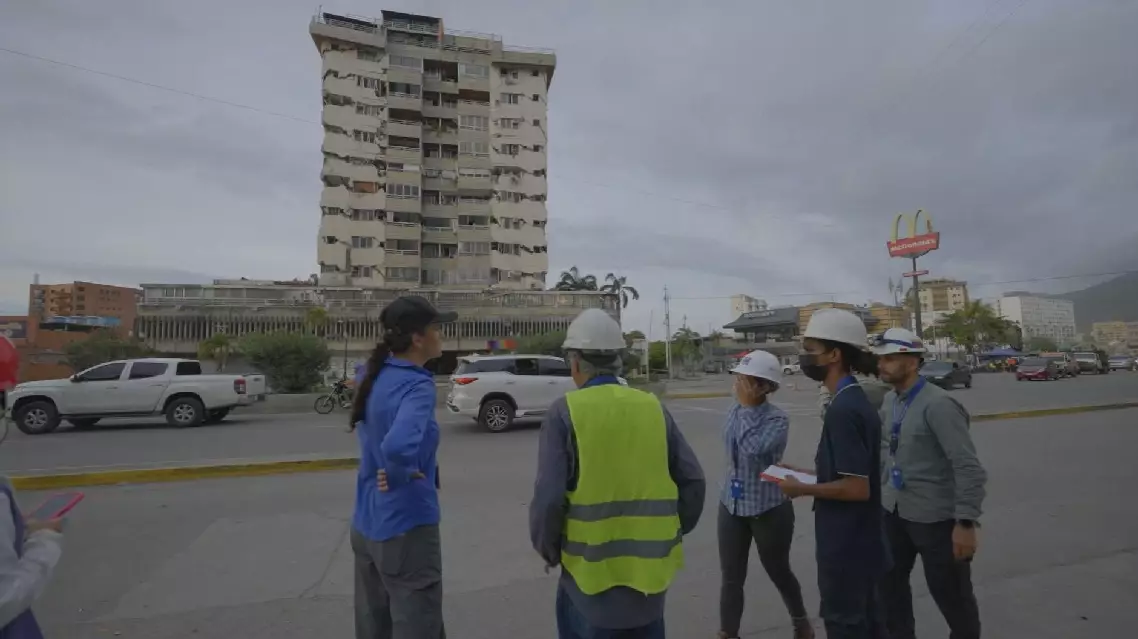
Beyond the physical challenge of rebuilding, the question for many families is whether their homes are safe enough to return to at all. Engineers and technical teams, working with Venezuela's Ministry of Public Works and Housing as well as universities, have been deployed to inspect damaged buildings and assign a "traffic-light" rating, green, yellow or red, to indicate the level of structural safety.
"We are evaluating the buildings and assigning what we call a traffic-light rating. After assessing the structure, we determine the building's condition after the earthquake. If there is no problem, it receives a green sticker. This is an international system," explained Guillermo Bonilla, a professor at Catholic University of Venezuela.
The teams have been working since the first night of the quakes, often more than 14 hours a day, with little rest. Bonilla said around 70 percent of homes in some areas collapsed, and each inspection carries an emotional weight as they deal with families who have virtually lost everything.
"This is the first stage, and in theory, it should be quick. But in some areas, around 70 percent of the homes collapsed. That makes it slow. And it is also slow because of the way you have to deal with people. An evaluation itself can be done in a relatively short time, but then you have 20 people -- or 14, or 10 -- and each one wants an explanation of what happened, and some reassurance," said Bonilla.
For La Guaira, the challenge is not only rebuilding fast but also safely. Engineers say the next phase will require geological studies and decisions about what kind of construction should be allowed in these coastal communities. For families like Leal's, the future remains uncertain. For now, they are simply trying to hold on.
Venezuela begins painstaking reconstruction after twin quakes claim over 4,700 lives