China is accelerating the provision of premium medical resources to rural areas to bridge the urban-rural healthcare gap and advance the government's strategic goal of building a "Healthy China" by 2035.
China's size and uneven development across its regions once meant that high-quality medical resources were heavily concentrated in major cities, leaving rural residents facing difficulties in accessing care.
To address this, the country has built the world's largest and most complete grassroots healthcare system. Currently, over 80 percent of counties have established resource-sharing centers for imaging, electrocardiogram (ECG), and lab tests, serving more than 330 million people and allowing patients to receive county-level diagnoses locally without traveling to big cities.
In western regions with weaker medical foundations, telemedicine is connecting village clinics directly to county hospitals.
In Anning City, Yunnan Province, 5G technology enables real-time ECG data transmission from village clinics to county experts.
"This year, we will also build AI-assisted diagnosis and achieve full coverage of remote consultations across the county, township, and village levels, so that the public can enjoy medical and health services right at their doorstep," said Song Chao, president of the Anning Medical Consortium.
Beyond technology, China is actively bolstering its grassroots medical workforce. Between 2016 and 2025, the number of grassroots medical personnel grew by nearly 50 percent, supported by targeted programs that assign general practitioners to township health centers.
Top-level hospitals also regularly dispatch experts to provide training and remote guidance in rural areas. By the end of 2025, the country had 1.39 million family doctors, with 180 million elderly residents enrolled in the health system, marking a systemic shift from disease-centered care to health-centered care.
"In our village, elderly people aged 65 and above get a free physical examination once a year. For those of us with chronic diseases, family doctors come to measure our blood sugar and blood pressure. We feel very satisfied," said Lin Houze, a villager in Sichuan Province.
The decentralization of medical resources is also offering hope to patients with severe and complex diseases in remote areas.
Three years ago, a Tibetan girl from southwest China's Xizang Autonomous Region named Kunsang , who suffered from severe scoliosis, was discovered and treated by an expert medical team from Beijing. Following successful surgery and rehabilitation, she grew from under 120 centimeters to over 140 centimeters and recently enrolled in university.
Not long ago, she was serving as a volunteer with a medical team conducting a free clinic tour in Xizang, showcasing the profound and lasting impact of these medical outreach programs.
"Three years ago, the doctors from Beijing crossed thousands of miles to come here and performed the surgery and helped with my rehabilitation. I never imagined I could be where I am today. Now I am full of hope for the future," Kunsang said.
As China enters the critical 15th Five-Year Plan period (2026-2030), it will continue to solidify its grassroots healthcare network, ensuring equitable and universal access to medical services as a foundation for national modernization.
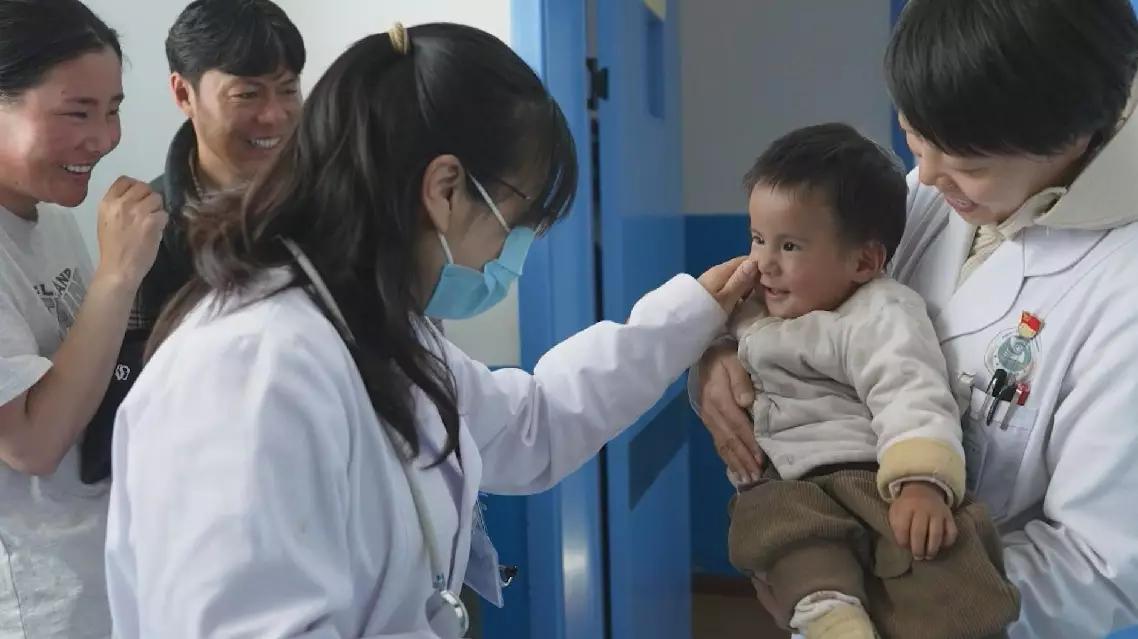
Modern medical resources increasingly accessible in China's rural areas