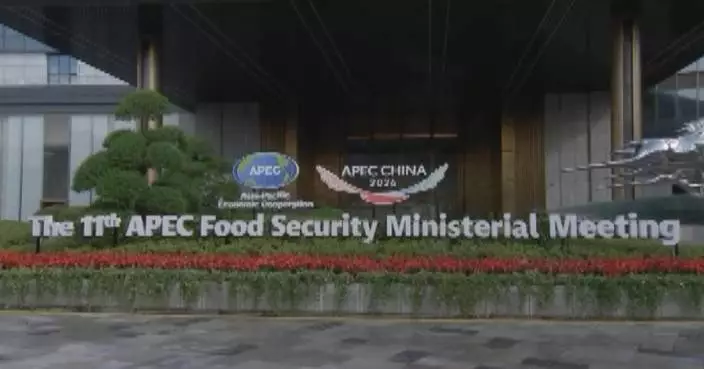
A Chinese-built AI platform is helping smallholder farmers across APEC economies fight back against extreme weather, delivering smarter tools to boost productivity, resilience and sustainability.
The Feiniao intelligent farming platform, developed by a team led by Professor Shi Qian at Sun Yat-sen University's School of Geography and Planning, is an AI-powered system that digitizes farm conditions, monitors daily crop growth and pest risks, and generates precision planting guidance, enabling effective agricultural management from planting to harvest.
During an interview with CGTN on Tuesday, Professor Shi discussed the role of AI in enhancing food security and shared her perspective on international cooperation in smart agriculture, particularly among APEC member economies.
According to her, the Feiniao system tackles a pressing challenge: how to help millions of small-holder farmers, who often lack both economic resources and technical know-how, adapt to a rapidly changing climate.
"The rising frequency of extreme weather events increases the risk of crop stress, and a large proportion of agricultural producers are small-holder farmers who often lack economic knowledge and practical planting capacity. We can frame its value along three dimensions: early warning, precise decision-making and broader reach. AI helps close productivity gaps between smallholders and large-scale commercial farmers," said Shi.
The technology has already moved from pilot testing to full deployment in China, while similar field-level trials are underway in several other APEC economies. Emphasizing that a one-size-fits-all approach is not viable, Shi said the team will adapt its AI models to each location based on locally collected data.
"We have carried out adaptive local trials with agriculture partners in Southeast Asia. For instance, we localized our remote-sensing-driven AI models in Indonesia and Malaysia. We adjust our algorithm with local soil, climate and crop data sets. We also actively share China's practical experience on AI-powered early warning service and inclusive small farmer solutions. Looking ahead, we can build inclusive digital agriculture services so small-scale farmers across the APEC economies can actually benefit from AI tools," said the expert.

China's AI system helps bridge agricultural gaps in APEC economies