Among the various everyday scenarios of Chinamaxxing, mobile payment is probably the one that allows foreign young people to "integrate" into Chinese daily life the fastest. From utter bewilderment upon arrival to being unable to imagine life without QR code payments by the time they leave—this transformation has become a shared experience for almost every foreign visitor to China.
A Londoner's "One App for Everything"
Click to Gallery
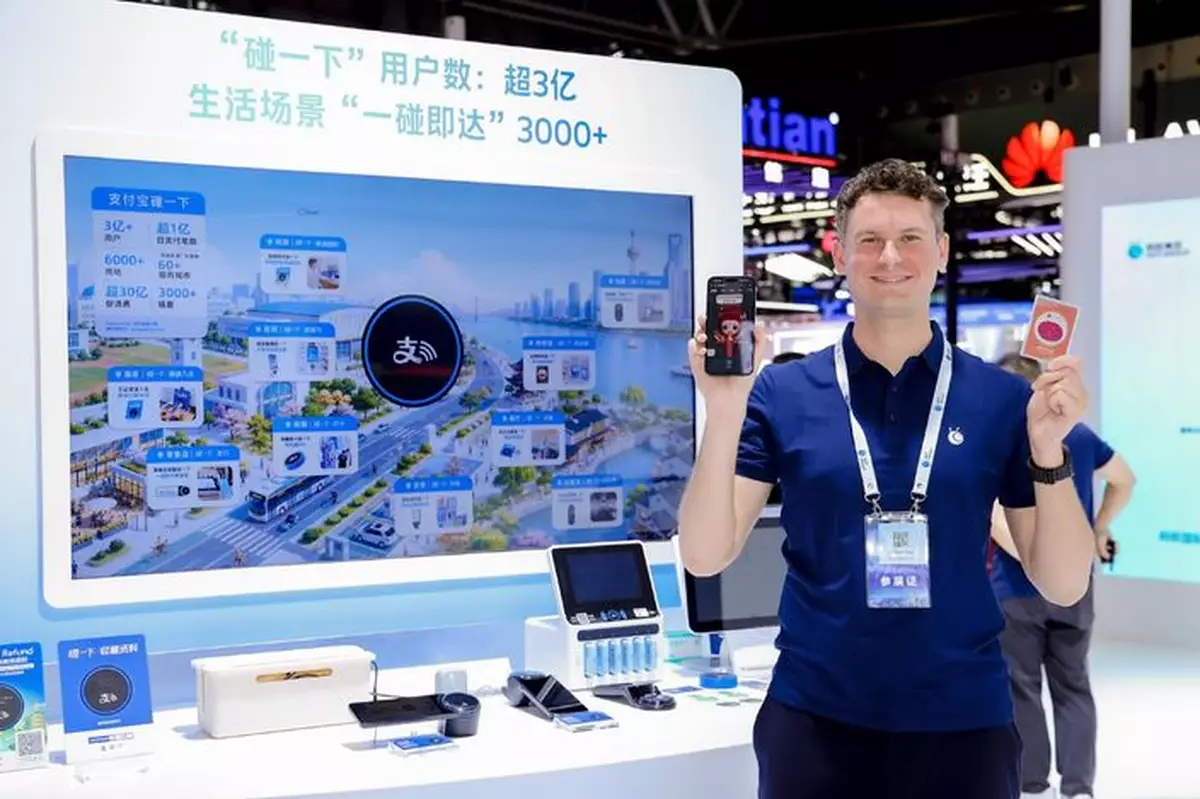
Josh Wei explains the cross-border payment ecosystem at Ant International's booth during the 2026 China International Fintech Exhibition. (Source: China City News)
Greek tourist Theo receives AI assistance to register and bind her card—a smooth, straightforward, and convenient process. (Source: CCTV News screenshot)
French designer Xiao Ma and his partner Da Yu at their studio in Beijing. (Source: CCTV News screenshot)
Brazilian tourist Adriano gives an interview in Shanghai about the convenience of mobile payments in China. (Source: CCTV News screenshot)
Josh, a London-based employee of Ant International, has personally compared the payment ecosystems of London and Shanghai. London has high NFC (Near-Field Communication) adoption and mature digital banks like Revolut and Monzo. But Shanghai, with its highly integrated super-apps, allows him—even as a foreigner—to easily hail rides, order food delivery, scan QR codes for shopping, and even plan itineraries and order milk tea through AI-powered mini-apps.
" London has a very mature financial market and professional services system; Shanghai, under a prudent, clear and forward-looking regulatory framework, has rapidly built a digital-first innovation ecosystem with an exceptionally rich range of application scenarios." Josh summarised his experience. For him, the experience of getting everything done with a single app is the most intuitive portrayal of China's mobile payment ecosystem.
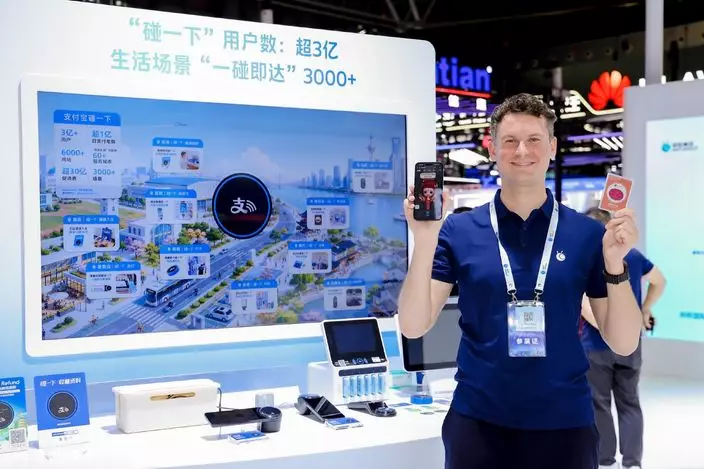
Josh Wei explains the cross-border payment ecosystem at Ant International's booth during the 2026 China International Fintech Exhibition. (Source: China City News)
A Greek Tourist: AI Assistant Clears Payment Hurdles
For first-time short-term visitors to China, the ease of the bank card binding process directly shapes their first impression of China's mobile payment system.
Greek tourist Theo had already registered her bank card through a relevant entry service application before departure. She described the entire process as "very smooth, straightforward, and convenient"—the app's AI-powered assistant provided multilingual human-computer interaction, significantly lowering the barrier to card binding.
"To pay for today's shopping, I simply open the app and scan the QR code. I don't need to carry a physical bank card or cash at all. I Paying really is convenient," Theo said. By the end of 2025, China UnionPay further launched the Nihao China one-stop entry service app, equipped with an AI assistant offering multilingual interaction. The service now covers users from over 160 countries and regions.

Greek tourist Theo receives AI assistance to register and bind her card—a smooth, straightforward, and convenient process. (Source: CCTV News screenshot)
A French Designer: The "Walking" Story from Five Years Ago
For French designer Xiao Ma, who arrived in China five years ago, the popularisation of mobile payments was not always this seamless.
He recalls that when he and his partner Da Yu first started working in Beijing, their office was far from home, and they needed to rent shared bikes to get to the subway station. But there was a problem—they didn't know how to scan the QR codes on the bikes. So they ended up walking everywhere. "I walked a lot," Xiao Ma said with a smile.
Five years on, they have set up their own design studio in Beijing, shuttling through the hutongs daily and familiar with every street and shop. Now, grabbing a snack by scanning a QR code on the way home is just part of everyday life. From "couldn't scan" to "can't live without scanning"—this journey is a microcosm of how mobile payment has become woven into the lives of foreigners in China.

French designer Xiao Ma and his partner Da Yu at their studio in Beijing. (Source: CCTV News screenshot)
A Brazilian Tourist: One Scan, No Cash Needed
Brazilian tourist Adriano was deeply impressed by the convenience of payments in China. "I used to have to carry a lot of cash and then exchange it for RMB, which took a lot of time. Now none of those steps are needed… You just tap, and the payment goes through."

Brazilian tourist Adriano gives an interview in Shanghai about the convenience of mobile payments in China. (Source: CCTV News screenshot)
The data confirms this trend. During the summer of 2025, spending by global inbound tourists using Alipay increased by over 130% year-on-year.
From a Londoner's "one app for everything," to a Greek tourist's AI-assisted card binding, to a French designer's journey from "couldn't scan" to "scanning daily," to a Brazilian tourist's "no-cash" astonishment—these real-life stories show that mobile payment has become a key entry point for foreigners to experience the convenience of life in China.
At its heart, Chinamaxxing has never been about propaganda. It is about people embracing a way of life that genuinely makes things simpler. As Josh put it, Shanghai's payment ecosystem allowed him to "intuitively experience AI applications at the everyday consumer level." This kind of everyday convenience, enabled by technology, may well be the quietest yet most compelling expression of Chinese-style modernisation.
Chinamaxxing
** 博客文章文責自負,不代表本公司立場 **
In the "Chinamaxxing" narrative, young foreigners are often mesmerized by the sleek, futuristic aesthetics of Chinese megacities. But ask them when they realized "this isn't sci-fi, this is daily life," and they rarely point to towering skyscrapers or space rockets. More often, it’s the scenery blurring past a high-speed train window—and the almost luxurious, tranquil order inside the cabin.
A One-Hour "Time-Space Miracle"
The straight-line distance between Chengdu and Chongqing is about 300 kilometers. In the UK, that’s roughly the distance from London to Manchester—a train journey taking two and a half hours, with delays practically guaranteed. In the US, a similar intercity rail trip (such as on Amtrak) easily drags beyond three hours, with punctuality rates well behind China's; outside the Northeast Corridor, you might not even find a usable rail option.
In China, however, the same journey takes as little as 60 minutes on flagship non-stop Bullet trains. Even multi-stop services wrap up within 90 minutes. Running at 350 km/h, the Chengdu-Chongqing high-speed line operates with the sheer frequency of a subway.
Foreign vloggers love attempting the ultimate "day trip challenge": slurping a bowl of sweet-water noodles in Chengdu for breakfast, marveling at the two rivers merging at Chongqing's Chaotianmen by noon, and returning to Chengdu for tea in the afternoon. For young Westerners used to notoriously sluggish train networks back home, this level of "time-space compression" is a complete shock to the system.
During his viral trip to China, American streamer IShowSpeed showed off his phone’s signal bars while speeding through a mountain tunnel, shouting in disbelief: "Full-bar 5G inside a tunnel?!" The clip instantly blanketed global social media.

IShowSpeed live-streaming on the Beijing-Shanghai High-Speed Railway, highlighting full 5G bars even while speeding through a tunnel.
A "Mobile Haven" in the Sky
High-speed rail has become Chinamaxxing’s ultimate "mobile haven"—not just for its dizzying speed, but for the unique flavor of "slowness" it offers.
Western Gen Zers are all too familiar with the roar of long-haul buses, cramped airplane seats, or the white-knuckle exhaustion of long road trips. On China's high-speed rail, they stumble upon a rare paradox: complete stillness at 350 km/h. Phone calls on speaker are discouraged, seats are palatial, tray tables easily accommodate laptops, and the view outside transitions seamlessly from vast plains to dramatic mountainscapes.
When British vlogger Jason ("Living in China") posted a video of his journey, he ended with a genuinely exasperated remark: "Seriously, the world needs to catch up!" In the comments, foreign viewers chimed in: "China lives in the future," while another joked, "The fastest train in America is the little scenic train at the zoo."

In his video, British vlogger Jason notes that China accounts for roughly two-thirds of the world's total high-speed rail mileage.
This level of seamless convenience transforms the train from mere transportation into a dynamic, versatile space to work, recharge, dine, and take in the view. For young Western travelers, it feels downright utopian.
Redefining Travel: The Decentralized Network
Another tier of Chinamaxxing is how the high-speed rail network completely rewrites travel itineraries. In the past, foreign tourists stuck to a rigid route—Beijing, Xi'an, Shanghai, and Hong Kong—like a pre-programmed "golden circle." But the widespread reach of high-speed rail has emboldened them to venture far into second-, third-, and fourth-tier cities.
This "decentralized" mode of exploration lies at the heart of Chinamaxxing. With hundreds of cities connected by rail, foreign youth are no longer just "visiting tourist spots"—they are "living at China's pace." They learn yellow wine brewing in Shaoxing, watch rocket launches in Wenchang, and ride light rails straight through apartment buildings in Chongqing. Every single one of these bucket-list moments begins with a high-speed train ticket.
Take the China-Laos Railway, a 1,035-kilometer cross-border artery opened in December 2021. By late May, it had served over 73 million passengers, including more than 840,000 international travelers from over 120 countries and regions. In the first five months alone, cross-border passenger traffic reached 164,000—a 35.3% year-on-year surge. It is now common to see Thai, Laotian, French, and Chinese passengers sharing a table. "Rice noodles in Kunming for breakfast, coffee in Vientiane by sunset"—this same-day cross-border lifestyle is now everyday reality along the line.
Hard Data Behind the Modern Miracle
This "mobile haven" experience rests on a staggering scale of infrastructure. By the end of 2025, China's operating high-speed rail network crossed the 50,000-kilometer milestone—accounting for roughly 70% of the world's total high-speed track. In the first half of the year, national railways carried 2.35 billion passengers, up 5% year-on-year. Behind these figures are tens of thousands of trains running like clockwork every day, giving foreign travelers an affordable gateway to explore every corner of the country.
A Quiet Declaration of Modernity
For decades, mainstream Western narratives equated "modernization" with "Westernization." Yet, as a young foreigner sits by the window of the Chengdu-Chongqing express—watching flatlands morph into mountain cities, enjoying a hotpot meal delivered directly to their seat, and seeing "350 km/h" displayed on their screen—that old narrative crumbles.
The high-speed rail itself is a silent declaration: Modernity can have a Chinese form, move at a Chinese speed, and operate on a Chinese rhythm.
Perhaps the true essence of Chinamaxxing is hidden within that 90-minute ride. When getting from one city to another ceases to be a hassle and becomes a highlight in itself, you're already experiencing the country through a whole new lens.


/wp-content/uploads/blogger/2026/08/WhatsApp-Image-2026-08-13-at-12.21.36.jpg.webp)