
When Western Gen Z point their phone cameras at China, what are they actually seeing? Why are more and more young foreigners starting to drink hot water, practice Baduanjin (eight-brocade qigong), soak their feet before bed, binge-watch Chinese dramas, and even put a spontaneous trip to China on their bucket lists?
From the "Threat Filter" to "Firsthand Experience"
For decades, mainstream Western narratives about China revolved around terms like "China Threat" and "strategic challenge." They acted like layers of filters, obscuring the everyday reality of life in China.
However, these filters are now being dismantled by the younger generation.
A Pew Research Center report released in July 2025 shows that among U.S. adults under 50, about 34% hold a favorable view of China, compared to just 19% among those aged 50 and older. The overall national favorability stood at 27%, nearly double the level in 2023. This is not statistical noise—it is a clear generational divide.
What explains this gap? The answer might lie inside young people's smartphones.
Media outlets like France's Le Monde have observed that Gen Z tends to get information from social media platforms like TikTok and Instagram rather than traditional news outlets. While the older generation still watches an "edited China" via newspapers and TV news, young people are already scrolling through short videos featuring Chongqing's "cyberpunk" nightscapes or Shanghai delivery riders weaving through skyscrapers on e-bikes, marveling: "The Chinese are living in 2050."
Sherry Zhu’s 20 Seconds and a "Balance-Checking" Trend on Xiaohongshu
The breakout popularity of the term Chinamaxxing is inseparable from a real-world account.
In December 2025, Chinese-American TikTok creator Sherry Zhu posted a roughly 20-second short video, deadpan announcing: "Tomorrow you are turning Chinese," before listing out the rules: swap for plush slippers upon entering the house, drink hot porridge for breakfast, cut out icy drinks, and keep warm. The video racked up millions of views, with the comment section flooded with "I'm becoming Chinese." Outlets like Lianhe Zaobao and China.org.cn subsequently covered the story, fueling the spread of hashtags like #Chinamaxxing and #BecomingChinese.
A few weeks later, in January 2026, as TikTok faced a "sell-or-ban" deadline in the U.S., a massive wave of American users calling themselves "TikTok refugees" flooded Xiaohongshu. Reports from CCTV and China News Service noted that starting January 13, Xiaohongshu climbed to the top of the U.S. App Store free charts, with over 700,000 new users pouring in within two days; by January 17, the hashtag #tiktokrefugee had garnered 1.18 billion views and 20.17 million discussions.
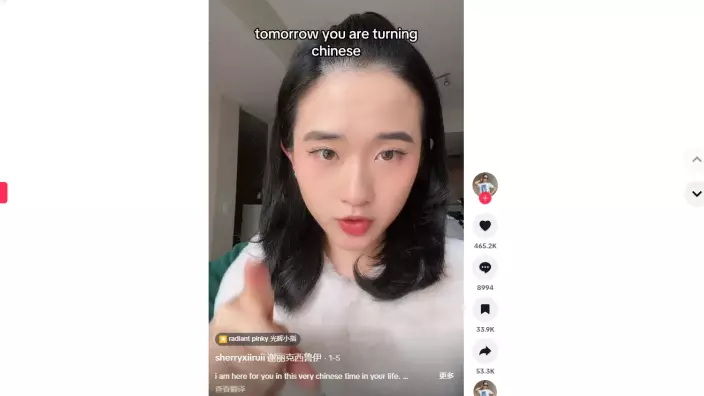
A screenshot of Sherry Zhu's TikTok video about Chinese daily life.
The most fascinating phenomenon that week wasn't cat tax memes, but "checking balances": American netizens posted medical bills, student loans, egg prices, and doctor registration fees, while Chinese netizens responded with posts about public health insurance and morning market prices. For the first time, young people from China and the U.S. bypassed traditional media to directly compare notes using receipts and selfies. This unmediated dialogue eroded stereotypes more effectively than any propaganda film could.
Chongqing Nightscapes and "Feeling Safe at 2 AM"
In April 2025, American mega-streamer IShowSpeed livestreamed his trip through Chongqing: light rail trains passing through residential buildings, the Hongyadong nightscape, traditional hot pot, and 10-yuan haircuts. Standing on an observation deck, he shouted, "Oh my God, this is China, crazy!" Clips from his stream were repeatedly shared across TikTok under the tag "Cyberpunk Chongqing."
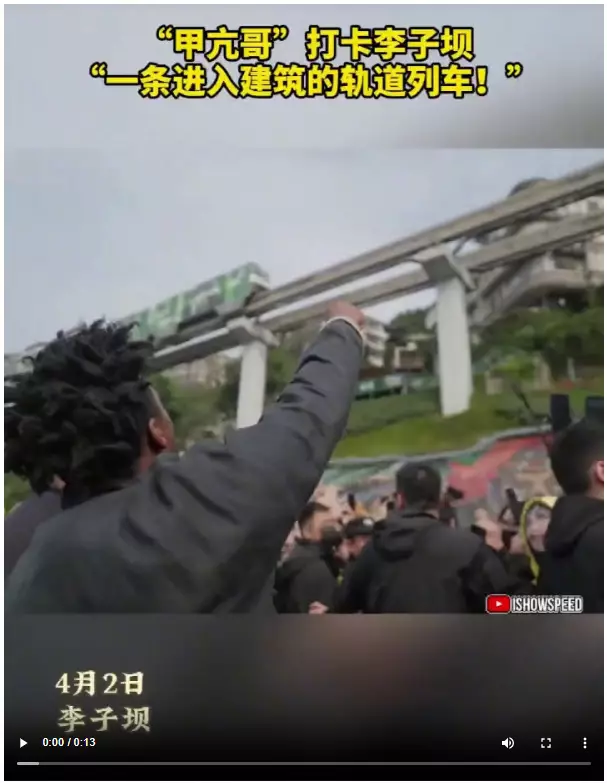
A screenshot of IShowSpeed's video about Chongqing.
This trend carried over to other foreign creators. In the second half of 2025, several Western creators filming late-night walks in Yuzhong District ran the same experiment: placing a backpack in an e-bike basket, walking away for half an hour, and returning to find it completely untouched. In a night video shot at Jiefangbei, an American creator noted: "In the U.S., I was taught from a young age not to go out at night. Here, at 2 AM, the streets are full of people eating barbecue, police lights are flashing, and I actually feel completely safe." Similar content appeared in Sohu's "Meet Yuzhong" series and was re-shared across various short-video platforms.
That same year, the Wenchang Space Launch Site, BYD factories, and facial recognition payments at night markets increasingly popped up in Western Gen Z's "atypical China trip" vlogs. In July 2026, China's National Immigration Administration reported that inbound foreign visitors reached 22.914 million in the first half of the year—a 20.4% year-on-year increase—with visa-free entries accounting for 77.7%. Moving beyond just climbing the Great Wall or seeing pandas, they ventured into nearly 500 cities, capturing "China = The Future" through a first-person lens.
This "off the beaten path" style of travel is becoming a trend. Data released by China’s National Immigration Administration in July 2026 showed that inbound foreign visitors reached 22.914 million in the first half of the year, a year-on-year increase of 20.4%. Among them, 17.815 million entered visa-free, accounting for 77.7%. No longer satisfied with just climbing the Great Wall or seeing pandas, visitors are venturing deep into nearly 500 cities to experience AI robot performances, chase rocket launches in Wenchang, and visit new energy vehicle factories. Tech trends like Chinese foldable smartphones and AI glasses have also become coveted purchases.
Why "Maxxing" Instead of "Panda"?
The term "Chinamaxxing" itself highlights the shift. In internet slang, "-maxxing" derives from "maximize," meaning pushing a specific trait to its extreme. It is not a superficial affection like simply "liking pandas," but a conscious choice to integrate Chinese elements into daily life.
Development scholars like Jostein Hauge at the University of Cambridge point out that the rise of China's overall strength has shattered the long-held Western equation that "modernization = Westernization." Disillusioned by political polarization, social fragmentation, and the cost-of-living crisis at home, some Western youth are borrowing a sense of "manageable order and wellness philosophy" from Chinese daily life—a gentle form of generational departure.
Travel articles in The Guardian have also advised readers to visit China in person. The punctuality of high-speed rail, the sense of street safety at night, and mobile payments for every scenario—these forms of "soft power" need no translation; the body remembers them.
Chinamaxxing is not a carefully orchestrated propaganda campaign. It is an authentic cultural resonance, voted by global youth with their feet, documented on their phones, and toasted with their thermoses.
When a country's modernization practices prove successful enough and its daily life becomes sufficiently compelling, cultural influence spreads naturally in a decentralized and de-ideologized manner. That, perhaps, is the most thought-provoking lesson of "Chinamaxxing."
Chinamaxxing
** 博客文章文責自負,不代表本公司立場 **