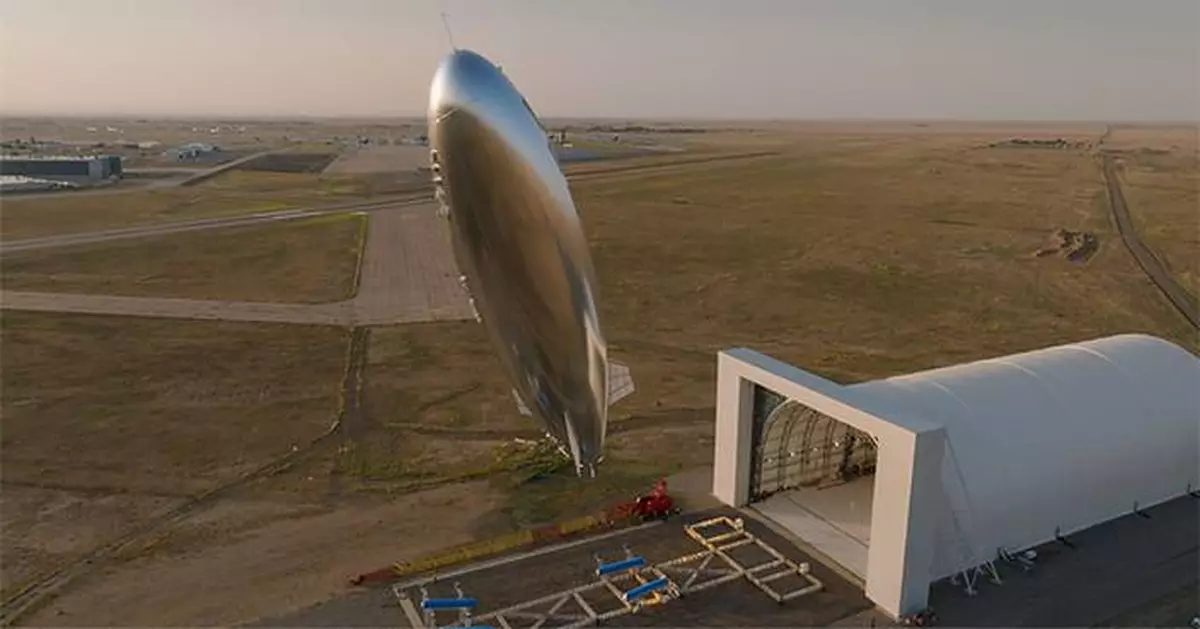
First mission of Sceye's Service Test Program travels more than 15,000 km from New Mexico to Japan in the stratosphere, backhauls into SoftBank Corp.'s core network, verifies Direct-to-Device and edge computing capabilities and HAPS-based communications with drones.
TOKYO, Sept. 2, 2026 /PRNewswire/ -- Sceye, a U.S. aerospace and material science company specializing in High-Altitude Platform Systems (HAPS) for telecommunications and real-time environmental monitoring, today announced the successful trans-Pacific flight of its Service Test 1 (ST1) mission from New Mexico to Japan. Traveling more than 15,000 km through the stratosphere in 13 days, upon arrival over Japan, ST1 demonstrated mobile broadband connectivity to unmodified devices through SoftBank Corp.'s core network and HAPS-based edge computing and communication with drones to support the development of a 3D communications network.
Conducted in partnership with SoftBank Corp. (TOKYO:9434, "SoftBank"), a leading operator of telecommunications and IT businesses in Japan and globally, ST1 marks Sceye's first flight to Asia and a groundbreaking milestone towards the commercial deployment of HAPS as stratospheric infrastructure.
"This flight marks a defining moment for Sceye and for the commercial potential of HAPS," said Mikkel Vestergaard Frandsen, Founder and CEO of Sceye. "Flying from the US to Japan demonstrates the performance required to make the stratosphere a viable layer of infrastructure and realize the future of AI, edge computing, and 6G. Together with SoftBank, we are moving beyond proving the technology to demonstrating how Sceye can complement and extend existing networks and deliver persistent connectivity at scale."
The stratosphere offers the optimal vantage point: It is close enough to Earth for high-capacity connectivity and observation, yet the altitude is high enough for wide-area reach. Importantly, the stratosphere offers space-like conditions without the cost of being in space and the disadvantages of being in orbit. Sceye's HAPS maintain altitude and their area of operation in the stratosphere through consecutive day and night cycles, operating like geostationary satellites, only 1,800 times closer to Earth and at a fraction of the cost.
In 2025, SoftBank Corp. invested in Sceye's HAPS-based stratospheric infrastructure as a scalable solution to complement terrestrial towers and satellite constellations. The strategic partnership advances a shared vision for HAPS and Non-Terrestrial Networks (NTN) as transformative infrastructure that can expand connectivity, support communications during disasters, and enable future applications across AI, IoT, aerial communications, edge computing, and 6G.
ST1 carried SceyeCELL, a first-of-its-kind "cell tower in the sky" designed to deliver wide-area mobile broadband directly to standard devices from the stratosphere. When deployed at full scale, one Sceye HAPS is designed to cover the equivalent area of approximately 500 terrestrial towers. During the ST1 mission, Sceye and SoftBank demonstrated mobile broadband from the stratosphere, including text messaging, voice calls, internet access, and video streaming. Testing also included emergency calls, using an emergency alert messaging system designed for large-scale disasters, and communications with drones.
Sceye's ST1 mission launched on August 9, 2026 at 7:00 AM MDT from New Mexico. Additional notable mission attributes include:
- Traveled more than 15,000 km across the Pacific to Japan in 13 days
- Operated within Japanese managed air space for over 7 days
- Remained continuously within its area of operation for an extended period, achieving a station-seeking radius as low as 5 km
- Operated at approximately 16.5 km in altitude while completing telecommunications, drone, and emergency communications
- Confirmed communications performance equivalent to that of terrestrial networks while reducing radio interference with ground-based base stations
- Through a server installed on the HAPS, Sceye and SoftBank conducted data processing directly on the platform, demonstrating average round-trip processing response time of 68 milliseconds, reducing communications latency by over 40% compared with internet-based cloud processing. This marks the world's first successful test in which a mobile core network and a web server for processing were installed on a HAPS, enabling response processing to be performed entirely onboard the HAPS and the results to be relayed back to smartphones.
ST1 remains in flight, returning towards the United States over the Pacific Ocean at the time of this announcement.
"SoftBank aims to build next-generation communications infrastructure that seamlessly connects the ground, the sky, and space. The fact that Sceye's HAPS reached Japan from the United States and successfully provided Japan's first trial services from the stratosphere in Japan's airspace marks an important step toward the commercialization of HAPS, which is at the core of this vision," said Junichi Miyakawa, President & CEO of SoftBank Corp. "By combining the HAPS flight and operational technologies that Sceye has developed with SoftBank's communications technologies, we have gained confidence to realize a three-dimensional communications network utilizing HAPS. Going forward, in collaboration with Sceye, we will continue to integrate a wide range of technologies, including communications and AI, to develop HAPS into a new form of social infrastructure."
This flight builds on Sceye's Endurance Program, completed earlier this year, when its SE2 HAPS traveled more than 10,000 km in the stratosphere from New Mexico to the coast of Brazil where it stayed over its area of operation for several days to test long-duration performance in preparation for the Service Test Program, the first of which flew to Japan.
About Sceye
Founded in 2014, Sceye (pronounced "sky") is an aerospace company dedicated to advancing stratospheric technology to connect people and protect the planet. Sceye leads the High-Altitude Platform Systems (HAPS) industry, focusing on universal connectivity, climate monitoring, natural resource management, and disaster prevention.
Contact: press@sceye.com
** This press release is distributed by PR Newswire through automated distribution system, for which the client assumes full responsibility. **
Sceye and SoftBank Corp. Complete Stratospheric Connectivity Demonstration in Japan, Advancing Towards HAPS Commercialization