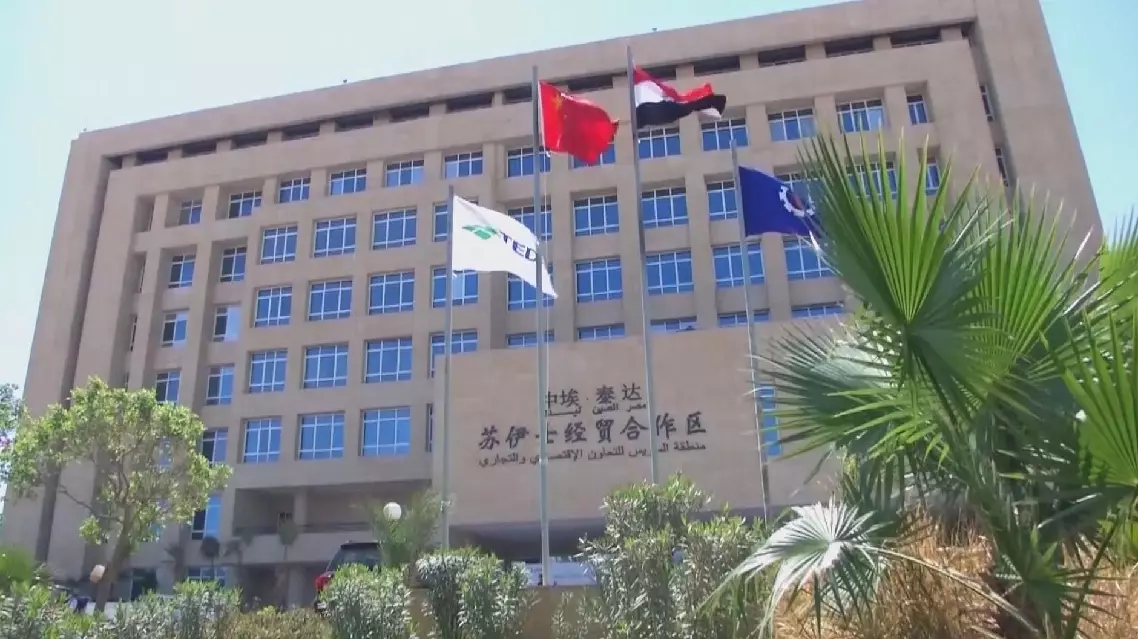
The China-Egypt TEDA Suez Economic and Trade Cooperation Zone, a flagship joint project under the Belt and Road Initiative, has emerged as a core platform for industrial cooperation between the two sides, with the zone playing a key role in helping Egypt advance its industrial upgrading and expand its global trade capacity.
Ties between the two countries are in the spotlight as Chinese President Xi Jinping arrived in Cairo to begin a state visit on Tuesday, with this marking his first trip to Egypt in a decade and coinciding with the 70th anniversary of the establishment of bilateral diplomatic ties.
One of the success stories in their long history of cooperation is Suez Economic and Trade Cooperation Zone. Located in Egypt's Suez Governorate, the zone was established by the Tianjin Economic-Technological Development Area (TEDA) back in 2008, and since then it has attracted more than 200 companies, created more than 10,000 direct jobs and supported tens of thousands of additional job opportunities.
Over the years, it has become a core demonstration project connecting the China-proposed Belt and Road Initiative with Egypt's Suez Canal Corridor Economic Zone strategy, as well as the wider Egypt Vision 2030, serving as a substantive platform for bilateral industrial cooperation and economic dialogue between the two nations.
Zhang Yixiang, the investment promotion director of the China-Africa TEDA Investment Company, described the industrial landscape that has taken shape within the zone over the last two decades.
"A total of 205 enterprises have settled in the zone, forming a development pattern of clustered industrial groups and complete industrial chains. The zone was initially planned with eight pillar industries. The start-up area focuses on four sectors: new building materials, high and low voltage electrical appliances, machinery manufacturing, and petroleum equipment, while the expansion zone covers textiles, chemicals, new energy, and home appliances," he said.
By the end of last year, the zone had garnered more than 3.8 billion U.S. dollars in actual investment while drawing a host of world-class enterprises that have helped fill technological gaps in relevant Egyptian industries. Products manufactured in the zone are sold to markets worldwide, significantly boosting Egypt's foreign exchange earnings from exports.
Ahmed Radwan, executive director of the Egypt-TEDA Group, noted that the zone not only enhances the advantages of the waterway economic corridor of the Suez but is driving industrial development, consistent with the goals of the Egypt Vision 2030 strategy, which includes promoting local industrialization.
"China is providing the highest standard of the industrial platform, but the value for the platform is open. Open for the Chinese companies to gain the gateway to Africa and to the Middle East and Europe as a market. At the same time, for the Egyptian companies to gain and for Egypt to gain the jobs, the revenue, the industrial upgrade and also to make [modern] industrialization," he said.
"Also, for other countries and the companies from other countries, they can gain the supply chain which is already near from the [Suez] canal and also [get access] to the markets. The real partnership is the understanding of the development goals for each other and share the benefits and they keep commitments in their difficult times. We can find this in China and Egypt cooperation," Radwan added.
The economic zone is one of a number of fruitful outcomes of China-Egypt cooperation, with the construction of Egypt's New Administrative Capital outside Cairo, the development of a Light Rail Transit (LRT) system in Ramadan city, joint projects in clean energy and even aerospace, as well as continued cultural cooperation such as in the archeology field between the two ancient civilizations being other examples of their strong partnership.
Flagship cooperation zone in Suez fuels China-Egypt bilateral industrial development