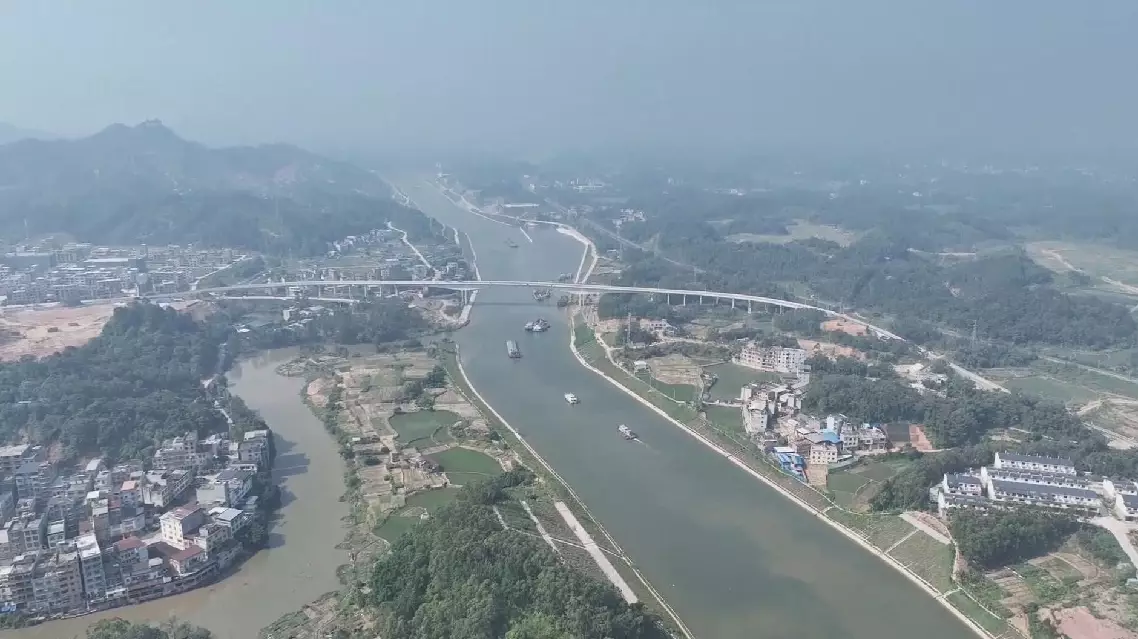
Pinglu Canal, a strategic route linking China's inland regions with member states of the Association of Southeast Asian Nations (ASEAN), is set to strengthen bilateral trade ties as industrial parks and ports along the waterway accelerate local development to help provide more efficient services ahead of its operation in this month.
The 134.2-km Pinglu Canal is a major project along China's New International Land-Sea Trade Corridor. The project began construction on Aug 28, 2022 and is expected to become operational in September.
The waterway is expected to slash the transport distance between the country's southwestern regions and ASEAN member states by 560 kilometers, a Chinese official said Tuesday.
The project directors at the Nanning Liujing Industrial Park, an important transportation hub for the China-ASEAN Free Trade Area, said they are accelerating construction to help improve facility network along the waterway, which is set to bring down operational costs for local and foreign businesses.
Thomas Wilsius, a Nanning project director for SNF, a France-based multinational company specialize in water chemistry, said they highly appreciate the efficiency provided by the Chinese market.
"So, we appreciate here, actually, for a foreign company here, investing here, is because we appreciate the speed that the Chinese market, the Chinese ecosystem can deliver to us," said Wilsius.
Port managers said as the canal is set to drastically cut transit time between China and ASEAN member states, related transportation companies are set to see lower logistics costs.
"A 5,000‑tonne container vessel can finish loading and unloading within a single day. Cargo from Vietnam sails straight to the Nanning Port. This new route is 560 kilometers shorter than the old Guangzhou‑based route. It cuts transit time by six to seven days and reduces logistics costs by 30 to 40 percent," said Wang Fakun, general manager at the Nanning Port Development and Investment Company Limited.
Pinglu Canal will be put into operation at a moment when China is mulling multi-trillion-yuan investment through a "Six Networks" initiative.
The "Six Networks" include water networks, new-type power grids, computing power networks, next-generation communication networks, urban underground pipeline networks and logistics networks.
Guangxi's new river-to-sea canal set to strengthen China-ASEAN trade ties