The Chinese medical support team participating in the China-Laos "Peace Train-2026" joint humanitarian medical rescue exercise arrived in the Lao capital Vientiane on Sunday morning.
The team will conduct a 17-day joint exercise and medical service program with the medical support team of the Lao People's Army.
"This is the sixth time the two armies have held this series of joint exercises. This joint exercise will further enhance the joint capabilities of the two militaries in health service, joint command, joint rescue, and joint prevention and control, demonstrating the deep-level military friendship and mutual trust between China and Laos, and continuously building a flagship model of bilateral military cooperation and exchanges," said Lang Dashan, a member of the Chinese command and coordination team for the joint exercise.
The Chinese military health service contingent consists of 150 personnel who are primarily drawn from the Army Medical University, with additional forces drawn from the PLA Air Force and the PLA Joint Logistic Support Force.
Bouasing Inthavong, deputy director of the General Logistics Department of the Lao People's Army, joined representatives from both sides in attending a warm welcome ceremony.
"As everyone knows, natural disasters are now occurring frequently and with severe consequences, directly affecting the lives and property safety of the people of Laos and indeed the countries all over the world. Therefore, this exercise is of extraordinary significance. We will learn from each other and exchange experiences in natural disaster rescue," said Bouasing Inthavpng.
Bouasing expressed gratitude for the assistance China has provided to Laos in the health sector in recent years. He said that, with the continued and in-depth development of the "Peace Train" series of activities, medical support exchanges and cooperation between the two militaries have established a sound mechanism and system, marking a new stage in mutual trust and cooperation in the medical field between the two sides.
Song Caiping, captain of the "Peace Train" medical team, said at the ceremony that the Chinese participants had completed 11 rounds of intensive medical skills training before departure and had conducted realistic combat drills en route.
"During the mobilization of the medical train, we simultaneously conducted realistic combat-oriented drills including intelligent command and joint medical treatment. The Chinese medical team, with their exceptional skills, superb medical expertise, and fine work ethic, will continue to uphold the golden reputation of the Victory Train, the Health Train and the Peace Train," said Song.
According to a member of the Chinese command and coordination group for the joint exercise, this year's exercise is being held against the backdrop of the 65th anniversary of the establishment of diplomatic relations between China and Laos, the "China-Laos Friendship Year," and the fifth anniversary of the opening of the China-Laos Railway. It is the sixth time the two militaries have held this series of joint exercises.
The exercise will further enhance the two militaries' capabilities in joint command, joint rescue, and joint prevention and control in medical support, demonstrating their deep military friendship and mutual trust while continuing to build a model for bilateral military cooperation and exchanges.
Following the exercise, the medical team will travel to Vientiane, Savannakhet, Champasak, and Attapeu provinces to provide medical services, including specialized diagnosis and treatment and academic lectures.
These activities are expected to further deepen strategic mutual trust, expand practical cooperation, and promote medical exchanges between the two militaries toward more comprehensive, in-depth, and regularized development. They will also contribute to advancing the building of a China-Laos community with a shared future toward higher standards, higher quality, and higher levels.
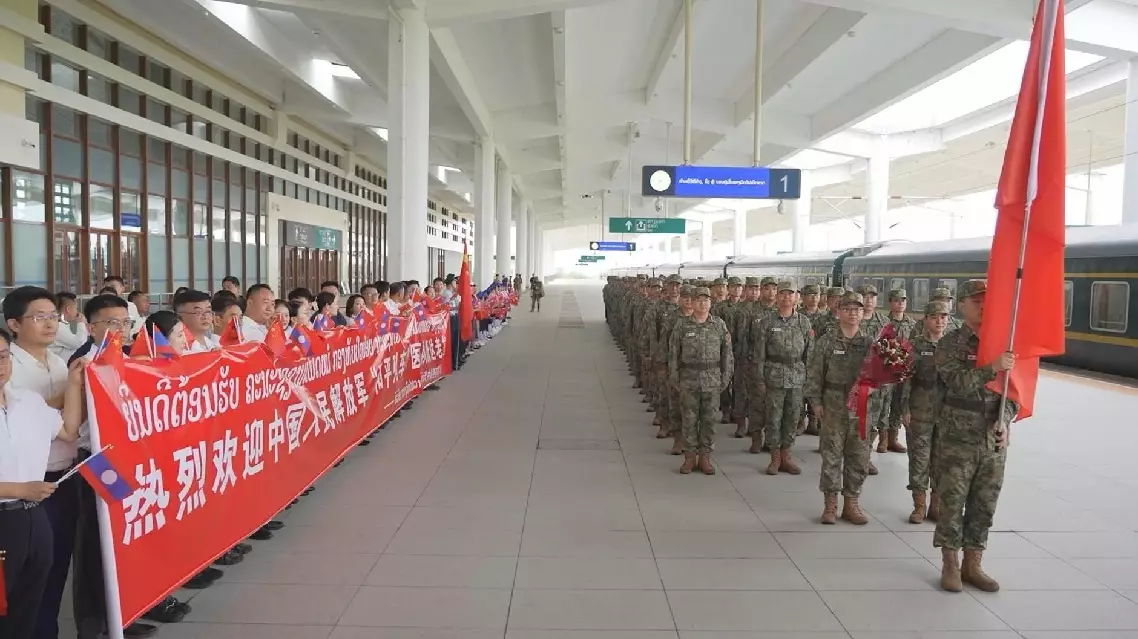
Chinese PLA "Peace Train" medical team arrives in Laos