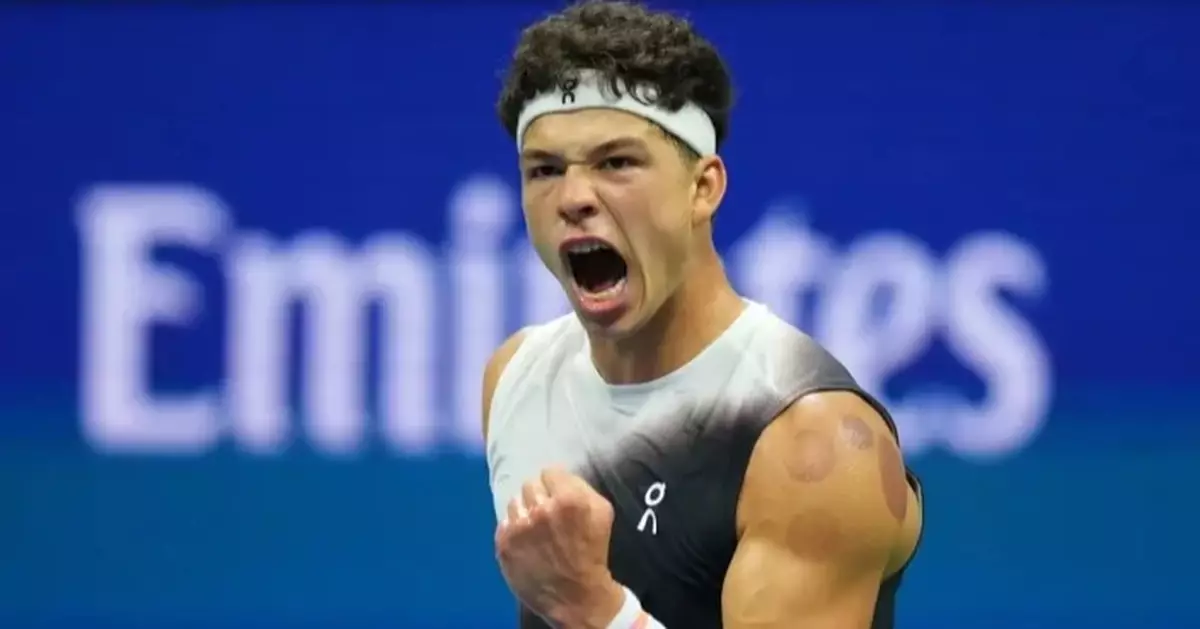
American tennis star Ben Shelton took to the court at the 2026 US Open wearing a sleeveless kit, with deep red circular marks clearly visible on his arm. British tabloid The Sun ran a story featuring the headline "The Red Marks on His Arm Are Amazing," igniting a flurry of curiosity among overseas fans. What were these mysterious rings? Some guessed bruises, others suspected a sudden rash, but viewers familiar with Chinese culture recognized them instantly: they were the unmistakable marks of cupping therapy.
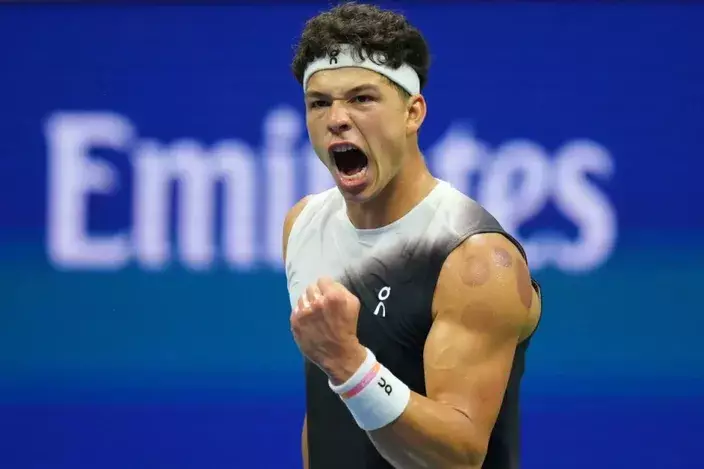
Deep red circular cupping marks are clearly visible on Ben Shelton's arm. (Source: Tencent News)
From Wimbledon to Flushing Meadows: Shelton's "Eastern Marks"
Click to Gallery
Deep red circular cupping marks are clearly visible on Ben Shelton's arm. (Source: Tencent News)
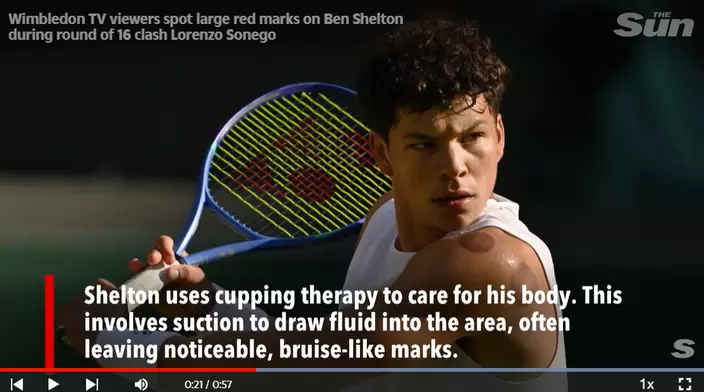
Cupping marks are clearly visible on Shelton's arm during a match. (Source: The Sun)
Michael Phelps sporting cupping marks at the 2016 Rio Olympics. (Source: ABC News)
Croatia celebrates a goal, revealing dark red cupping marks near Perišić's collar. (Source: Visual China Group)
Ranked ninth in the world, Shelton is no stranger to competing in Grand Slam tournaments bearing these cupping marks. As early as the 2023 US Open and the 2025 Australian Open, these circular impressions were already prominent on his left shoulder. During his quarter-final run at Wimbledon in 2025, broadcast commentators even paused to clarify for viewers: "Those marks aren't tattoos—they're from cupping, a technique often used by swimmers to draw blood flow to the skin's surface."
As The Sun highlighted, cupping is an ancient traditional Chinese therapy. By using heat or suction pumps to create a vacuum inside localized cups placed on the skin, negative pressure dilates and ruptures tiny subcutaneous capillaries, leaving distinct purplish-red circles. Shelton is just one of many elite athletes who swear by the practice. Having captured both ATP Masters 1000 and ATP 500 titles, cupping has become a staple in his routine for physical maintenance and recovery.
Cupping marks are clearly visible on Shelton's arm during a match. (Source: The Sun)
From Michael Phelps to Cristiano Ronaldo: A Global Roster of Cupping Converts
Shelton is hardly an outlier in adopting this ancient remedy. The surge of cupping in Western sports can be traced back to the 2016 Rio Olympics. When American swimming legend Michael Phelps stepped onto the blocks for the 4×100m freestyle relay, his back and shoulders were peppered with dark red circles, captivating global media. Phelps later shared in interviews: "I've been getting cupped for the past two or three years. I love it—it increases my flexibility, relieves muscle soreness, and has been hugely effective for my races." His coach had reportedly incorporated cupping into his regimen as early as the autumn of 2014.
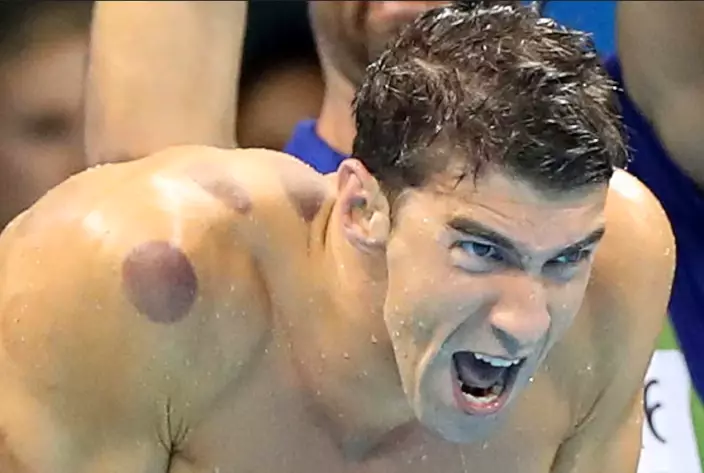
Michael Phelps sporting cupping marks at the 2016 Rio Olympics. (Source: ABC News)
American gymnast Alex Naddour similarly took to social media to praise cupping as his "secret to staying healthy," noting that he bought his own DIY cupping kit online for around $15.
The trend soon swept through international football. At the 2022 World Cup in Qatar, Croatian star Luka Modrić was photographed with circular marks across his back while changing on the training ground. At the 2026 World Cup, teammate Ivan Perišić was spotted with dark red rings peeking out from above his collar line, proving that cupping has evolved into a traditional recovery mainstay for the Croatian national squad.

Croatia celebrates a goal, revealing dark red cupping marks near Perišić's collar. (Source: Visual China Group)
NBA superstars are equally avid fans of the therapy: LeBron James, Stephen Curry, Dwyane Wade, Russell Westbrook, and Giannis Antetokounmpo have all been seen with cupping marks. Even Cristiano Ronaldo, famous for his hyper-strict physical preparation and recovery routine, has been snapped with the telltale circular impressions.
How the "Mysterious Eastern Force" Conquered Western Sports
Why has cupping gained such rapid traction across Western athletics? Analysts suggest that the 2016 Rio Games served as a global showcase, introducing traditional Chinese medicine (TCM) techniques to a massive roster of international athletes. By utilizing negative pressure to enhance localized blood circulation, stimulate energy pathways, and alleviate deep-tissue muscle soreness, cupping offers professional athletes a non-pharmacological, non-invasive recovery solution ideal for enduring relentless training and competition cycles.
Academic research provides further scientific backing for the technique. A study on collegiate baseball players demonstrated that cupping helped improve post-exercise autonomic nervous system recovery and daytime physical functionality. Another systematic review noted that cupping offers potential benefits in pain management and range of motion for elite athletes.
From Shelton striding onto Wimbledon's grass courts with red rings on his arm, to Phelps sparking global intrigue at the Rio Olympics, to Croatian football stars displaying their cupping marks as a team tradition—what started as an ancient Chinese healing art has transformed into a universal "recovery language" among the world's elite athletes.
For these competitors, the appeal of cupping lies not in the exotic label of "Traditional Chinese Medicine," but in a simple reality: it helps their bodies feel better and recover faster. When a treatment speaks through tangible performance, cultural boundaries naturally fade—offering perhaps the most authentic and persuasive example of Chinamaxxing on the global sporting stage.
Chinamaxxing
** 博客文章文責自負,不代表本公司立場 **
On June 10, 2025, at the Yongle Spring Auction in Beijing, a 131-centimeter mint-green first-generation Labubu was hammered down for RMB 1.08 million, ultimately realizing RMB 1.242 million ($171,000) including buyer's premium—cataloged by the auction house as "the sole piece in existence." At the same sale, a 160-centimeter brown Labubu fetched a hammer price of RMB 820,000. All 48 lots in the dedicated session sold out, generating a total hammer turnover of RMB 3.7254 million.
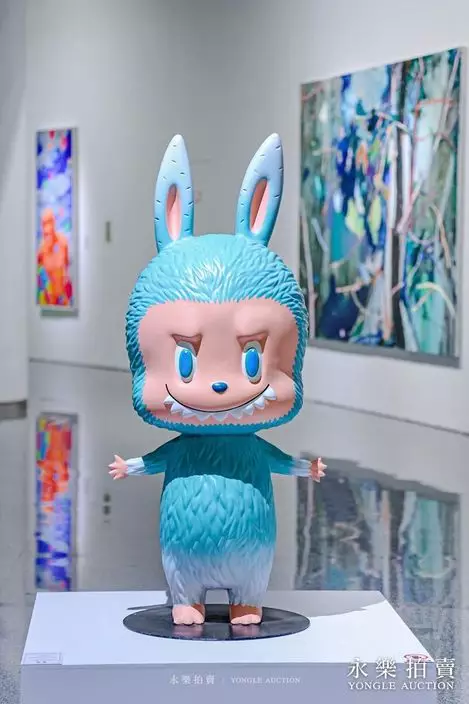
The world's sole mint-green LABUBU makes its debut at the Yongle 2025 Spring Auction in Beijing. (Source: Yongle Auctions official photo)
Yet the iconic character’s creative roots lie in Hong Kong: Labubu was created by Hong Kong artist Kasing Lung as a Nordic forest sprite. Earlier at Sotheby’s Hong Kong, a set of three sculptures titled The Three Wise Men LABUBU Series had already commanded HK$203,200 ($26,000). How did an "ugly-cute" monster drive adults worldwide into a queueing frenzy? The answer lies in the latest chapter of "Chinamaxxing": Chinese IP is capturing global markets not by being cheap, but by leveraging absolute scarcity.
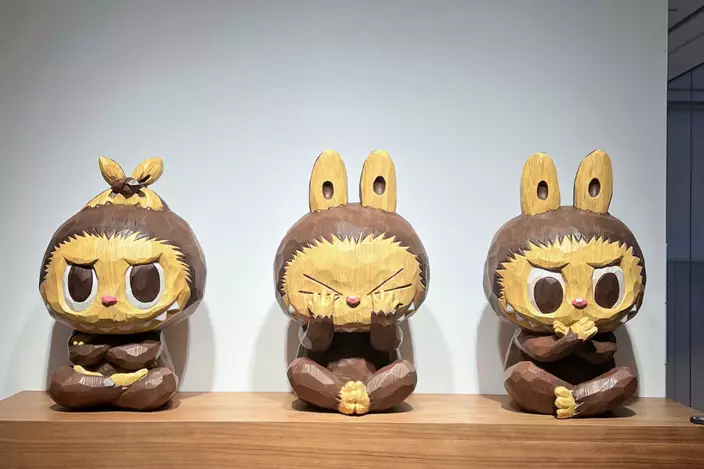
A trio of Labubu figures auctioned at Sotheby's Hong Kong for HK$203,200. (Source: ZTYLEZ photo)
Scarcity Economics: From $14 Blind Boxes to a $170,000 Auction Lot
Labubu’s commercial playbook hinges on calculated unpredictability. Its blind-box format turns every purchase into a game of chance: odds for securing the elusive "chase variants" (secret editions) are extremely low, sending secondary-market prices soaring tenfold or more. A UK store was forced to temporarily suspend retail operations following chaotic crowds, while a rare chase variant commanded up to 2,300 yuan ($320) on the secondary market—a 20-fold markup. Meanwhile, a single TikTok Shop livestream in the Americas generated over $1.5 million in gross merchandise value (GMV).
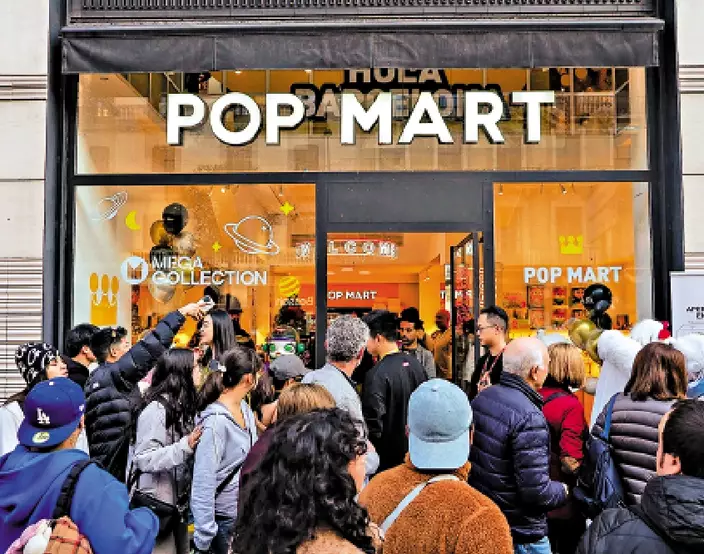
Labubu goes viral across Europe, drawing massive crowds outside a POP MART flagship store in Barcelona, Spain. (Source: Ta Kung Wen Hui Net photo)
The pivotal tipping point arrived in April 2024: Lisa, the Thai member of K-pop megagroup Blackpink, posted photos featuring Labubu on Instagram. Soon, icons like Madonna, David Beckham and his daughter, and actress Charmaine Sheh were seen displaying the plush toy. Designed as a "bag charm," the plush figure transitioned from a desktop display into a wearable flex and social currency. TikTok topics surrounding Labubu surpassed one billion views, prompting Thai tourism authorities to officially award Labubu the title of "Amazing Thailand Experience Officer."
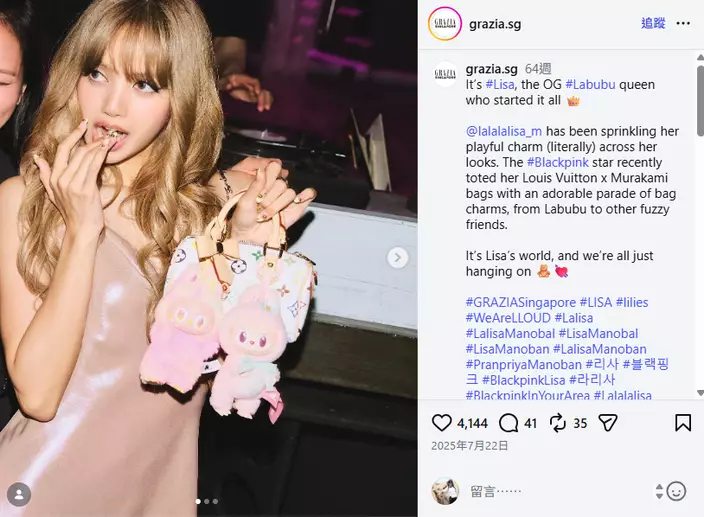
Blackpink's Lisa spotted posing with her beloved Labubu plush. (Source: Instagram screenshot)
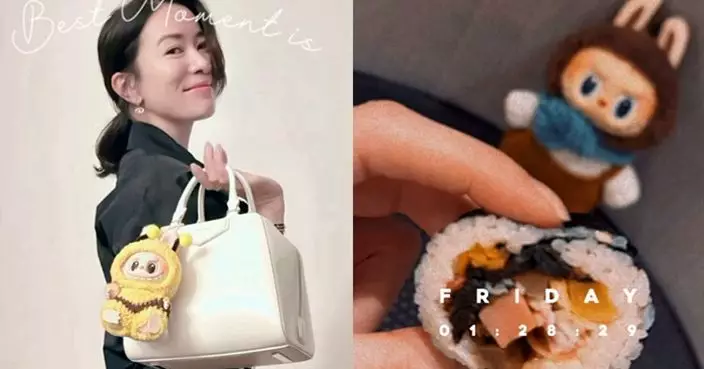
Actress Charmaine Sheh embraces the viral trend with her own Labubu charm. (Source: Instagram screenshot)
The financial returns have been unprecedented. For the full year 2025, POP MART reported annual revenue of RMB 37.12 billion—a massive 184.7% year-on-year surge—with adjusted net profit skyrocketing 284.5% to RMB 13.08 billion. Labubu as a standalone IP contributed RMB 14.16 billion, up 365.7% year-on-year. Overseas revenue reached RMB 16.27 billion (a 291.9% surge), accounting for 43.8% of total revenue, with sales in the Americas exploding by 748.4%. Founder Wang Ning revealed in a People's Daily interview that following September 2025, global sales of Labubu were approaching nearly 10 million units per month.
Beyond the Frenzy: Labubu's Canonization and China's Next-Gen Art Toys
Crossing the threshold of fine art auction houses marks the first step in Labubu’s institutional canonization—when a designer toy trades at Yongle or Sotheby’s under fine-art protocols, it evolves from a fast-moving consumer novelty into an investment-grade collectible.
Yet the flip side of canonization is the relentless churn of consumer trends. In the first half of 2026, POP MART recorded an 11.1% year-on-year dip in overseas revenue—its first contraction since expanding internationally. Labubu’s revenue shrank 7.5% year-on-year, its overall share moderating to 26%. Wang Ning characterized 2026 as a "year of operational adjustment," acknowledging that "overnight queues, chaotic store rushes, and chronic stockouts are not sustainable norms," while conceding that the company would likely miss its 20% growth target.
Yet successor IPs are already stepping into the spotlight. Twinkle Twinkle has emerged as the next viral phenomenon following Labubu, triggering fresh buying frenzies across domestic and global markets. Its "Delicious Moments" blind-box series sold out online instantly upon release, with hundreds of thousands of users adding items to their carts simultaneously. Launched only in 2024, this breakout IP generated RMB 8.79 billion in full-year revenue for 2025. Secondary-market premiums for its secret editions surged up to 16 times original retail price, setting a POP MART record for the fastest new IP to break RMB 100 million in gross sales.
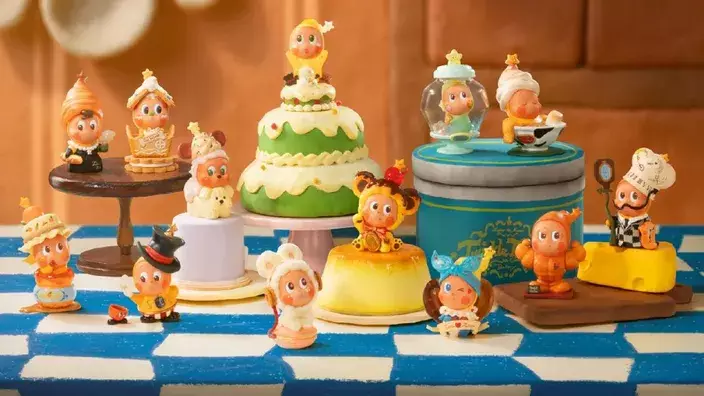
POP MART's breakout "Twinkle Twinkle: Delicious Moments" blind-box series.
In the first half of the year, POP MART saw six distinct IPs each cross the RMB 1 billion revenue milestone, as global registered loyalty members passed 100 million. The company has explicitly shifted focus toward "building timeless, classic IPs." The broader industry is expanding rapidly as well: rival designer toy brands such as 52TOYS, TOP TOY, Heyone, and Sunny are making strides toward public listings, transforming the sector from a single-dominant player into a multi-polar competitive landscape. Labubu hasn't lost its charm; it has simply shared the spotlight—a hallmark of a maturing art-toy market where no single character reigns supreme forever.
The Lightest Vessel for Soft Power
An abstract character with no underlying animation, no feature film, and no narrative origin story—conquering global pop culture purely through design intuition and emotional resonance. Where "Made in China" once exported functional affordability, "Created in China" now exports emotional connection. A small plush monster with nine pointy teeth and a mischievous grin has inspired sprawling queues from London to Los Angeles, while keeping foot traffic flowing constantly into POP MART boutiques in Hong Kong.
Conceived by a Hong Kong artist, listed on the Hong Kong Stock Exchange, and adored by fans across the globe, Labubu’s journey is a masterclass in leveraging scarcity and emotional attachment. It demonstrates that the lightest vessel for soft power often leaves the deepest, most enduring imprint on human hearts.


/wp-content/uploads/blogger/2026/08/WhatsApp-Image-2026-08-13-at-12.21.36.jpg.webp)