In recent years, foreign observers have gained a fresh perspective on modern China. As a CNN report noted in October 2024, pet cafés have become big business across the country: since China's first cat café opened in Guangzhou in 2011, the number of similar establishments has surged by 200% annually.

A cat café in Shenzhen. (Source: U Travel photo)
Research from global travel tech firm Amadeus reveals that vacationing with pets is rapidly becoming a mainstream global trend. Fred Barou, an Asia-Pacific senior executive at the firm, described the surge in pet tourism as "nothing short of amazing." When it comes to market vibrancy, China stands out as the most watched arena: the urban cat and dog population has reached 126 million—double the country's population of children under four (approx. 60 million). By 2025, China's urban pet market reached RMB 312.6 billion, with projections expecting it to top RMB 405 billion by 2028.
Click to Gallery
A cat café in Shenzhen. (Source: U Travel photo)
Pet owners shop alongside their "fur babies" inside a Beijing pet store. (Source: China Daily photo)
A gourmet pet birthday cake from Holiland Pet. (Source: Sanxiang Metropolis Daily photo)
Exhibition hall at the 6th TOPS Pet Expo. (Source: Xinhua photo)
An automated pet feeder featuring AI cat facial recognition.

Pet owners shop alongside their "fur babies" inside a Beijing pet store. (Source: China Daily photo)
"Fur Babies" Enjoying Luxury Better Than Humans
What fascinates foreign media most is the unprecedented quality of life enjoyed by Chinese pets. An analysis by the Cheung Kong Graduate School of Business highlighted that in tier-one hubs like Shanghai, Beijing, and Chengdu, pets can check into luxury pet hotels featuring air-conditioned suites and dedicated butler services. They can attend pet yoga classes, indulge in aromatherapies and hydro-spas, and even receive acupuncture rooted in Traditional Chinese Medicine (TCM).
Throwing lavish birthday parties for "fur babies" has evolved from a niche personal trend into a lucrative commercial sector. Mainland bakery titan Holiland launched its dedicated pet brand, "Holiland Pet," in February 2024, specializing in artisanal pet birthday cakes. Featuring 17 distinct designs priced between RMB 168 and 218 ($23–$30), each cake comes complete with accessories including candles, greeting cards, and birthday plaques, backed by an animal protein content exceeding 80%. One industry journal jokingly remarked that these pets "eat better than contemporary corporate workers." Alan, a specialized pet cake baker, shared that sculpting a custom cake requires three to five hours of meticulous handiwork—with intricate designs taking up to two full days. A tailored birthday cake has officially become a standard milestone for urban pet parenting.

A gourmet pet birthday cake from Holiland Pet. (Source: Sanxiang Metropolis Daily photo)
Smart Innovations Redefining Everyday Lifestyles
The other driving force behind China's pet economy is cutting-edge technology. At the 6th TOPS Pet Expo in June, AI cameras, automated water fountains, smart feeders, and robotic companion pets dominated the exhibition floor. A People's Daily report republished by Xinhua described how artificial intelligence is transforming pet ownership into a highly automated, hyper-refined experience.

Exhibition hall at the 6th TOPS Pet Expo. (Source: Xinhua photo)
Ms. Wang, a multi-cat owner in Beijing, utilizes a smart feeder equipped with facial recognition for cats. The device automatically dispenses tailored meal portions whenever a specific cat approaches, while a mobile app allows her to monitor feeding schedules and intake remotely during business trips. Tech giants like Xiaomi and Midea have aggressively entered the sector. During the 2024 "618" shopping festival, sales of smart odor eliminators, automated feeders, and self-cleaning litter boxes on Tmall surged two- to three-fold year-on-year. Anna, a Beijing white-collar professional, represents a typical consumer: nearly half of her "Double 11" shopping cart was dedicated to pet tech, including an automated feeder—"so I never have to worry about my cat going hungry when I'm traveling for work."

An automated pet feeder featuring AI cat facial recognition.
Cradle-to-Grave Service Ecosystems
Even more astonishing to international observers is the rapid professionalization of pet end-of-life care. In 2023, China's pet funeral service market reached RMB 1.825 billion, representing a 27.4% year-on-year surge. After paying RMB 1,000 for the cremation of her deceased dog "Zaizai," Ms. Liu in Beijing was guided by staff to observe the traditional "Seventh-Day" mourning ritual, ultimately spending RMB 3,500 on a memorial urn and ceremonial offerings.
Hongkongers' New "Weekend Getaway" Routine
Hong Kong residents are active participants in this trend. At the 13th Shenzhen Pet Expo in March 2025, Yu Ting, representative for pet brand "Miao Duo La," directly addressed Hong Kong's "poop-scoopers" (pet owners): "Head north for the weekend to visit the Shenzhen Pet Expo! You can score unbeatable deals and bring home premium gifts for your fur babies—it's incredibly cost-effective." Shenzhen now boasts over 88,000 pet-related commercial entities, generating an annual output value exceeding RMB 30 billion.
The Gentlest Face of "Chinamaxxing"
From cat cafés to smart feeders, and from air-conditioned luxury suites to dignified end-of-life care, what truly amazes foreign observers about China's pet economy is not merely its market scale, but a lifestyle philosophy that embraces pets as core family members. Nearly 86% of Chinese pet owners view their animals as family, with Gen Z and Millennials making up nearly 70% of the demographic.
This represents the gentlest, most human face of "Chinamaxxing": through the lens of pampered cats and dogs, the world catches a glimpse of a modern China that is not only prosperous and sophisticated, but deeply emotional and caring.
Chinamaxxing
** 博客文章文責自負,不代表本公司立場 **
In March 2018, a recruitment post on WeChat Moments permanently altered the trajectory of a retired police officer from Luxembourg. Xie Wanju, then First Secretary stationed in Zhadong Village, Yizhou District, Hechi, Guangxi, issued an urgent appeal for volunteers to help cultivate passion fruit—the land was cleared and seedlings were secured, but labor was desperately lacking. Hansen Nick René, a backpacker who had recently retired from the Luxembourg police force and was traveling through Guangxi, slung his camera over his shoulder and boarded a bumpy bus deep into the karst mountains.
At the time, Zhadong was an autonomous region-designated impoverished village encompassing 182 households and 619 residents, with a staggering poverty incidence rate of 51%. What greeted Nick’s eyes were earthen dwellings plastered with yellow mud and families living without running water or electricity. He decided to stay on as Xie’s "foreign assistant"—building fruit trellises, installing water pipes, wiring electricity, and planting passion fruit and watermelons.
What touched him most deeply was constructing a rugged mountain road for just three isolated households. When skeptics argued that building a paved road for only three families was cost-inefficient, local officials insisted it was mandatory—raising private sponsorships when government funds ran short, and physically carrying steel rebar and heavy stones up the mountain themselves. On the day the access road opened, the villagers grasped Nick’s hands with tears of gratitude. "In my heart," Nick reflected, "this is the most beautiful road in the world."
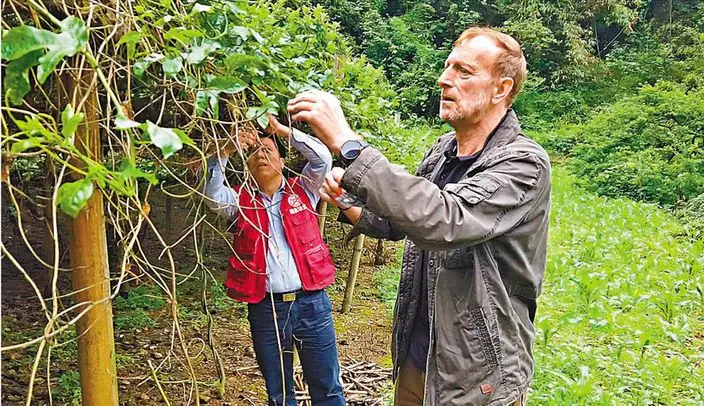
Nick (right) and Xie Wanju tend vines under a passion fruit trellis; Xie wears a red volunteer vest. (Source: Ta Kung Wen Hui Net photo)

Nick chats warmly with local villagers. (Source: Ta Kung Wen Hui Net photo)
In 2020, Zhadong Village officially lifted itself out of poverty, presenting Nick with an honorary silk banner that read: "Bound to Zhadong with Selfless Dedication." In 2025, Xie Wanju bestowed upon him a Chinese name, "Xie Wanke"—sharing his own surname "Xie" to signify that they had become family. More than eight years on, Nick authored an op-ed for People's Daily, posing a soul-searching question: "Why has rural China undergone such earth-shaking transformations?" His answer lay in the unyielding commitment to "never leave a single person behind" and the collective solidarity of millions working toward a shared goal.

Nick and Xie Wanju share a lighthearted laugh beneath the fruit vines. (Source: People's Daily Overseas Edition photo)
The Global Impact Behind 800 Million People
The true weight of one foreign volunteer's eight-year journey becomes clear when placed within a global context. China's 40 Years of Poverty Reduction, a joint landmark report by the World Bank and the Development Research Center of the State Council, highlights that measured against the international extreme poverty line of $1.90 per person per day, nearly 800 million people in China escaped poverty over four decades—accounting for close to 75% of global poverty reduction during the same period. Since the onset of Reform and Opening-up, China has contributed over 70% to global poverty alleviation efforts. During its eight-year Targeted Poverty Alleviation Campaign, China steadily lifted over 10 million people out of poverty annually, enabling nearly 100 million rural poor to escape poverty and achieving the UN 2030 Sustainable Development Agenda's poverty reduction target a full decade ahead of schedule. UN Secretary-General António Guterres noted: "Targeted poverty alleviation strategies are the only way to assist the poorest populations and achieve the ambitious goals of the 2030 Agenda."
Beyond Nick: Decades of International Eyewitnesses
Nick is hardly alone; many international witnesses share similar journeys. Dr. Károly Hrotkó, former head of the Fruit Science Department at Hungary’s Corvinus University, first arrived in China in 1994, when Shaanxi farmers earned an annual net income of just a few hundred yuan. Over nearly three decades, he introduced advanced cherry cultivation to the Loess Plateau, even setting a historical milestone by successfully growing European sweet cherries (Prunus avium) on the fringes of the Mu Us Desert. "When I first came to China, most farmers I met were living in deep poverty," he recalled. "Today, almost every fruit-growing household owns a personal vehicle."

A thriving cherry orchard on the edge of the Mu Us Desert stands in sharp contrast to the surrounding arid dunes. (Source: Phoenix Net photo)
Salah Adly, General Secretary of the Egyptian Communist Party, visited China four times. In Houtan Village, Zunyi, Guizhou, he witnessed a community that exited poverty status in 2016 achieve an average per capita net income exceeding 10,000 RMB: "Every single household has built a handsome, modern brick home." In October 2020, over 30 foreign diplomatic envoys visited Chixi Village in Fujian—dubbed "China's Number One Village in Poverty Alleviation." The Cuban Ambassador noted: "The genuine smiles on the villagers' faces left an indelible impression on me." Meanwhile, the Moldovan Ambassador, who had visited rural China 30 years prior, described the transformation as "earth-shaking," adding: "China’s poverty alleviation story deserves to be seen and emulated by the entire world."

The rejuvenated landscape of Chixi Village nestled among scenic mountain ranges. (Source: Xinhua photo)
From "Gazing at Poverty" to "Gazing at Smiles"
In decades past, the world understood poverty primarily through depictions of human suffering. Today, an increasing number of international observers are choosing to walk directly into rural China—some staying for eight years, others dedicated for three decades, and many boarding high-speed "bullet trains" to sip local white tea in once-impoverished mountain hamlets.
Nick's latest initiative aligns seamlessly with this trend: he and Xie Wanju are actively developing rural ecotourism, making impassioned appeals to international audiences on social media: "Don't rely solely on soundbites from distant media outlets—come to China and see it with your own eyes. I will personally take you on a tour."
From free-range eggs to boutique guesthouses, and from produce-farmer bus lines to passion fruit orchards, foreign tourists exploring rural China are retracing a monumental pathway—the very road by which 800 million people walked out of poverty. The ultimate expression of "Chinamaxxing" is instilling global confidence that extreme poverty can indeed be eradicated. Volunteers like Nick have demonstrated over eight—and even thirty—years that this road is undeniably real, and that it truly is "the most beautiful road in the world."



/wp-content/uploads/blogger/2026/08/WhatsApp-Image-2026-08-13-at-12.21.36.jpg.webp)