In the past, a weekend getaway to Shenzhen for Hong Kong residents meant a simple schedule of dining, shopping, and entertainment. Over the past two years, however, a futuristic ritual has joined the itinerary: standing near Futian Port or Lianhuashan Park, watching a drone steadily hover downward to deliver a freshly brewed coffee or a hot KFC meal directly into an automated drop-off locker. Behind this "coffee from the sky" lies a booming, trillion-yuan sector—the low-altitude economy.
Shenzhen: Russian Tourists Marvel as "Coffee Comes from Heaven"
Click to Gallery
The maiden drone delivery route opens at Lianhuashan Park, delivering "aerial takeaway" in as little as 7 minutes. (Source: Shenzhen Economic Daily)
A Meituan drone making a takeaway delivery in Shenzhen. (Source: Meituan Official Photo)
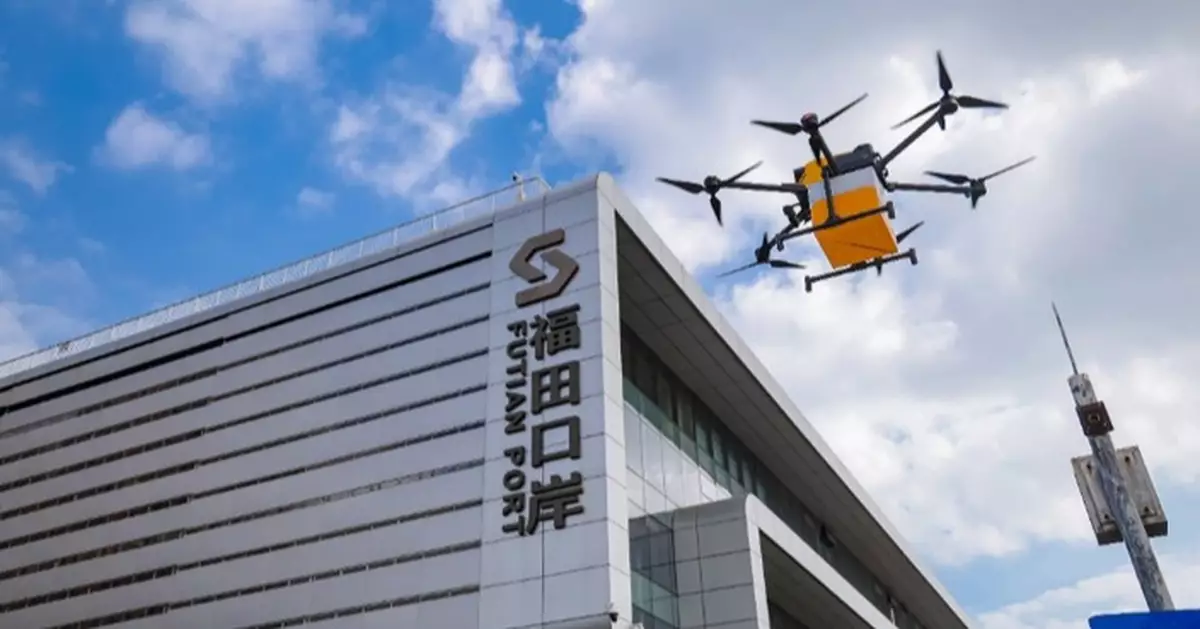
A delivery drone maneuvers past the Futian Port complex. (Source: Meituan Official Photo)
Citizens collecting their orders at a drone smart locker near the border checkpoint. (Source: Meituan Official Photo)
A Keeta Drone fulfilling a Pizza Hut delivery trial. (Source: U Lifestyle Photo)
In February 2026, two Russian tourists tried drone-delivered takeaway for the first time at Shenzhen's Lianhuashan Park. As their hot coffee descended smoothly from above, they gasped in Chinese, calling the experience "awesome" (lihai) and exclaiming in delight, "Coffee came from heaven to us!"
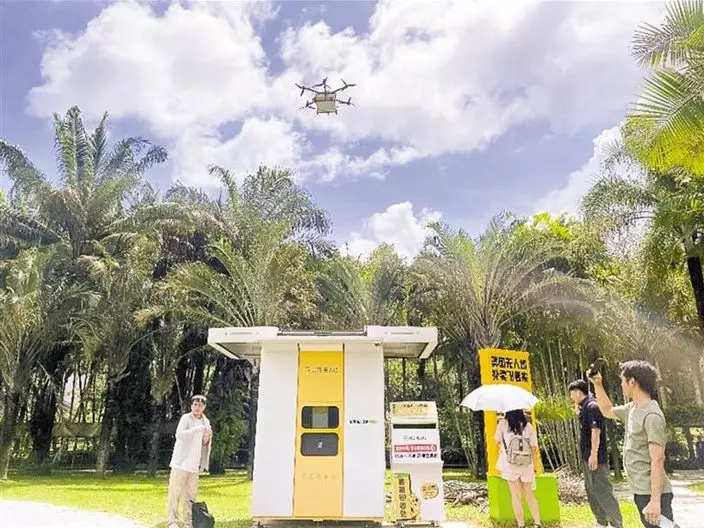
The maiden drone delivery route opens at Lianhuashan Park, delivering "aerial takeaway" in as little as 7 minutes. (Source: Shenzhen Economic Daily)
This is far from a novelty gimmick. To date, Meituan Drone has launched over 60 commercial delivery routes in Shenzhen, completing more than 1 million deliveries across office towers, residential neighborhoods, scenic hotspots, public parks, and university campuses. During the summer of 2026, Shenzhen experienced a surge in international visitors seeking "cool tech escapes," with drone food delivery becoming a top viral bucket-list experience for foreign tourists.
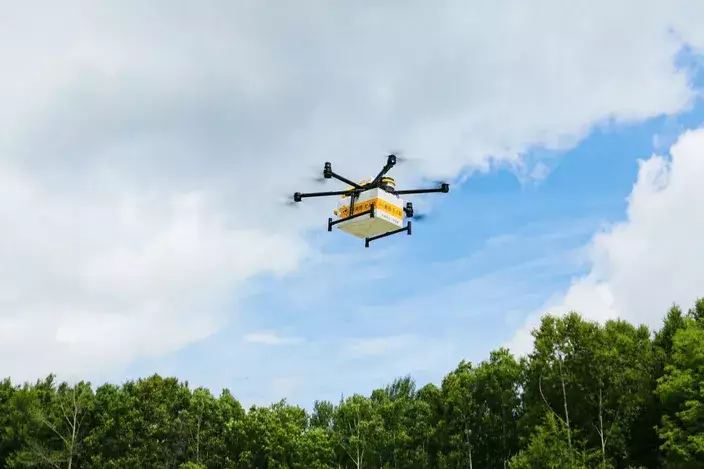
A Meituan drone making a takeaway delivery in Shenzhen. (Source: Meituan Official Photo)
For Hong Kong travelers, the real game-changer arrived in October 2024 with the launch of the Futian Port route—Mainland China's first regular drone delivery corridor operating within a border checkpoint area. Hong Kong residents can order via their local phone numbers and pay seamlessly in HKD using WeChat Pay HK. During its initial launch, nearly half of all daily orders originated from Hong Kong commuters. Yan Yan, head of public affairs at Meituan Drone, explained that Futian Port sees hundreds of thousands of cross-border travelers daily. Finding a delivery rider in such dense crowds was notoriously difficult; drone delivery slashes waiting times by nearly 30 minutes.
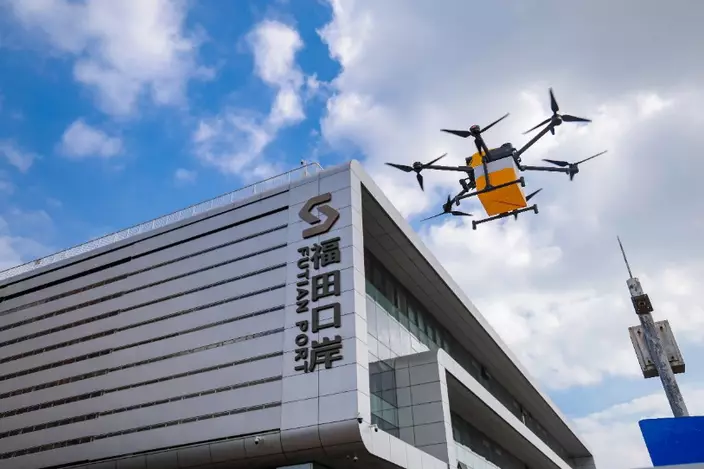
A delivery drone maneuvers past the Futian Port complex. (Source: Meituan Official Photo)
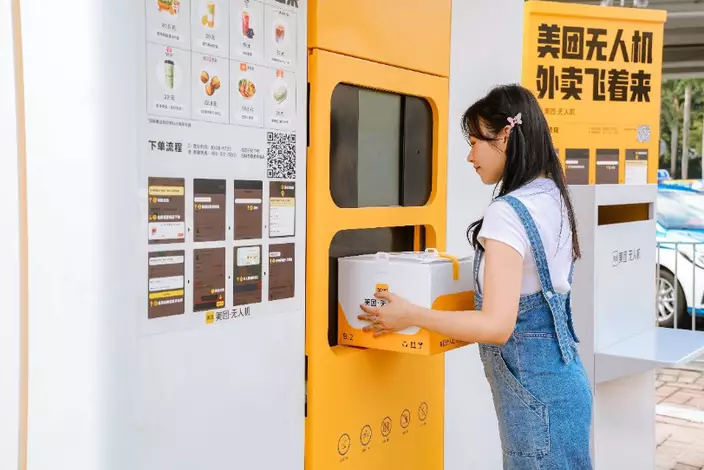
Citizens collecting their orders at a drone smart locker near the border checkpoint. (Source: Meituan Official Photo)
Shenzhen's Technological Edge: Manufacturing 70% of the World's Consumer Drones
Shenzhen's title as the "Drone Capital of the World" is well-earned. The city manufactures 70% of the global consumer drone market and nearly 50% of industrial drones, hosting a dense ecosystem of over 1,900 companies related to the low-altitude economy. In 2025, the total output value of China's civil drone industry reached RMB 176.1 billion, a year-on-year surge of approximately 20%. Data from the National Development and Reform Commission (NDRC) projects the low-altitude economy market to eclipse RMB 1 trillion in 2026 and hit RMB 3.5 trillion by 2035.
Cross-Border Air Corridors: Shekou to Tuen Mun in Just 10 Minutes
What matters most to Hong Kong is the impending "aerial logistics mesh" linking Shenzhen and Hong Kong. Phongwing Technology, a subsidiary of logistics giant SF Express, is advancing plans for a cross-border flight route connecting Shenzhen's Shekou directly to Hong Kong's Tuen Mun, cutting transit time to a mere 10 minutes. Concurrently, Hong Kong's Transport and Logistics Bureau confirmed in a response to the Yuen Long District Council that the government is actively consulting mainland authorities on flight path planning and customs clearance to launch cross-border drone trial flights as soon as possible.
Hong Kong's Low-Altitude Sector Takes Off
On the regulatory front, Hong Kong officially launched its low-altitude economy "regulatory sandbox" in March 2025. Out of the first batch of 38 approved trial projects, 32 are actively testing across more than 50 designated flight paths. Notably, Meituan Drone completed its inaugural trial delivery at the Hong Kong University of Science and Technology (HKUST). In June, Pizza Hut's Science Park branch pioneered a commercial trial route delivering meals across the harbor to the Ma On Shan Promenade in just 5 minutes. Meanwhile, SF Express Hong Kong launched its maiden drone route in September 2025 between Cyberport and Cheung Chau, focusing on urgent medical supplies across a 12-kilometer over-sea flight path—boosting logistics efficiency by over 60% compared to traditional sea transport.
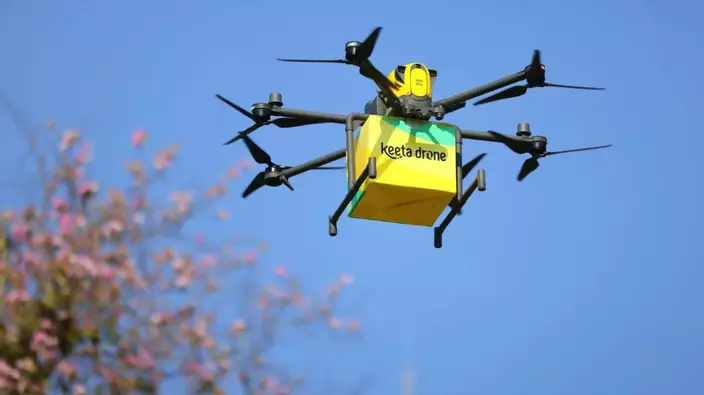
A Keeta Drone fulfilling a Pizza Hut delivery trial. (Source: U Lifestyle Photo)
The Big Picture Behind a Cup of Coffee
From a cup of coffee at Lianhuashan Park to a 10-minute cross-border flight between Shekou and Tuen Mun, and a 5-minute delivery across the harbor from Science Park to Ma On Shan, drone logistics is redefining urban mobility between Shenzhen and Hong Kong.
The significance of this "sky corridor" extends far beyond fast food. International media outlets have noted Meituan completing tens of thousands of automated flights monthly amidst Shenzhen's dense urban skyscraper canyons. To date, Meituan alone has surpassed 1 million commercial drone orders. For Hong Kong residents, ordering a drone takeaway to Futian Port may well be the most grounded, tangible, and everyday manifestation of "Chinamaxxing."
Chinamaxxing
** 博客文章文責自負,不代表本公司立場 **
This Mid-Autumn holiday, border checkpoints across China experienced a massive surge in travel. The National Immigration Administration reported an average of 2.236 million daily cross-border trips during the holiday period. Amid this influx, a striking scene has become increasingly common: foreign travelers arriving with empty suitcases and departing with luggage packed to the brim. On social media, a running joke has gained traction about tourists "bringing three suitcases each to shop till they drop." This trend, dubbed the "China Haul," is going viral across global social media platforms—and behind it lies a strategic, national-level vision far larger than any social media video.
What Is Filling These Suitcases?
A "haul" video is a well-established genre in global internet culture featuring unboxings of shopping sprees. British YouTuber Elliot Page, who boasts 940,000 subscribers, uploaded a nearly 20-minute unboxing video on August 27, 2026, showcasing clothes and shoes he bought in Guangzhou and Shenzhen. By late September, the video had crossed 127,000 views. Another video following his shopping trip through Li-Ning and Anta flagship stores on Beijing Road racked up over 530,000 views in the same period.
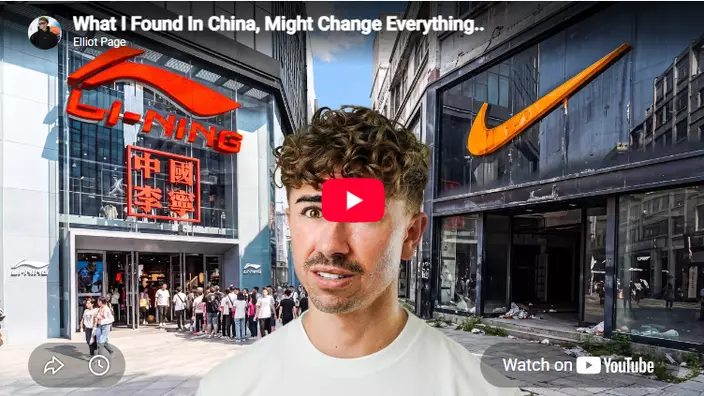
Screenshot from Elliot Page's YouTube channel.
The haul is remarkably diverse: high-tech products like DJI drones, Insta360 cameras, and Huawei foldable phones; "trendy local specialties" including designer bags, backpacks, apparel, home fragrances, and Pop Mart collectibles; as well as traditional wellness items such as Nin Jiom Pei Pa Koa (loquat syrup), herbal soaps, and moxibustion products.
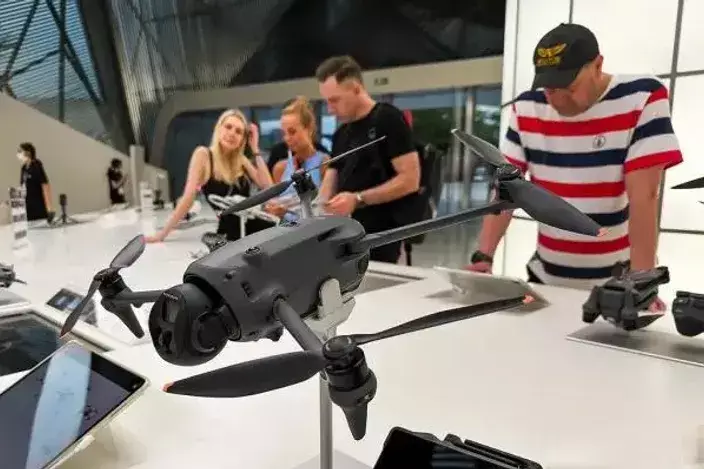
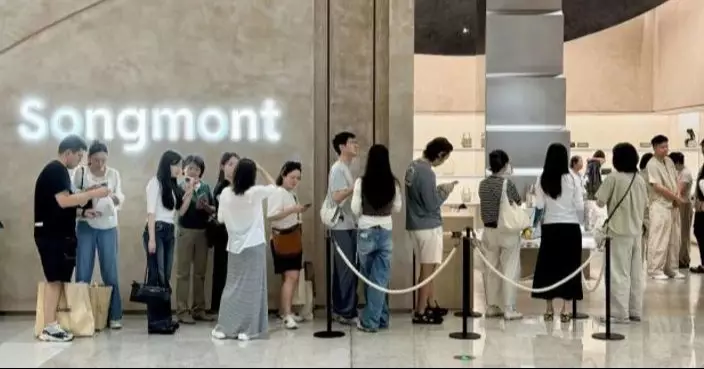
Experiential counters for DJI, Insta360, Huawei, and Xiaomi have become viral photo-ops for foreign tourists.

A Portuguese content creator posts a "China Haul" video on Instagram, sharing traditional wellness items like loquat syrup, Ganmaoling, and Guipi Wan. (Source: Instagram screenshot)
A Ghana-born YouTuber living in China filmed himself testing a robotic dog in Shenzhen's Huaqiangbei electronics market, garnering 740,000 views. A top comment on the video captured the essence of the phenomenon: "I strongly advise everyone traveling to China to pack as lightly as possible—because you will shop until you are completely exhausted."
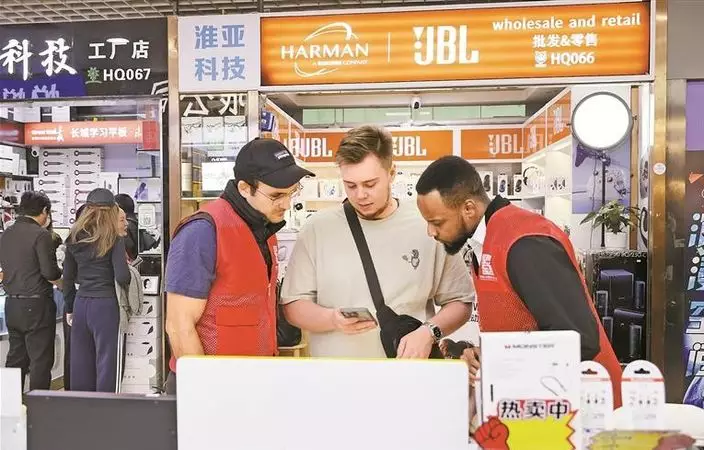
Foreign visitors shopping inside a commercial complex in Huaqiangbei. (Source: Shenzhen Government Online)
According to Dotdotnews, savvy travelers have even mastered an hyper-efficient shopping hack: using Chinese e-commerce apps to order products directly to their hotels ahead of time, then packing everything up on their final day. A ten-day itinerary essentially turns into a ten-day delivery frenzy.
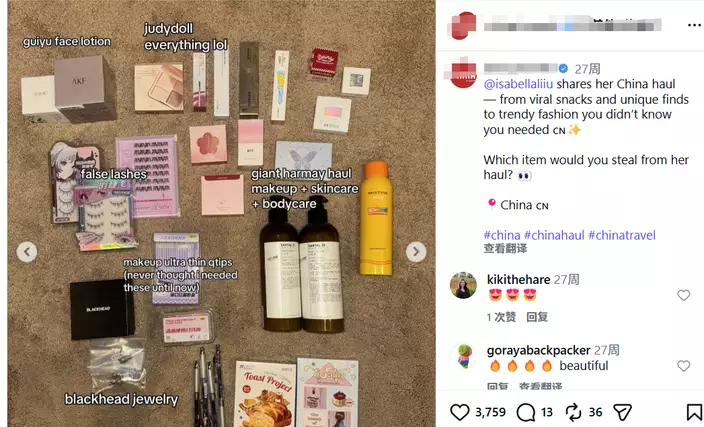
Foreign tourists sharing their "China Haul" videos on social media. (Source: Social media screenshot)
Policy Tailwinds: Visa-Free Entry, Tax Refunds, and Strategic Subsidies
This trend is not merely a spontaneous grassroots phenomenon. As of August 2026, China has extended unilateral visa-free entry to 50 countries, alongside a 240-hour visa-free transit policy for 57 nations across 65 open ports in 24 provinces. Transit passengers can stay for up to 10 full days across multiple provinces, making "deep-dive multi-city travel" seamless. On departure tax refunds, the minimum purchase threshold has been lowered to RMB 200 per transaction, with "Buy-and-Refund On the Spot" services expanded nationwide. In May 2026, six government ministries launched Version 2.0 of the departure tax refund policy, extending the departure window to 28 days and enabling cross-regional refund processing. Furthermore, the Ministry of Finance and the Ministry of Commerce allocated up to RMB 200 million per city over two years to 15 key hubs—including Beijing, Shanghai, and Hangzhou—specifically to boost international retail tourism.
From Curiosity to Recognition: What Mid-Autumn Shopping Lists Reveal
During this year's Mid-Autumn Festival, many international tourists turned the holiday into a full-scale shopping season. Ayman, a tourist from Algeria, shared: "I've visited almost all of China. Every time I come back, there’s something new to discover. Since it's Mid-Autumn, I bought lots of gifts for my family and friends—especially mooncakes." Daniel, a visitor from Slovenia, offered a lighthearted reflection: "China has so much new technology and endless shops. The hard part isn't finding what to buy; it's fitting it all into your luggage."
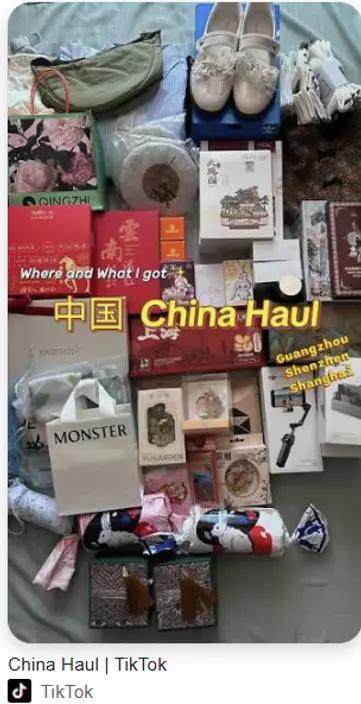
Foreign tourists sharing their "China Haul" videos on social media. (Source: Social media screenshot)
The nature of consumer spending is also evolving toward higher-value experiences. A specialized cross-border consumption model blending "medical care, tourism, and shopping" is taking shape: herbal soaps, moxibustion wellness products, and medicinal cuisine are becoming staples on tourists' shopping lists. At the same time, "smart-factory tech tours" have emerged as a hot trend in inbound tourism, where visitors tour state-of-the-art automated automotive plants and witness cutting-edge manufacturing firsthand.
The Hard Data Speaks for Itself
Between January and August 2026, China recorded 61.287 million foreign inbound and outbound trips, representing a 19.5% year-on-year increase. Among these, visa-free entries reached 23.72 million, accounting for 77.6%—nearly eight out of every ten foreign visitors. In the first half of 2026, the number of foreign travelers processed for departure tax refunds nationwide surged by 366% year-on-year, while tax-free sales and total refund amounts rose by 69%.
"Reverse Daigou": The Next Chapter of Chinamaxxing
In the past, Chinese consumers traveled abroad to buy foreign goods; today, international consumers are making dedicated trips to China to purchase products from domestic brands that are unavailable, limited, or vastly more expensive back home. This phenomenon of "reverse daigou" (personal shopping) is not merely about cheap price tags—it represents a vote of confidence backed by real spending power toward the value transformation of Chinese brands. Analysts note that the core motivation of foreign tourists is shifting from "novelty buying" to "value recognition"—they are purchasing items not for exotic charm, but for genuine quality, design, and utility.
For China, the significance of the "China Haul" goes far beyond tourist dollars. "Made in China" is no longer just a cold statistic on container docks; it has materialized into tangible products being unboxed, tested, and genuinely lauded by global creators. From mooncakes to commercial drones, and from moxibustion patches to foldable smartphones, the space between an empty suitcase and a full one marks the final stretch of Chinese manufacturing's evolution—from OEM supplier to global brand. And that journey has only just begun.


/wp-content/uploads/blogger/2026/08/WhatsApp-Image-2026-08-13-at-12.21.36.jpg.webp)