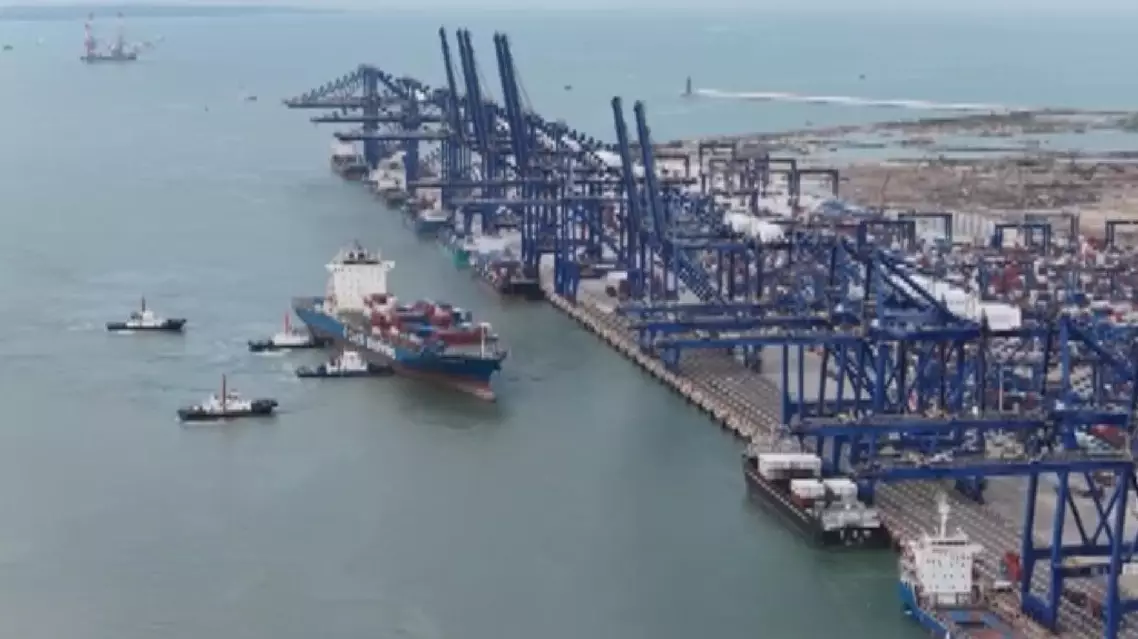
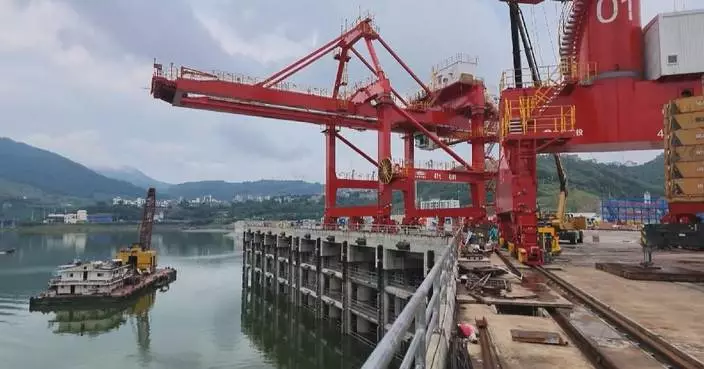
China opened the Pinglu Canal in its southern region of Guangxi on Wednesday, giving the country's landlocked southwest a shortcut to the coast and overseas markets, particularly those in the Association of Southeast Asian Nations (ASEAN), the country's largest trading partner.
Built at a cost of 72.7 billion yuan (about 10.75 billion U.S. dollars), the 134.2-kilometer canal runs from Nanning City, capital of the Guangxi Zhuang Autonomous Region, to the Beibu Gulf in the South China Sea, the closest maritime outlet for much of southwest China.
The canal stretches along the New International Land-Sea Trade Corridor, a strategic trade route connecting China's inland regions with ASEAN and other global markets. It is the first river-to-sea canal project planned and coordinated at the national level since the founding of the People's Republic of China in 1949.
Designed for vessels of up to 5,000 tonnes, the canal shortens the inland waterway journey for goods from southwest China to the sea by more than 560 kilometers compared with traditional routes through ports in neighboring Guangdong Province. It is expected to reduce overall logistics costs by 18 to 30 percent and save more than 5 billion yuan (about 745.4 million U.S. dollars) in transportation costs each year.
The canal took more than four years to build. Most of it was created by widening, deepening and straightening existing waterways, while a small section had to be excavated through dry land and mountainous terrain.
One of the biggest engineering challenges was the existence of a 65-meter difference in total water level, roughly the height of a 20-plus-story building.
On the exact inauguration day, 30 cargo ships passed through the canal as the Nanning Port and the Qinzhou Port saw initial voyage operations of cargo ships on the newly opened canal. The cargoes included construction materials, coal, minerals, steel and fertilizers. Four passenger ferry routes were also launched on the same day. The three navigation hubs of Madao, Qishi and Qingnian, all featuring twin-line ship locks, were built to raise and lower vessels on the canal, which has set multiple world records for capacity and lock transit speed among similar canal systems.
"We independently developed the world's first three-tier stacked configuration of water-saving basins to overcome challenges including how to make comprehensive utilization of the 315 million cubic meters of earth and rock excavated in the process of construction. The project balances navigation needs, water conservation and ecological protection, while also driving quality upgrades in related industries, such as green and intelligent shipbuilding, and offering China's solution for canal construction worldwide," said Cheng Yaofei, commander of the canal's construction headquarters.
The new artery carries particular significance for China's southwest, which has long lagged behind the more prosperous eastern coast and faced higher costs getting goods to seaports. Coal, ore, grain, new-energy materials and auto parts from the region can now take a more direct route to overseas markets.
With China and ASEAN seeking closer economic ties and greater regional connectivity, experts say the Pinglu Canal could provide a new corridor for goods to flow in both directions between the vast Chinese and ASEAN markets.
China's trade with ASEAN exceeded 1 trillion U.S. dollars for the first-time last year. In the first seven months of 2026, total trade between the two sides reached 744.41 billion U.S. dollars, an increase of 24.7 percent year on year, accounting for 21.8 percent of China's total foreign trade during this period.
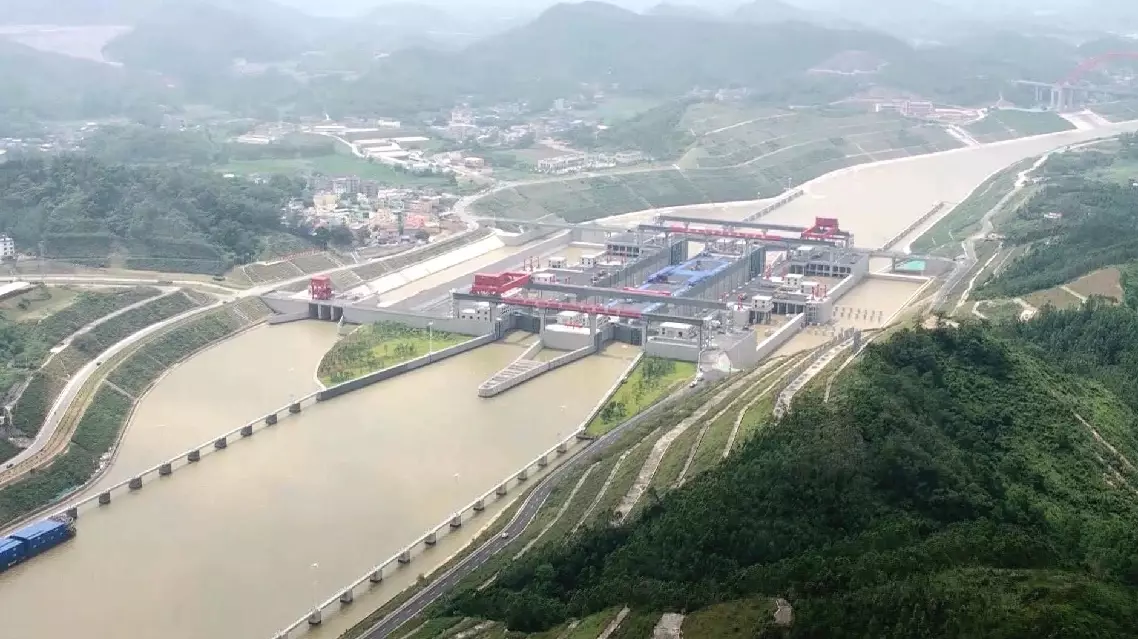
China opens major river-to-sea canal, creates trade shortcut to Southeast Asia