Long-term military pressure has proved that it will not bring peace, Iran's Minister of Foreign Affairs Seyyed Abbas Araghchi said on Saturday.
Araghchi delivered a speech at the virtual forum of Global Town Hall 2026, saying that decades of foreign intervention, military pressure, and endless wars in the Middle East have proven an undeniable truth that military intervention does not create security, and the exertion of pressure and coercion does not lead to peace.
Araghchi called on the international community to once again restore real meaning and credibility to international law, from interventionism toward respect for national sovereignty, from collective punishment toward the protection of civilians, from selective accountability toward universal justice, and from endless wars toward the lasting peace.
Global Town Hall, hosted by the Foreign Policy Community of Indonesia (FPCI), is an annual virtual dialogue that brings together world leaders and leading minds to discuss major global issues. The theme of this year's forum is "Calling for a Global U-Turn: Recentering Development, Reclaiming Humanity, Restoring Justice in a Crazy World."

Military pressure will not bring peace to Middle East: Iranian FM

Military pressure will not bring peace to Middle East: Iranian FM
Japanese peace activists screened the Chinese wartime drama "Dead to Rights" in Tokyo on Saturday, with organizers and viewers calling for greater public reflection on Japan's wartime aggression and the Nanjing Massacre.
"Dead to Rights," whose Chinese title translates as "Nanjing Photo Studio," is a 2025 film directed by Shen Ao. Set during the Nanjing Massacre, it follows Chinese civilians who take refuge in a photo studio and risk their lives to preserve photographs documenting Japanese atrocities.
"Japanese society is moving further to the right. Some people even go so far as to claim the Nanjing Massacre never happened. But facts are facts. We must acknowledge them and tell the truth. In that sense, I think people in Japan today lack a sufficient understanding of the history," said Hiroshi Echigo, organizer of the screening.
Dozens of people attended. Viewers said more people in Japan need to learn about the historical facts of the Nanjing Massacre.
"Japanese troops did carry out such massacres in Nanjing, yet some in Japan are trying to suggest that it never happened. It is vital to pass those historical facts on to future generations. Japan is moving toward war again, and I think that is extremely serious. Young people do not know this history, and that is a major problem. That is why it is so important to pass this part of modern history on to the younger generation," one member of the audience said.
Another audience member called for a fuller acknowledgment of Japan's wartime past and stronger exchanges with China.
"Japanese people should learn more about these historical facts and promote friendly exchanges between Japan and China. Japan should acknowledge what it did. On that basis, and to ensure such tragedies are never repeated, I believe every Japanese person has a responsibility to confront this history seriously," she said.
Japanese troops captured Nanjing on Dec 13, 1937, beginning a six-week campaign of mass killing, rape, looting and arson. More than 300,000 Chinese civilians and disarmed soldiers were killed. China observes Dec 13 as the National Memorial Day for Nanjing Massacre Victims.
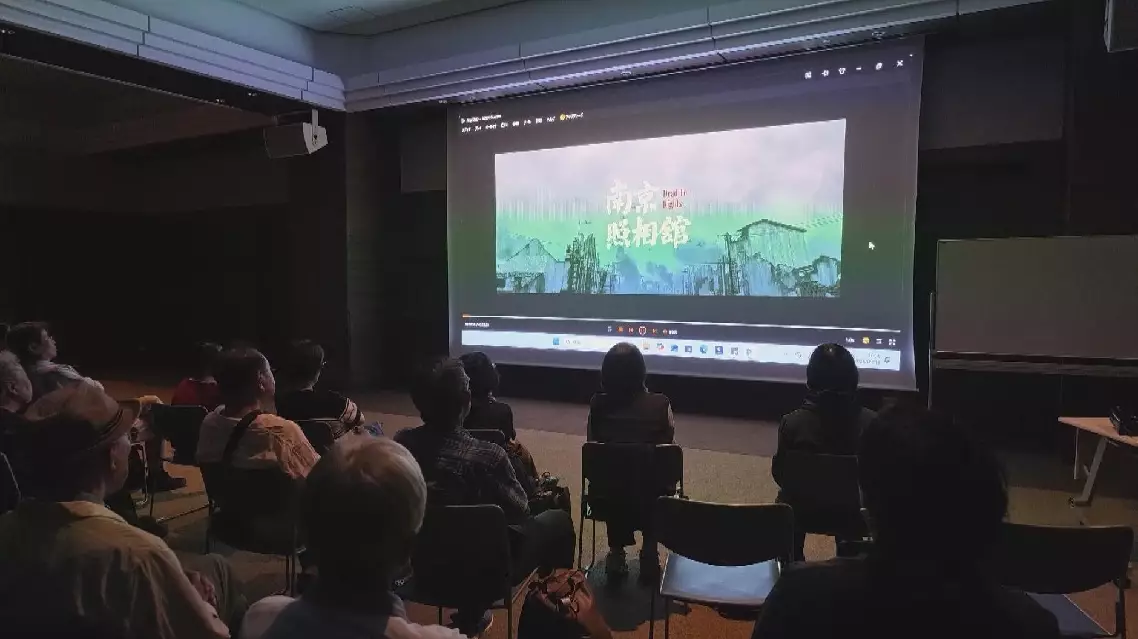
Tokyo screening of "Dead to Rights" prompts calls to face Japan's wartime past