
Skip to Content Facebook Feature Image

How a Middle East Crisis Unlocked the "King of Renewable Energy": 50 Nations Rush for Chinese Green Tech Amid Global Fuel Shocks

Blog

How a Middle East Crisis Unlocked the "King of Renewable Energy": 50 Nations Rush for Chinese Green Tech Amid Global Fuel Shocks
Blog

Blog

How a Middle East Crisis Unlocked the "King of Renewable Energy": 50 Nations Rush for Chinese Green Tech Amid Global Fuel Shocks

2026-10-27 10:54 Last Updated At:10:54

In late February 2026, escalations in the Middle East disrupted approximately one-fifth of global oil and gas transit. As crude prices spiked, CNN ran a headline with a striking designation: "The King of Renewable Energy—China." By April, CNN reported with astonishment that as nations suffering from severe "oil thirst" scrambled for fuel alternatives, their eyes turned almost unanimously toward Chinese-made solar panels, lithium batteries, and electric vehicles.

Hard trade figures confirm this shift: energy think tank Ember reported that in March 2026, China’s solar technology exports smashed records to hit 68 gigawatts (GW)—a 50% jump over the previous record set in August 2025, equivalent to Spain’s total installed solar capacity. That same month, Chinese solar cell exports reached $9.1 billion, representing an 84% year-on-year surge. Even more striking was the geographic reach: in a single month, 50 countries set all-time high records for solar imports from China, led by emerging markets in Asia and Africa hardest hit by the fossil fuel crunch.

More Images
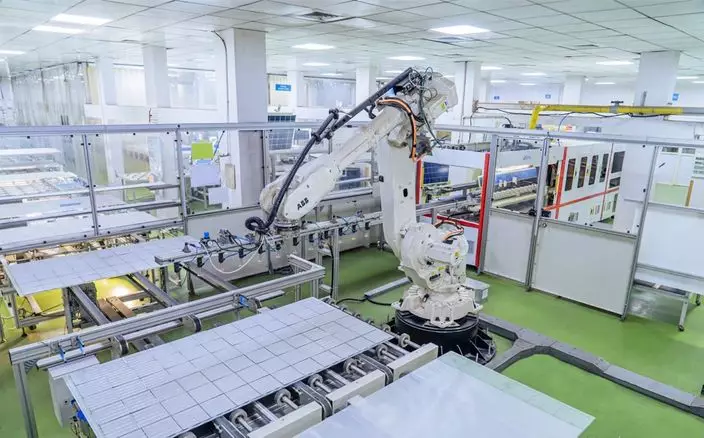
Taiqi Robot's automated PV module assembly line: robotic arms precisely maneuver solar cell components along the production line. (Source: Taiqi Robot official website)
Taiqi Robot's automated PV module assembly line: robotic arms precisely maneuver solar cell components along the production line. (Source: Taiqi Robot official website)

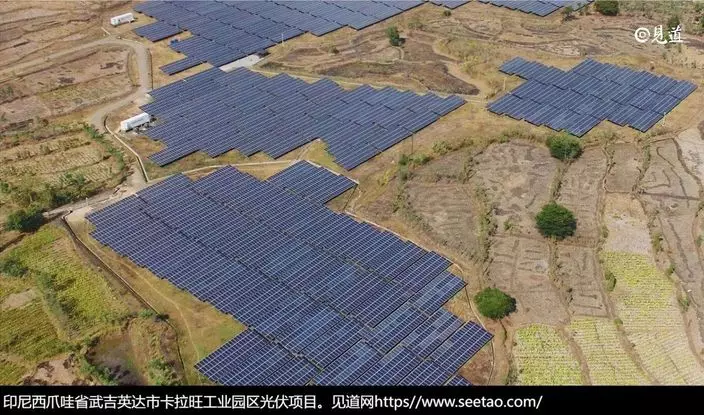
Aerial view of the solar installation at the Bukit Indah Karawang Industrial Park in West Java, Indonesia, where blue module arrays contrast against the red terrain. (Source: Jiandao Net photo)
Aerial view of the solar installation at the Bukit Indah Karawang Industrial Park in West Java, Indonesia, where blue module arrays contrast against the red terrain. (Source: Jiandao Net photo)

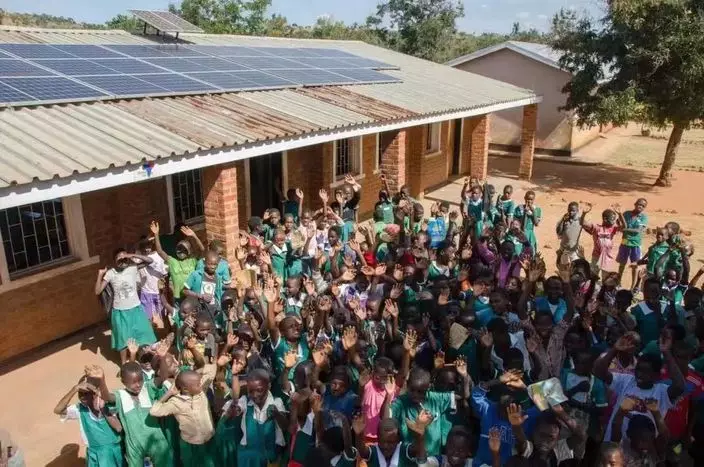
A school rooftop in Africa lined with solar panels, as students cheer below. (Source: LONGi official photo)
A school rooftop in Africa lined with solar panels, as students cheer below. (Source: LONGi official photo)

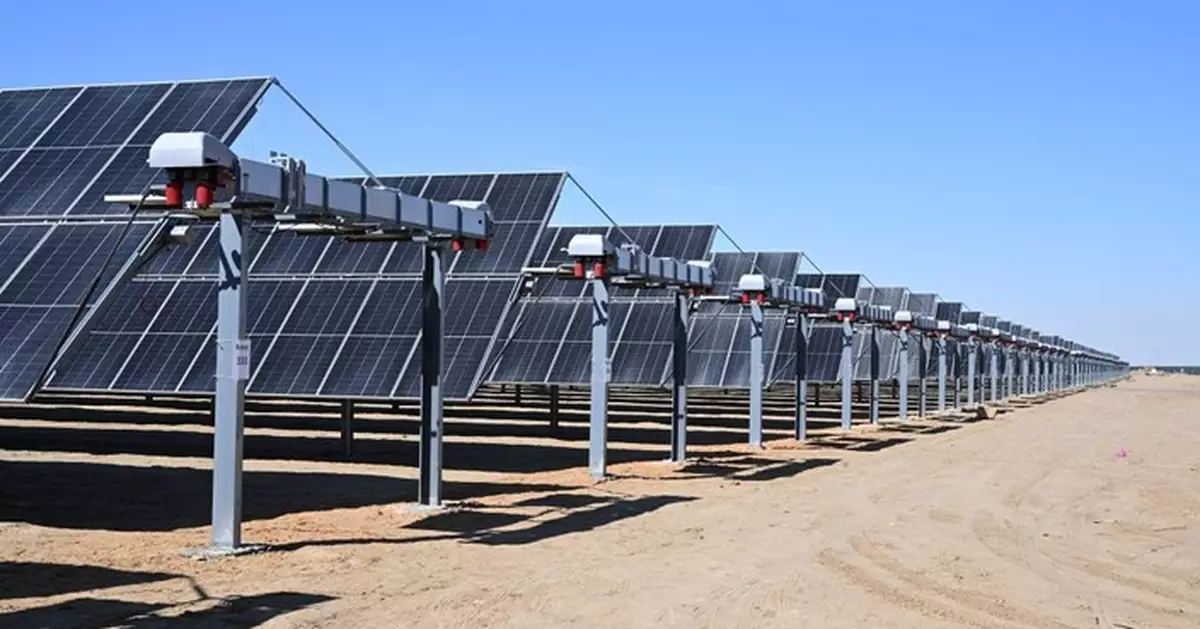
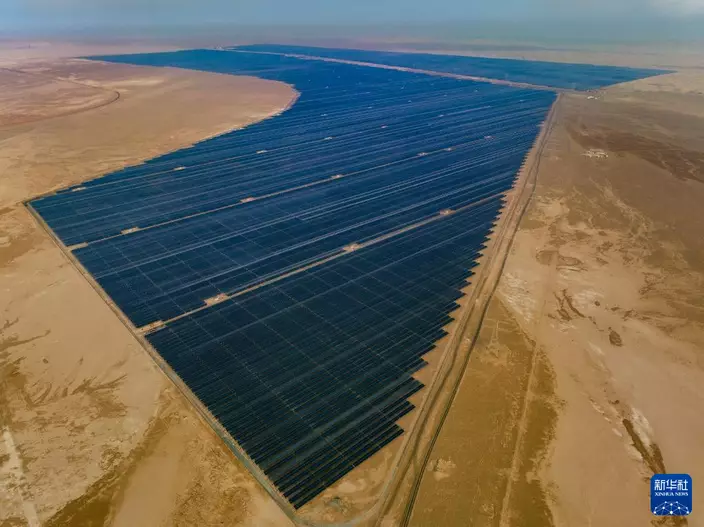
An "energy oasis" in the Abu Dhabi desert: the Al Dhafra PV2 Solar Power Plant in the UAE. (Source: Xinhua photo)
An "energy oasis" in the Abu Dhabi desert: the Al Dhafra PV2 Solar Power Plant in the UAE. (Source: Xinhua photo)

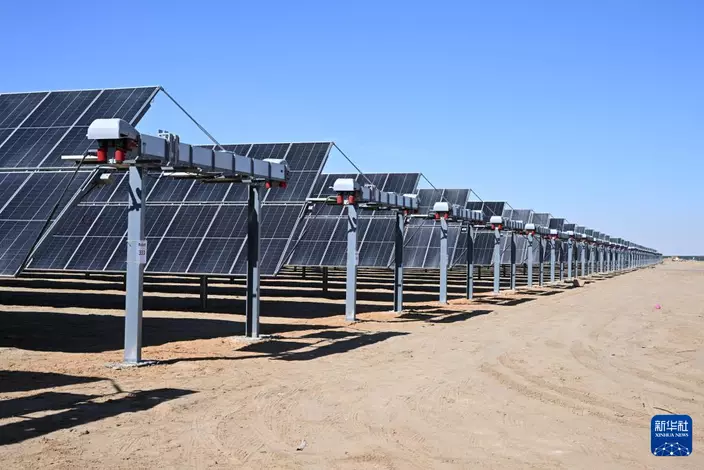
Automated cleaning robots maintaining solar panels in desert conditions. (Source: Xinhua photo)

Automated cleaning robots maintaining solar panels in desert conditions. (Source: Xinhua photo)

A Dominant Foundation: 90% of Global Solar Cells Originating from China

China's designation as the "King of Renewable Energy" is no stroke of luck; it reflects structural dominance across the clean-tech supply chain. Data cited by People's Daily reveals that by the end of 2025, China commanded 96% of global polysilicon capacity, 96.2% of silicon wafer capacity, 91.3% of solar cell production, and 80.1% of finished PV module manufacturing. In 2025, China's new domestic solar installations accounted for 57% of the global total—the same year global newly installed solar capacity surpassed coal power for the first time, establishing photovoltaics as the primary driver of global power grid expansion.

Taiqi Robot's automated PV module assembly line: robotic arms precisely maneuver solar cell components along the production line. (Source: Taiqi Robot official website)

Taiqi Robot's automated PV module assembly line: robotic arms precisely maneuver solar cell components along the production line. (Source: Taiqi Robot official website)

Domestic expansion remains equally massive: in 2025, China added 317 GW of new photovoltaic capacity (up 14% year-on-year), bringing cumulative solar capacity past 1.2 billion kilowatts (1.2 TW), alongside 120 GW of new wind power capacity—a 51% surge.

A Redrawn Trade Map: Pivot from Europe to the Global South

The most profound transformation lies in the geographic realignment of exports. According to InfoLink statistics, China exported 4.41 GW of solar modules to Africa in March 2026—a 235% year-on-year surge. Export value to Southeast Asia jumped 267% year-on-year, with monthly import volumes to the Philippines nearly quadrupling.

In West Java, Indonesia, the Karawang 100 MW photovoltaic plant—built by PowerChina Hubei Engineering—was commissioned in 2024 with 90% of its equipment sourced from China. The project set an overseas record of "5 months to initial grid connection and 7 months to full delivery," generating over 150 million kWh of clean electricity annually to power 112,000 local households while cutting carbon emissions by 114,700 tonnes per year.

Aerial view of the solar installation at the Bukit Indah Karawang Industrial Park in West Java, Indonesia, where blue module arrays contrast against the red terrain. (Source: Jiandao Net photo)

Aerial view of the solar installation at the Bukit Indah Karawang Industrial Park in West Java, Indonesia, where blue module arrays contrast against the red terrain. (Source: Jiandao Net photo)

Across rural Africa, the "Africa Light Belt" initiative deploys distributed solar systems to supply reliable power for local schools, medical clinics, and homes—demonstrating how "small yet beautiful" livelihood projects are reshaping Sub-Saharan Africa's energy ecosystem.

A school rooftop in Africa lined with solar panels, as students cheer below. (Source: LONGi official photo)

A school rooftop in Africa lined with solar panels, as students cheer below. (Source: LONGi official photo)

The Middle East market is accelerating fastest of all: PowerChina clinched a major contract in Abu Dhabi, UAE, for 2.1 GW of photovoltaics paired with 7.75 GWh of battery energy storage (BESS), valued at RMB 13.962 billion ($1.92 billion). This forms the northern block of the world's largest integrated solar-plus-storage complex (5.2 GW PV + 19 GWh storage). Groundbreaking took place in October 2025, with commercial operations slated for 2027.

An "energy oasis" in the Abu Dhabi desert: the Al Dhafra PV2 Solar Power Plant in the UAE. (Source: Xinhua photo)

An "energy oasis" in the Abu Dhabi desert: the Al Dhafra PV2 Solar Power Plant in the UAE. (Source: Xinhua photo)

Automated cleaning robots maintaining solar panels in desert conditions. (Source: Xinhua photo)

Automated cleaning robots maintaining solar panels in desert conditions. (Source: Xinhua photo)

From Exporting Hardware to Exporting Industrial Capabilities

An even fundamental structural shift is underway: Chinese exports of solar cells and silicon wafers are outpacing finished modules. Nations across the Global South are no longer content merely purchasing off-the-shelf panels; instead, they are importing raw cells to assemble locally, establishing indigenous solar manufacturing capabilities. This is the industrial thesis of "Chinamaxxing": rather than flooding markets with finished goods, China enables developing economies to build their own manufacturing bases along its technology roadmap.

Macroeconomic metrics underscore this shift: in the first half of 2026, clean-tech products accounted for 6.6% of China’s total exports, reaching $140 billion—rapidly approaching the combined export value of the traditional "old three" pillars (clothing, furniture, and home appliances).

Energy Security Is the Prerequisite for Economic Growth

Where China once exported toys, consumer electronics, and civil infrastructure, it now exports energy autonomy itself. Every time geopolitical shocks ripple through global energy markets, it reinforces a fundamental reality: solar power is the ultimate energy source capable of bypassing maritime chokepoints and vulnerable pipelines. Today, China stands as the only industrial power capable of supplying this "energy independence" at global scale and unmatched cost efficiency.

Crucially, energy security is never an end in itself—it is the prerequisite for economic development. Every fraction of a cent saved on electricity costs directly translates into expanded factory orders; every margin of grid stability bolsters the foundation of data centers, the electric vehicle ecosystem, and the entire manufacturing realm.

For the Global South, China’s green energy solutions provide precisely this dual-track path: liberating economies from the shackles of imported fossil fuels while delivering affordable clean power as an entry ticket to industrialization and job creation. Fifty nations setting record monthly import volumes represents the quietest yet most decisive vote of the year—as the global market casts an overwhelming vote of confidence in Chinese green manufacturing.


Chinamaxxing

** 博客文章文責自負,不代表本公司立場 **
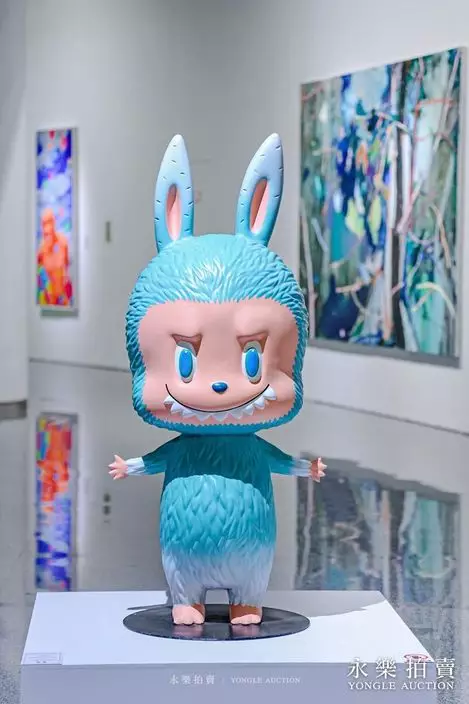
On June 10, 2025, at the Yongle Spring Auction in Beijing, a 131-centimeter mint-green first-generation Labubu was hammered down for RMB 1.08 million, ultimately realizing RMB 1.242 million ($171,000) including buyer's premium—cataloged by the auction house as "the sole piece in existence." At the same sale, a 160-centimeter brown Labubu fetched a hammer price of RMB 820,000. All 48 lots in the dedicated session sold out, generating a total hammer turnover of RMB 3.7254 million.

The world's sole mint-green LABUBU makes its debut at the Yongle 2025 Spring Auction in Beijing. (Source: Yongle Auctions official photo)

The world's sole mint-green LABUBU makes its debut at the Yongle 2025 Spring Auction in Beijing. (Source: Yongle Auctions official photo)

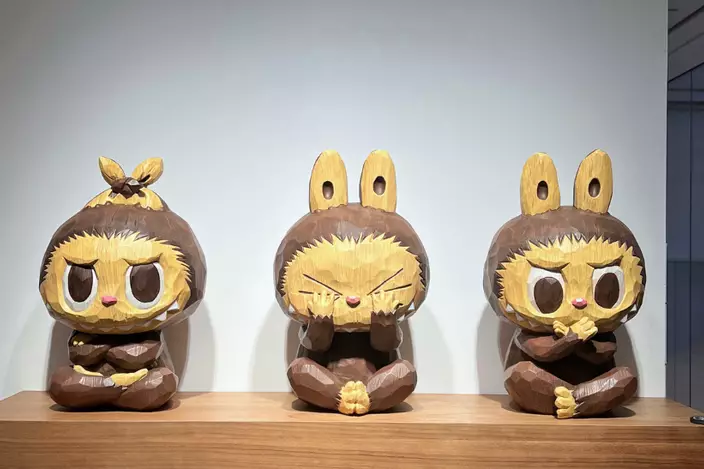
Yet the iconic character’s creative roots lie in Hong Kong: Labubu was created by Hong Kong artist Kasing Lung as a Nordic forest sprite. Earlier at Sotheby’s Hong Kong, a set of three sculptures titled The Three Wise Men LABUBU Series had already commanded HK$203,200 ($26,000). How did an "ugly-cute" monster drive adults worldwide into a queueing frenzy? The answer lies in the latest chapter of "Chinamaxxing": Chinese IP is capturing global markets not by being cheap, but by leveraging absolute scarcity.

A trio of Labubu figures auctioned at Sotheby's Hong Kong for HK$203,200. (Source: ZTYLEZ photo)

A trio of Labubu figures auctioned at Sotheby's Hong Kong for HK$203,200. (Source: ZTYLEZ photo)

Scarcity Economics: From $14 Blind Boxes to a $170,000 Auction Lot

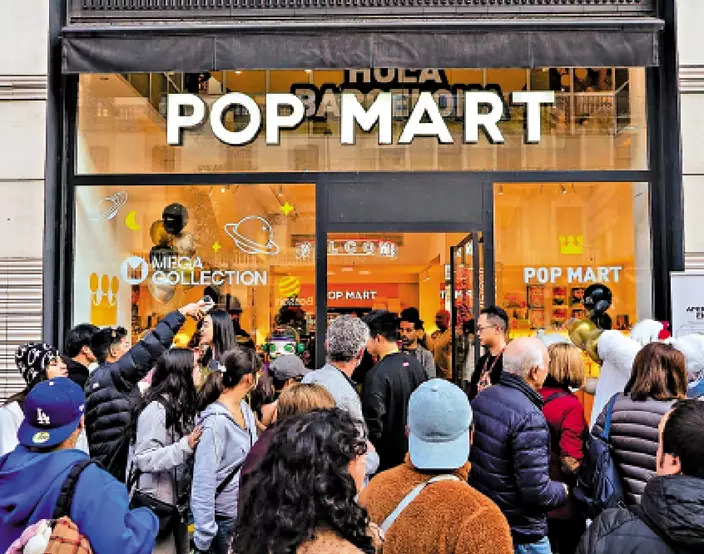
Labubu’s commercial playbook hinges on calculated unpredictability. Its blind-box format turns every purchase into a game of chance: odds for securing the elusive "chase variants" (secret editions) are extremely low, sending secondary-market prices soaring tenfold or more. A UK store was forced to temporarily suspend retail operations following chaotic crowds, while a rare chase variant commanded up to 2,300 yuan ($320) on the secondary market—a 20-fold markup. Meanwhile, a single TikTok Shop livestream in the Americas generated over $1.5 million in gross merchandise value (GMV).

Labubu goes viral across Europe, drawing massive crowds outside a POP MART flagship store in Barcelona, Spain. (Source: Ta Kung Wen Hui Net photo)

Labubu goes viral across Europe, drawing massive crowds outside a POP MART flagship store in Barcelona, Spain. (Source: Ta Kung Wen Hui Net photo)

The pivotal tipping point arrived in April 2024: Lisa, the Thai member of K-pop megagroup Blackpink, posted photos featuring Labubu on Instagram. Soon, icons like Madonna, David Beckham and his daughter, and actress Charmaine Sheh were seen displaying the plush toy. Designed as a "bag charm," the plush figure transitioned from a desktop display into a wearable flex and social currency. TikTok topics surrounding Labubu surpassed one billion views, prompting Thai tourism authorities to officially award Labubu the title of "Amazing Thailand Experience Officer."

Blackpink's Lisa spotted posing with her beloved Labubu plush. (Source: Instagram screenshot)

Blackpink's Lisa spotted posing with her beloved Labubu plush. (Source: Instagram screenshot)

Actress Charmaine Sheh embraces the viral trend with her own Labubu charm. (Source: Instagram screenshot)

Actress Charmaine Sheh embraces the viral trend with her own Labubu charm. (Source: Instagram screenshot)

The financial returns have been unprecedented. For the full year 2025, POP MART reported annual revenue of RMB 37.12 billion—a massive 184.7% year-on-year surge—with adjusted net profit skyrocketing 284.5% to RMB 13.08 billion. Labubu as a standalone IP contributed RMB 14.16 billion, up 365.7% year-on-year. Overseas revenue reached RMB 16.27 billion (a 291.9% surge), accounting for 43.8% of total revenue, with sales in the Americas exploding by 748.4%. Founder Wang Ning revealed in a People's Daily interview that following September 2025, global sales of Labubu were approaching nearly 10 million units per month.

Beyond the Frenzy: Labubu's Canonization and China's Next-Gen Art Toys

Crossing the threshold of fine art auction houses marks the first step in Labubu’s institutional canonization—when a designer toy trades at Yongle or Sotheby’s under fine-art protocols, it evolves from a fast-moving consumer novelty into an investment-grade collectible.

Yet the flip side of canonization is the relentless churn of consumer trends. In the first half of 2026, POP MART recorded an 11.1% year-on-year dip in overseas revenue—its first contraction since expanding internationally. Labubu’s revenue shrank 7.5% year-on-year, its overall share moderating to 26%. Wang Ning characterized 2026 as a "year of operational adjustment," acknowledging that "overnight queues, chaotic store rushes, and chronic stockouts are not sustainable norms," while conceding that the company would likely miss its 20% growth target.

Yet successor IPs are already stepping into the spotlight. Twinkle Twinkle has emerged as the next viral phenomenon following Labubu, triggering fresh buying frenzies across domestic and global markets. Its "Delicious Moments" blind-box series sold out online instantly upon release, with hundreds of thousands of users adding items to their carts simultaneously. Launched only in 2024, this breakout IP generated RMB 8.79 billion in full-year revenue for 2025. Secondary-market premiums for its secret editions surged up to 16 times original retail price, setting a POP MART record for the fastest new IP to break RMB 100 million in gross sales.

POP MART's breakout "Twinkle Twinkle: Delicious Moments" blind-box series.

POP MART's breakout "Twinkle Twinkle: Delicious Moments" blind-box series.

In the first half of the year, POP MART saw six distinct IPs each cross the RMB 1 billion revenue milestone, as global registered loyalty members passed 100 million. The company has explicitly shifted focus toward "building timeless, classic IPs." The broader industry is expanding rapidly as well: rival designer toy brands such as 52TOYS, TOP TOY, Heyone, and Sunny are making strides toward public listings, transforming the sector from a single-dominant player into a multi-polar competitive landscape. Labubu hasn't lost its charm; it has simply shared the spotlight—a hallmark of a maturing art-toy market where no single character reigns supreme forever.

The Lightest Vessel for Soft Power

An abstract character with no underlying animation, no feature film, and no narrative origin story—conquering global pop culture purely through design intuition and emotional resonance. Where "Made in China" once exported functional affordability, "Created in China" now exports emotional connection. A small plush monster with nine pointy teeth and a mischievous grin has inspired sprawling queues from London to Los Angeles, while keeping foot traffic flowing constantly into POP MART boutiques in Hong Kong.

Conceived by a Hong Kong artist, listed on the Hong Kong Stock Exchange, and adored by fans across the globe, Labubu’s journey is a masterclass in leveraging scarcity and emotional attachment. It demonstrates that the lightest vessel for soft power often leaves the deepest, most enduring imprint on human hearts.

Recommended Articles