
He was once among the most influential voices in American liberal media—former host of The Daily Show and global comedy icon Trevor Noah. In July 2026, he dedicated a special episode of his podcast, What Now? with Trevor Noah, to a discussion with China analyst Alice Han. The episode title was sharp and uncompromising: "Chinamaxxing."

Official show graphic for "What Now? with Trevor Noah."
During the episode, Noah delivered a line destined to be quoted for years: "We’ve been living in the dark ages of information about China." He explained that while watching a video by an American vlogger documenting daily life in Shenzhen, he found himself repeatedly blurting out, "I didn't know that about China." The knowledge gap, he realized, was no longer a mere gap—it was an information blackout.
Click to Gallery
Official show graphic for "What Now? with Trevor Noah."

Video screenshot from the YouTube channel "What Now? with Trevor Noah."

China analyst Alice Han featured on "What Now? with Trevor Noah."

Video screenshot from "What Now? with Trevor Noah."
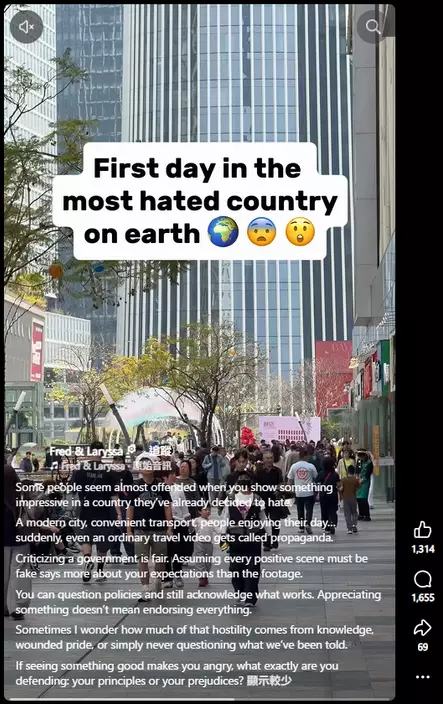
Screenshot of Fred & Laryssa's viral Facebook post.
Video screenshot from the YouTube channel "What Now? with Trevor Noah."
"China Is No Longer the China of the 2010s"
Guest Alice Han contextualized the surge in interest: following the pandemic, international travel to China slowed dramatically. Only in "the past year or two" did momentum shift—fueled by new visa-free travel policies and the rise of "Chinamaxxing" as a global trend. A new wave of American creators flooded into China, uploading daily vlogs that racked up millions of views.
"China is far more affordable than Japan—it’s one of the most underrated travel destinations right now," Han noted. Post-pandemic improvements in domestic tourism, logistics, and transit infrastructure caught many arriving travelers off guard. "People arrive only to be shocked," Han observed, recalling the Olympic-era coverage dominated by smog talk: "China is no longer the China of the 2010s—the sheer scale of transformation over the past decade is mind-boggling."
China analyst Alice Han featured on "What Now? with Trevor Noah."
Noah shared his own fascination with the country throughout the broadcast: describing Shanghai as "the Paris of China," picturing Yunnan as a bohemian haven of linen trousers and indie coffee shops, and marveling at Chongqing's massive Crown Escalator ("It feels like China is constantly doing the impossible"). Turning to giant pandas, Noah pulled out his phone to show his WhatsApp avatar: "I love pandas—this is literally my profile picture."
"I Can Be Ignorant, but Lawmakers Cannot"
The most incisive segment arrived when Noah turned his focus toward Western political elites. "I can be a dumb guy sitting at home with an opinion about China—that's fine," Noah remarked. "But if you are writing laws, if you are making foreign policy toward China and you know nothing about China—what the hell are we doing?"
Han added a sharp critique of arm-chair commentary, noting her frustration with "a steady stream of commentators who have never stepped foot in China, never lived there, yet purport to write definitively about it." She pointed to media images of US Secretary of State Marco Rubio walking into a summit hall in Beijing and staring up at the ceiling in open astonishment as a telling symbol of that knowledge deficit.
Noah concluded with a straightforward appeal: "I'm not saying there's a grand conspiracy in how people get their media impressions—as a South African, I've had to correct people's wild assumptions about South Africa countless times. But man, we've got to go to China and see it for ourselves."
Video screenshot from "What Now? with Trevor Noah."
Fissures in the Ice of Public Opinion
This episode represents a significant milestone in the "Chinamaxxing" narrative. Over the past two years, the phenomenon has evolved from an internet meme into a mainstream travel trend—from Russian tourists packing empty suitcases to Thai visitors flying in for weekend skylines—and now into the living rooms of mainstream Western media.
These shifts extend beyond celebrity podcasts. Travel vloggers Fred & Laryssa reflected on Facebook about a recurring pattern: whenever they shared positive glimpses of a country that some audiences had been "conditioned to dislike"—showcasing modern skylines, efficient transit, and peaceful everyday routines—certain viewers reacted with anger, dismissing ordinary travel footage as "propaganda."
Their critique was pointed: questioning government policy is natural, but assuming every positive depiction of daily life must be fabricated reveals more about the viewer's biases than the content itself. Appreciating a country's infrastructure or culture does not equate to endorsing every aspect of its politics. Their closing question raised a compelling point: if seeing something good makes you angry, what exactly are you defending: your principles or your prejudices?
Screenshot of Fred & Laryssa's viral Facebook post.
This context highlights why Noah's commentary resonated so widely. He is not a partisan commentator, but one of the most recognizable figures in mainstream American media. His podcast covered topics ranging from daily culture to technical subjects, including the global AI talent pool—where Han noted that roughly 39% of top-tier AI researchers globally are of Chinese origin.
When prominent media figures speak openly about an "information dark age," and when everyday vloggers find themselves defending simple street footage, it signals a broader shift driven by direct observation: a thousand street vlogs from Shenzhen communicate an authentic reality that official statements rarely match.
Behind those casual vlog scenes lies a quieter, foundational layer: brightly lit streets late at night, young children walking home unescorted from school, and well-ordered public spaces. National security and baseline social stability function as the invisible operating system beneath the skyscrapers and high-speed rail lines. For a society of 1.4 billion people, maintaining this level of public safety represents a significant organizational capability—one that serves as the essential prerequisite for development, openness, and the entire "Chinamaxxing" experience.
Chinamaxxing
** 博客文章文責自負,不代表本公司立場 **
In late February 2026, escalations in the Middle East disrupted approximately one-fifth of global oil and gas transit. As crude prices spiked, CNN ran a headline with a striking designation: "The King of Renewable Energy—China." By April, CNN reported with astonishment that as nations suffering from severe "oil thirst" scrambled for fuel alternatives, their eyes turned almost unanimously toward Chinese-made solar panels, lithium batteries, and electric vehicles.
Hard trade figures confirm this shift: energy think tank Ember reported that in March 2026, China’s solar technology exports smashed records to hit 68 gigawatts (GW)—a 50% jump over the previous record set in August 2025, equivalent to Spain’s total installed solar capacity. That same month, Chinese solar cell exports reached $9.1 billion, representing an 84% year-on-year surge. Even more striking was the geographic reach: in a single month, 50 countries set all-time high records for solar imports from China, led by emerging markets in Asia and Africa hardest hit by the fossil fuel crunch.
A Dominant Foundation: 90% of Global Solar Cells Originating from China
China's designation as the "King of Renewable Energy" is no stroke of luck; it reflects structural dominance across the clean-tech supply chain. Data cited by People's Daily reveals that by the end of 2025, China commanded 96% of global polysilicon capacity, 96.2% of silicon wafer capacity, 91.3% of solar cell production, and 80.1% of finished PV module manufacturing. In 2025, China's new domestic solar installations accounted for 57% of the global total—the same year global newly installed solar capacity surpassed coal power for the first time, establishing photovoltaics as the primary driver of global power grid expansion.
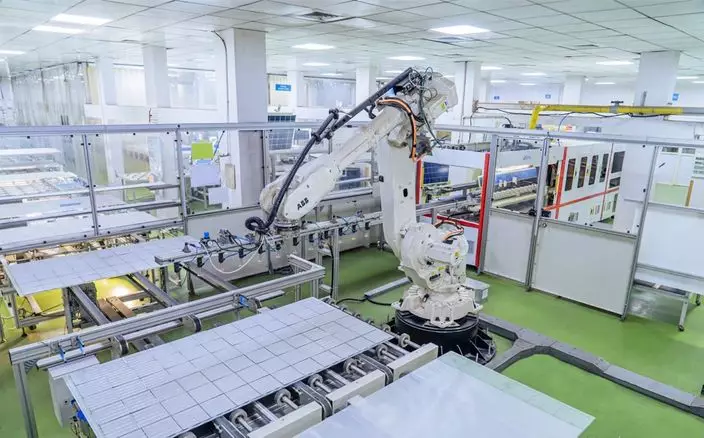
Taiqi Robot's automated PV module assembly line: robotic arms precisely maneuver solar cell components along the production line. (Source: Taiqi Robot official website)
Domestic expansion remains equally massive: in 2025, China added 317 GW of new photovoltaic capacity (up 14% year-on-year), bringing cumulative solar capacity past 1.2 billion kilowatts (1.2 TW), alongside 120 GW of new wind power capacity—a 51% surge.
A Redrawn Trade Map: Pivot from Europe to the Global South
The most profound transformation lies in the geographic realignment of exports. According to InfoLink statistics, China exported 4.41 GW of solar modules to Africa in March 2026—a 235% year-on-year surge. Export value to Southeast Asia jumped 267% year-on-year, with monthly import volumes to the Philippines nearly quadrupling.
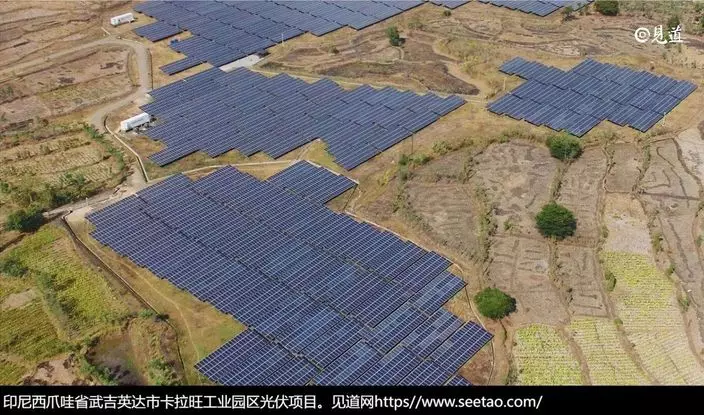
In West Java, Indonesia, the Karawang 100 MW photovoltaic plant—built by PowerChina Hubei Engineering—was commissioned in 2024 with 90% of its equipment sourced from China. The project set an overseas record of "5 months to initial grid connection and 7 months to full delivery," generating over 150 million kWh of clean electricity annually to power 112,000 local households while cutting carbon emissions by 114,700 tonnes per year.
Aerial view of the solar installation at the Bukit Indah Karawang Industrial Park in West Java, Indonesia, where blue module arrays contrast against the red terrain. (Source: Jiandao Net photo)
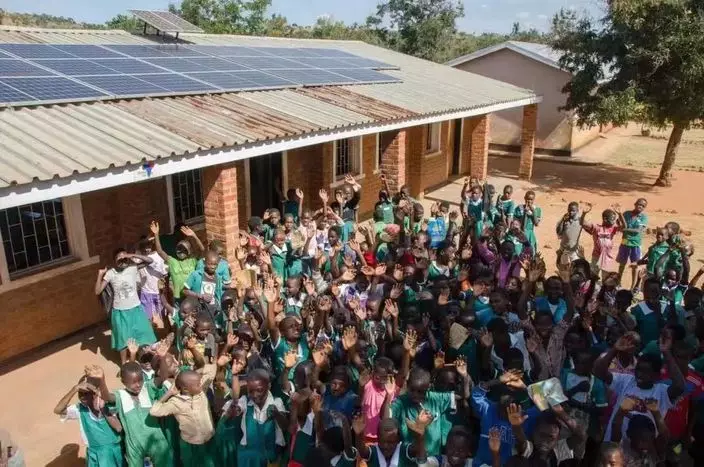
Across rural Africa, the "Africa Light Belt" initiative deploys distributed solar systems to supply reliable power for local schools, medical clinics, and homes—demonstrating how "small yet beautiful" livelihood projects are reshaping Sub-Saharan Africa's energy ecosystem.
A school rooftop in Africa lined with solar panels, as students cheer below. (Source: LONGi official photo)
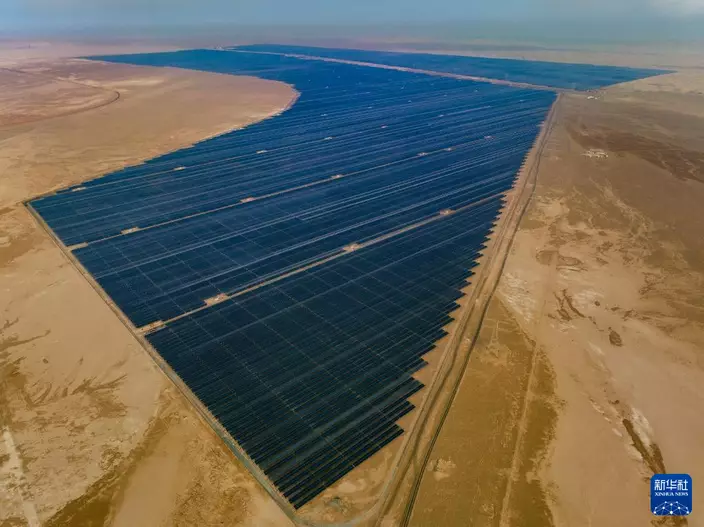
The Middle East market is accelerating fastest of all: PowerChina clinched a major contract in Abu Dhabi, UAE, for 2.1 GW of photovoltaics paired with 7.75 GWh of battery energy storage (BESS), valued at RMB 13.962 billion ($1.92 billion). This forms the northern block of the world's largest integrated solar-plus-storage complex (5.2 GW PV + 19 GWh storage). Groundbreaking took place in October 2025, with commercial operations slated for 2027.
An "energy oasis" in the Abu Dhabi desert: the Al Dhafra PV2 Solar Power Plant in the UAE. (Source: Xinhua photo)
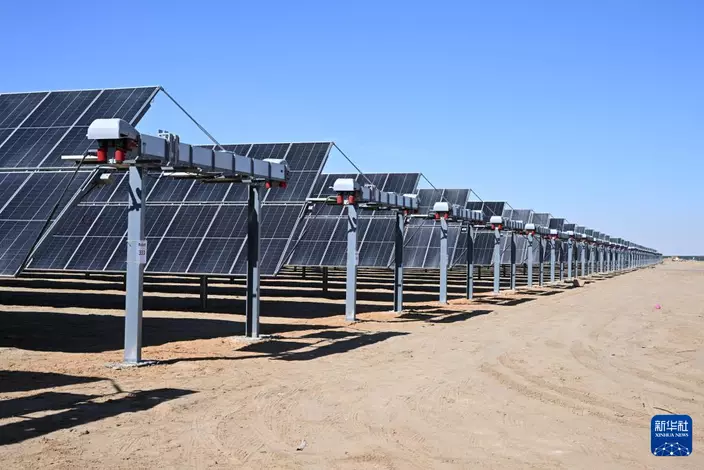
Automated cleaning robots maintaining solar panels in desert conditions. (Source: Xinhua photo)
From Exporting Hardware to Exporting Industrial Capabilities
An even fundamental structural shift is underway: Chinese exports of solar cells and silicon wafers are outpacing finished modules. Nations across the Global South are no longer content merely purchasing off-the-shelf panels; instead, they are importing raw cells to assemble locally, establishing indigenous solar manufacturing capabilities. This is the industrial thesis of "Chinamaxxing": rather than flooding markets with finished goods, China enables developing economies to build their own manufacturing bases along its technology roadmap.
Macroeconomic metrics underscore this shift: in the first half of 2026, clean-tech products accounted for 6.6% of China’s total exports, reaching $140 billion—rapidly approaching the combined export value of the traditional "old three" pillars (clothing, furniture, and home appliances).
Energy Security Is the Prerequisite for Economic Growth
Where China once exported toys, consumer electronics, and civil infrastructure, it now exports energy autonomy itself. Every time geopolitical shocks ripple through global energy markets, it reinforces a fundamental reality: solar power is the ultimate energy source capable of bypassing maritime chokepoints and vulnerable pipelines. Today, China stands as the only industrial power capable of supplying this "energy independence" at global scale and unmatched cost efficiency.
Crucially, energy security is never an end in itself—it is the prerequisite for economic development. Every fraction of a cent saved on electricity costs directly translates into expanded factory orders; every margin of grid stability bolsters the foundation of data centers, the electric vehicle ecosystem, and the entire manufacturing realm.
For the Global South, China’s green energy solutions provide precisely this dual-track path: liberating economies from the shackles of imported fossil fuels while delivering affordable clean power as an entry ticket to industrialization and job creation. Fifty nations setting record monthly import volumes represents the quietest yet most decisive vote of the year—as the global market casts an overwhelming vote of confidence in Chinese green manufacturing.