Serbia's student-led electoral list, "Student List - Students Are Winning," won 140 seats in the 250-member parliament, securing a clear majority in the Oct. 25 parliamentary election, the Republic Electoral Commission (RIK) announced on Thursday.
The electoral list led by President Aleksandar Vucic, "Aleksandar Vucic - United Serbia," came second with 103 seats, the commission said, adding that other lists entering parliament included minority lists representing ethnic Hungarians (two seats), ethnic Albanians (two seats) and ethnic Bosniaks (three seats).
A total of 4,441,636 voters cast ballots out of 6,451,292 registered voters, with the turnout standing at approximately 68.8 percent. The commission recorded 4,385,065 valid ballots and 56,571 invalid ones. Voting was conducted at 8,392 polling stations, according to the final results.
Outgoing parliamentary Speaker Ana Brnabic must convene a constitutive session of the new National Assembly within 30 days of the publication of the final results.
Under the Serbian constitution, the election of a new National Assembly will initiate the process of forming a new government.
After lawmakers elect a new parliamentary speaker, the speaker, who is currently serving as acting president, will nominate a candidate for prime minister. The nominee must present a government program and a proposed list of cabinet members and secure the support of a majority of National Assembly deputies to form a new government.

Serbia's student-led list wins parliamentary election with 140 seats

Serbia's student-led list wins parliamentary election with 140 seats
Chinese scientists have set a new record for the coldest temperature ever achieved by humans, cooling a cloud of rubidium atoms to 9.7 picokelvin, and keeping it stable for observation for seven seconds.
The result, announced by the Chinese Academy of Sciences' Technology and Engineering Center for Space Utilization on Friday, marks a major step toward absolute zero, the lowest temperature theoretically possible, creating the coldest artificial substance known to date. The work was published on Friday in the journal Science.
The experiment was carried out in the ultra-cold atom physics rack aboard China's space station. The project began feasibility studies in 2011, and its experiment system was launched with the Mengtian module in 2022. It was organized by the Technology and Engineering Center for Space Utilization under the CAS, while completed by Beijing University and the Shanghai Institute of Optics and Fine Mechanics (SIOM) of the CAS.
They cooled a rubidium atom cloud to an equivalent temperature of 9.7 picokelvin, 14 orders of magnitude below the roughly 300 kelvin room temperature on Earth, and kept it stable for observation for seven seconds. The result broke the previous record of 38 picokelvin, set by a German team in 2021.
"We have mastered the whole technology chain for deep cooling of ultracold atoms, allowing atoms to reach the picokelvin level. This shows that our engineering capability in deep atomic cooling is up to the world advanced level," said Chen Weibiao, Party secretary of SIOM.
On Earth, gravity pulls atoms downward, making it hard to cool them sufficiently. In the microgravity environment of China's space station, atoms could float freely and reach far lower temperatures without strong external confinement. The Chinese research team remotely controlled the space station's equipment from the ground to make the breakthrough, said the CAS center.
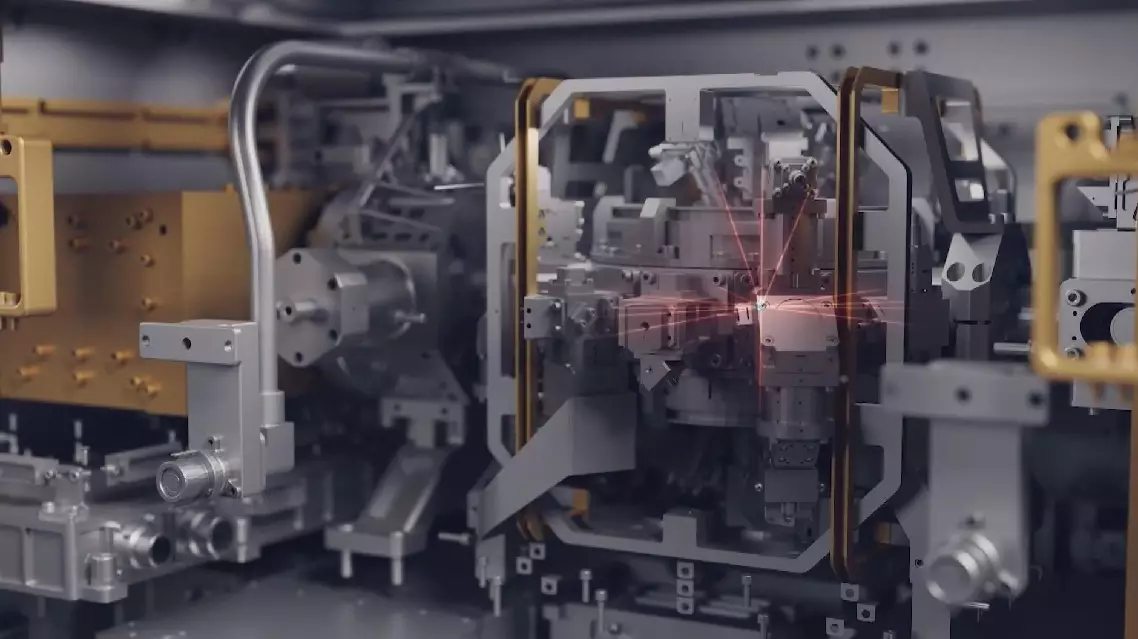
China sets world record for coldest temperature aboard space station