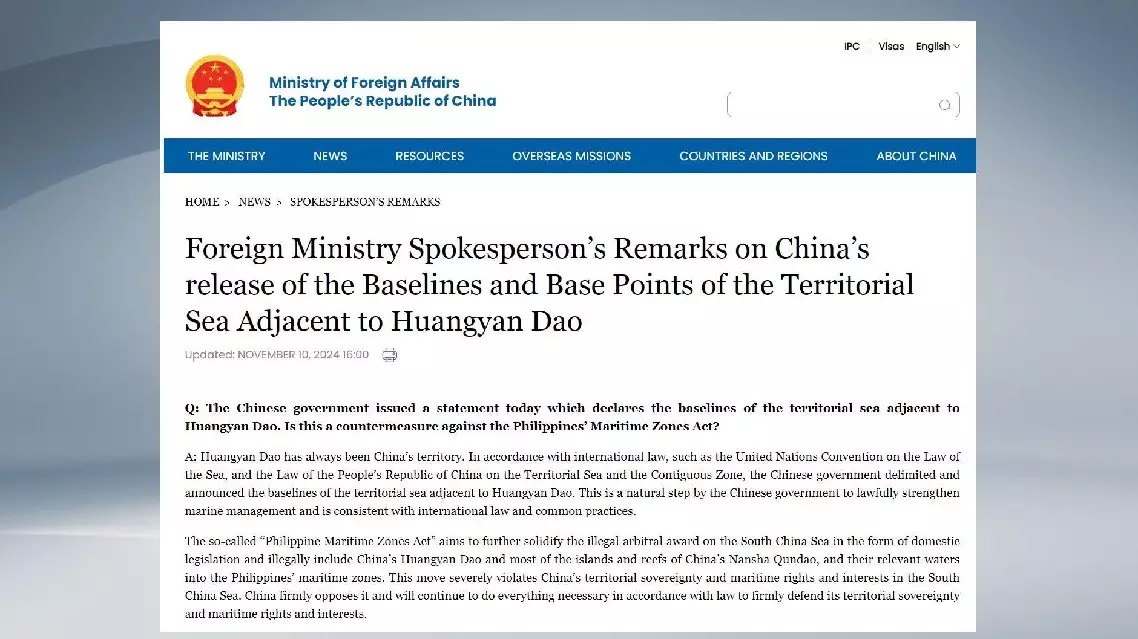
The Chinese government's announcement of the baselines, base points of the territorial sea adjacent to Huangyan Dao is a normal move to strengthen ocean management, and is in line with international law, said a foreign ministry spokesperson.
The Chinese government issued a statement on Sunday, releasing the baselines and base points of the territorial sea adjacent to Huangyan Dao.
Commenting on the issue, a spokesperson of the Chinese Ministry of Foreign Affairs said that the act is in line with international law.
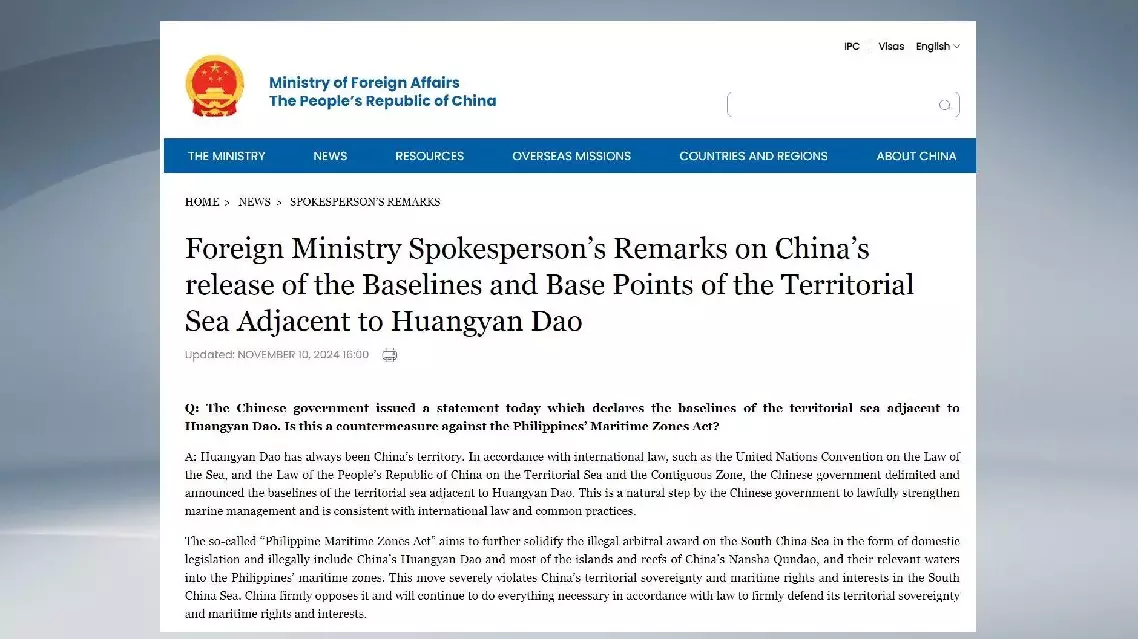
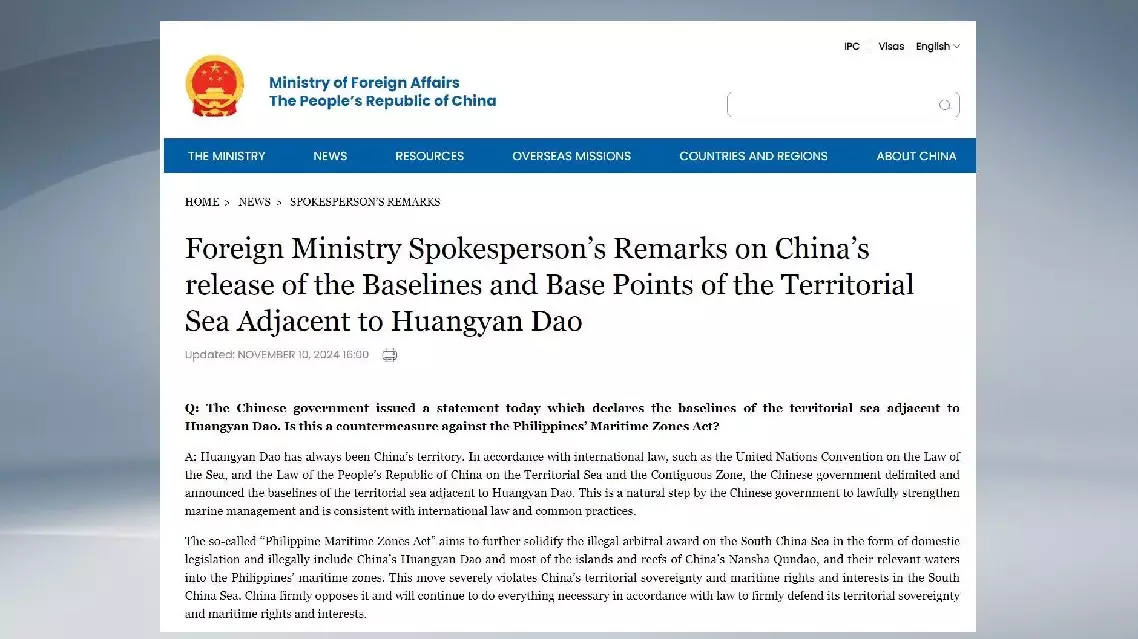
Noting that Huangyan Dao is China's inherent territory, the spokesperson said that the Chinese government has demarcated and announced the baselines of the territorial sea adjacent to Huangyan Dao in accordance with international laws including the United Nations Convention on the Law of the Sea and the Law of the People's Republic of China on the Territorial Sea and the Contiguous Zone.
This is a normal measure taken by the Chinese government to strengthen marine management in accordance with the law and is in line with international law and international practice, said the spokesperson.
The spokesperson also stressed that China strongly rejects the so-called Philippine Maritime Zones Act and Archipelagic Sea Lanes Act, which bolster the country's maritime claims in the South China Sea.
The Philippines enacted the so-called Maritime Zones Act in an attempt to solidify the illegal ruling of the South China Sea arbitration case in the form of domestic legislation, and illegally incorporate China's Huangyan Dao and most of the islands and reefs of the Nansha Qundao and related waters into its maritime zones, which seriously infringe on China's territorial sovereignty and maritime rights and interests in the South China Sea, the spokesperson said.
China firmly rejects this and will continue to take all necessary measures in accordance with the law to firmly defend its national territorial sovereignty and maritime rights and interests, said the spokesperson.
China to strengthen management of territorial sea around Huangyan Dao: FM spokesperson
China to strengthen management of territorial sea around Huangyan Dao: FM spokesperson
China to strengthen management of territorial sea around Huangyan Dao: FM spokesperson
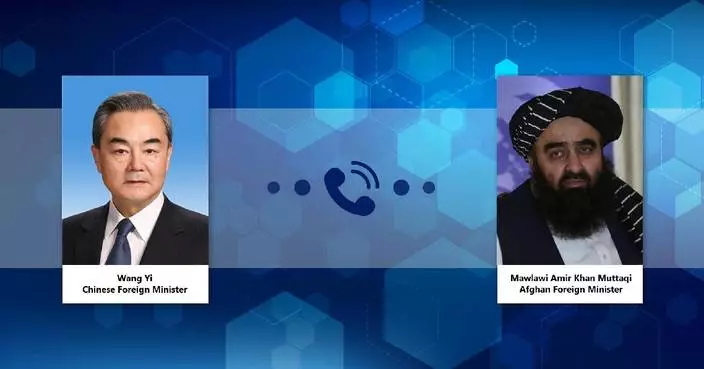
Chinese Foreign Minister Wang Yi said on Friday that both China and the Netherlands being committed to promoting mutually beneficial cooperation in an open and pragmatic spirit is in line with the shared interests of the two sides.
This is also conducive to the sound development of China-European Union (EU) relations as well as the security and stability of the global industrial and supply chains, he said.
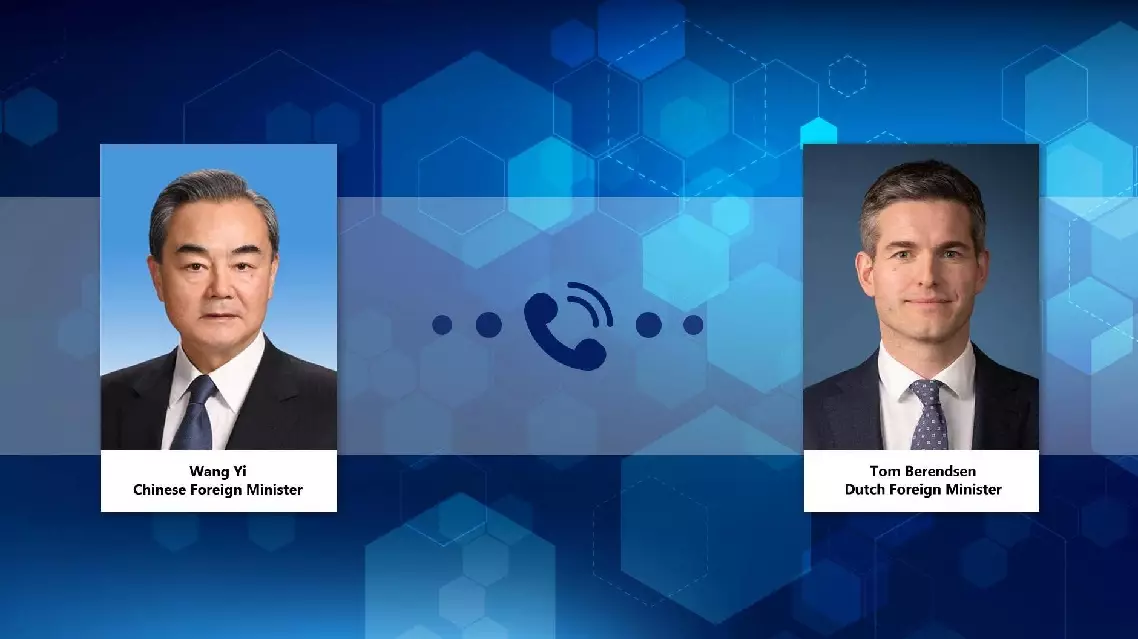
Wang, also a member of the Political Bureau of the Communist Party of China Central Committee, made the remarks in a phone conversation with Dutch Foreign Minister Tom Berendson at the latter's request.
Wang congratulated Berendson on his assuming office as the Netherlands' new foreign minister and said that China and the Netherlands are important partners of cooperation to each other.
China appreciates the positive signal released by the new Dutch government of valuing its relations with China, he said, noting that China's foreign policy maintains coherence and stability, and that China is willing to work with the Netherlands to strengthen exchanges and communication, promote mutual understanding and trust, and consistently deepen their open and pragmatic partnership for comprehensive cooperation.
Wang briefed his Dutch counterpart on the outcomes of China's just concluded "two sessions," noting that China will remain committed to opening wider to the outside world and expanding institutional opening-up, bringing more opportunities to countries around the world, including the Netherlands.
China-Netherlands economic and trade cooperation enjoys mutual complementarity of advantages, mutual benefit and win-win results, Wang noted.
He expressed hope that the new government of the Netherlands will take on a new look and new challenges, adhere to independence and self-autonomy, and support the normal economic and trade exchanges between enterprises of the two countries.
It is hoped that the Dutch side would push EU institutions to understand China in an objective and rational manner, and adhere to the positioning of partnership and open cooperation between China and the EU, Wang said.
For his part, Berendson said the new government of the Netherlands speaks highly of the achievements China has made in its rapid development, and regards the relations with China as one of its most important bilateral relationships.
Berendson said his country is willing to keep high-level exchanges with China, leverage bilateral mechanisms such as the political consultation between foreign ministries and the mixed economic and trade committee, increase dialogue and exchanges at all levels, deepen the pragmatic cooperation in climate change, water resource management and other areas, and jointly defend multilateralism, consistently advancing the bilateral open and pragmatic partnership for comprehensive cooperation to new levels.
The Dutch side is willing to play a constructive role for the sound and steady development of EU-China relations, he said.
The two sides also exchanged views on issues including the Ukraine crisis.
China-Netherlands mutually beneficial cooperation in line with common interests: Chinese FM