Chinese scientists have made multiple technological improvements for the Long March-5B carrier rocket, thus ensuring the successful launch of the first group of low Earth orbit satellites for a satellite internet constellation.
At the Wenchang Space Launch Site in southern Hainan Province on Monday, the group of satellites was launched by a Long March-5B carrier rocket with a Yuanzheng-2 (Expedition-2) upper stage atop the rocket. The satellites have entered the preset orbits.
As the first multi-satellite launch for the Long March-5B carrier rocket, the mission places high demands on separation technology for satellites.
"To address this problem, we have developed a new type of capture buffer device, which functions as a shock-absorbing buffer during the separation process. It can significantly reduce the impact load environment and ensure the successful completion of this mission," said Zhu Haiyang with the China Aerospace Science and Technology Corporation (CASC).
For this mission, the rocket underwent 20 technological improvements, further enhancing its adaptability and reliability.
The multi-satellite launch mission requires the rocket to deliver each satellite to its own designated point, which is fulfilled with the help of the Yuanzheng-2 upper stage.
Just like a ferry to transport passengers, the upper stage, assembled with their passengers -- satellites, is sent to a designated position by the rocket at first, and then deliver satellites to their desired destinations after a long-duration flight.
"The upper stage can carry multiple passengers, which allows it to save fuel for the satellites during the orbital insertion process and shorten the orbital insertion period. This enables the satellites to enter orbit more efficiently and quickly for operation," said Zhang Xinyu with the CASC.
The Yuanzheng-2 is China's largest liquid-fuel upper stage with the strongest capability for orbit transfer.
As early as 2016, the integration of Yuanzheng-2 with Long March-5 carrier rocket sent Shijian-17, a satellite for verifying new technology in geostationary orbit, into its designated orbit, marking the successful completion of the Long March-5 rocket's maiden flight mission.
In addition, the Long March-5B rocket is equipped with a fault diagnosis and handling system for the first time, making the rocket smarter and more reliable.
"Once its condition is diagnosed, its remaining capabilities can be further evaluated to determine which orbits it can still reach and reprogram the flight profile, thus greatly enhancing flight reliability of the Long March-5 series rockets, and also supporting the intelligent upgrades for the next generation of carrier rockets," Zhu said.
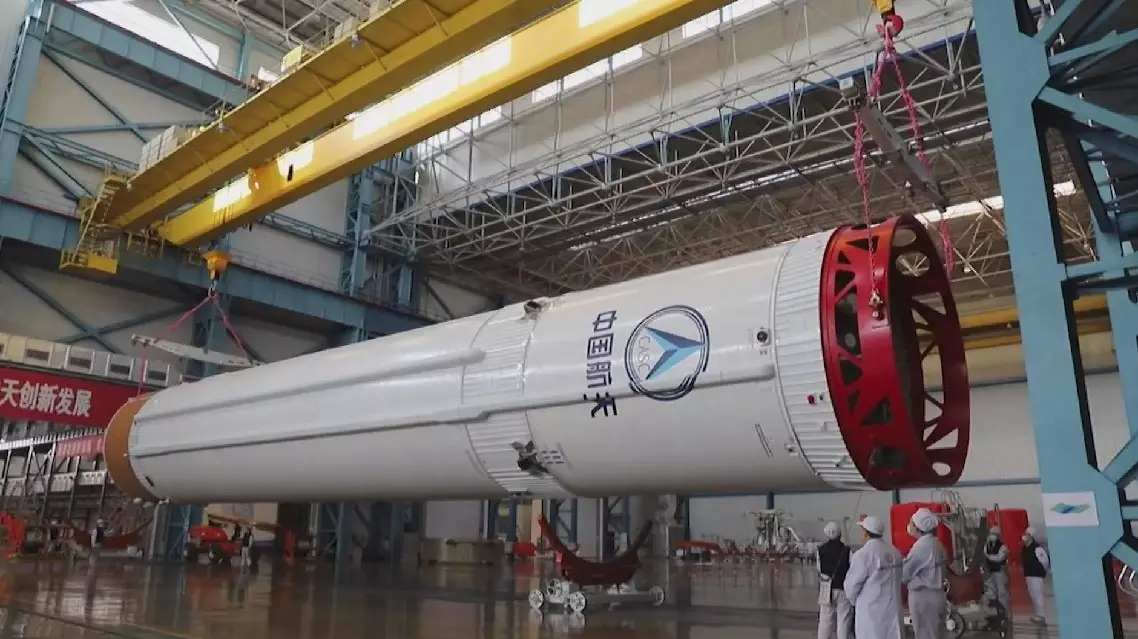
Multiple technological improvements permit successful launch of satellite group