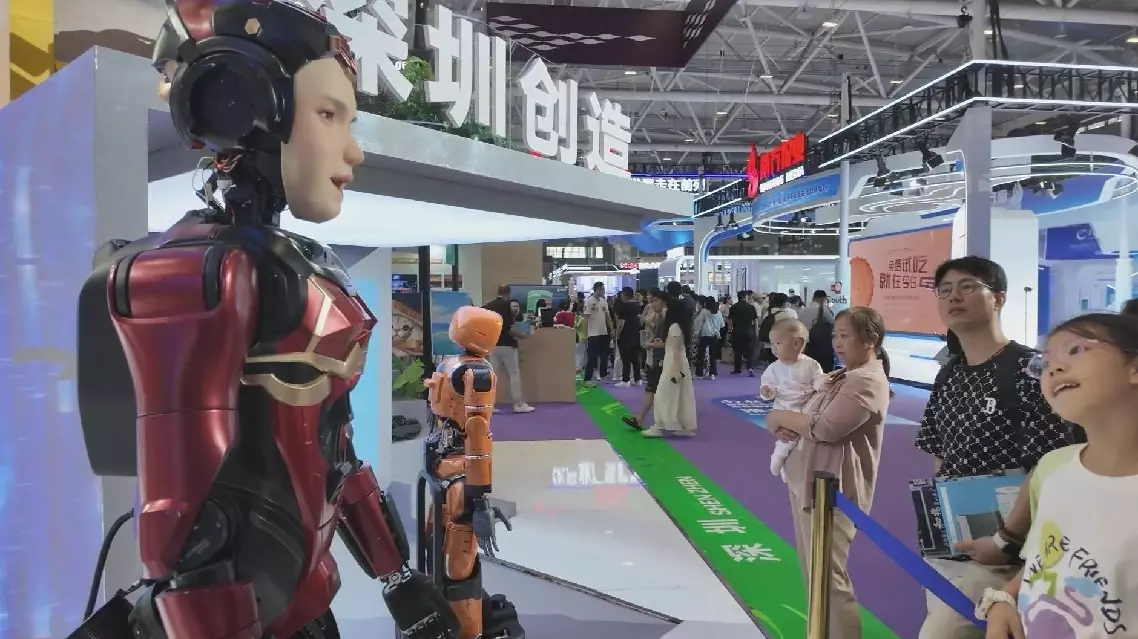
The 21st China (Shenzhen) International Cultural Industry Fair (ICIF), now underway in China's southern city of Shenzhen, is spotlighting cutting-edge artificial intelligence (AI) innovations, with a dedicated exhibition zone offering immersive demonstrations of technologies reshaping industries and daily life.
The newly launched AI section features products ranging from multi-form bipedal robots and AI-powered photography glasses to virtual reality (VR) systems.
One standout exhibit, a one-stop three dimensional (3D) content creation platform, allows users to input simple commands to generate detailed 3D models. These designs are then processed through an automated workflow and materialized via 3D printers within minutes.
"Here at the expo I feel that these advanced technologies have been part of our daily life. I hope that more technological innovations will be applied to our work and life in the future," said Guan, a visitor.
The event also highlights functional AI robots performing tasks. Some service robots are guiding the route for visitors, and translator robots are interpreting languages in real time.
Certain robots even showcased artistic skills. Demonstrations include piano-playing robots, chess matches against humans, and machines capable of calligraphy and painting.
"Robots can be used to extinguish fire in high buildings. I think things like this this can greatly change our life," said Luo, a visitor.
A total of 6,280 government delegations, cultural institutions, and enterprises are participating in the event either online or offline, an increase of 265 over the previous session, welcomed by 3,300 exhibitors at the fair.
Established in 2004, the China (Shenzhen) International Cultural Industries Fair has become a leading cultural event in China and an important platform to help Chinese culture go abroad.
AI-oriented robots, 3D innovation technologies take center stage at cultural industry fair
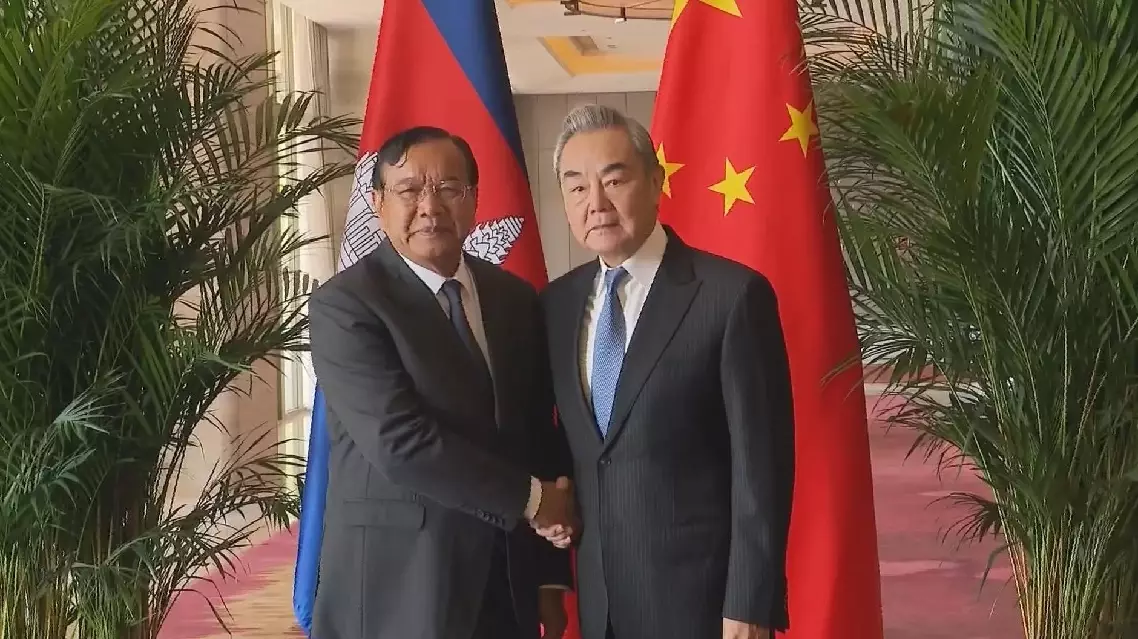
China is willing to provide humanitarian assistance to Cambodia to help resettle displaced people in border areas, Chinese Foreign Minister Wang Yi said on Sunday in Yuxi, southwest China's Yunnan Province.
Wang, also a member of the Political Bureau of the Communist Party of China Central Committee, made the remarks during a meeting with Prak Sokhonn, Cambodian Deputy Prime Minister and Minister of Foreign Affairs and International Cooperation.
Following the signing of a joint statement agreeing to a ceasefire, the Cambodian and Thai foreign ministers are leading delegations meeting in Yunnan from Dec. 28 to 29 at Wang's invitation.
China has been closely following the tense situation on the Cambodia-Thailand border and remains committed to facilitating peace through talks, Wang said, adding that China congratulates both sides on reaching a ceasefire agreement.
The ceasefire marks the beginning of peacebuilding, Wang said, calling on the two sides to proceed in a phased and measured approach to promote a comprehensive and lasting ceasefire, restore normal interactions, rebuild mutual trust, achieve turnaround in bilateral relations, and uphold peace and stability in the region.
He said that both countries can make good use of this face-to-face opportunity for diplomatic and military representatives to engage in dialogue and communication in a flexible manner, enhance mutual understanding, and build mutual trust. He also expressed hope that all sides would jointly send a message of peace from Yunnan, reach a consensus on peace, and demonstrate prospects for peace.
China supports ASEAN in playing its due role and stands ready to provide assistance to the ASEAN observation mission in monitoring the ceasefire, Wang said.
He added that China also hopes Cambodia will continue to enhance protection for Chinese citizens and projects in the country.
Cambodia highly values China's positive role in mediating the conflict, said Prak Sokhonn, citing the informal tea gathering among the foreign ministers of Cambodia, China and Thailand in Anning, Yunnan Province, as well as shuttle diplomacy conducted by China's special envoy.
Thanks to the joint efforts of China and other parties, Cambodia and Thailand were able to convene a meeting of the Joint Boundary Commission, and their militaries signed a ceasefire agreement, he said.
Sokhonn said Cambodia is ready to work with Thailand to fully implement the ceasefire agreement, make full use of existing dialogue mechanisms, and steadily build mutual trust between the two countries and their armed forces.
These steps, he noted, are vital to restoring bilateral exchanges, normalizing relations, and resolving the boundary issue at an early date.
Cambodia hopes for the early arrival of peace and expects the trilateral meeting to help rebuild lasting stability, he said.
The two sides also exchanged views on China-Cambodia relations, agreeing that under the strategic guidance of the leaders of the two countries, positive progress has been made in building an all-weather Cambodia-China community with a shared future in the new era.
The Cambodian side expressed gratitude for China's support and assistance to its development, describing China as its most reliable and trusted partner. It reaffirmed its adherence to the one-China principle, its opposition to Taiwan secessionism, and its support for China's reunification cause.
China will deliver humanitarian aid to Cambodia for displaced people along border: Chinese FM