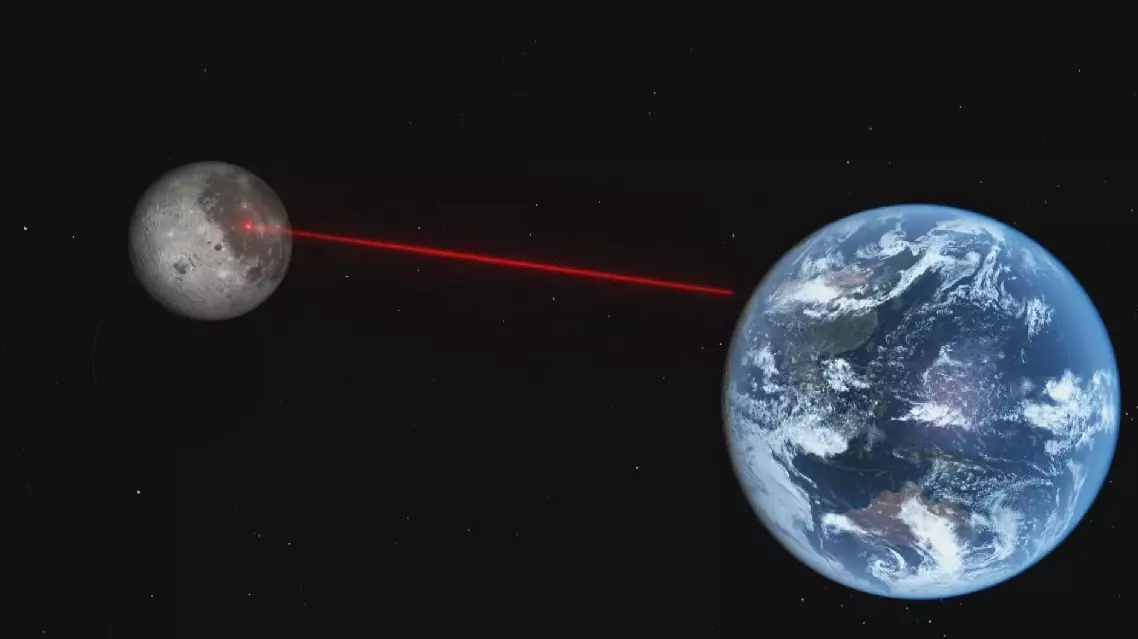
Chinese scientists detected the echo signal from the next-generation lunar retroreflector NGLR-1 for the first time and thus confirmed the success of the ranging experiment on Wednesday.
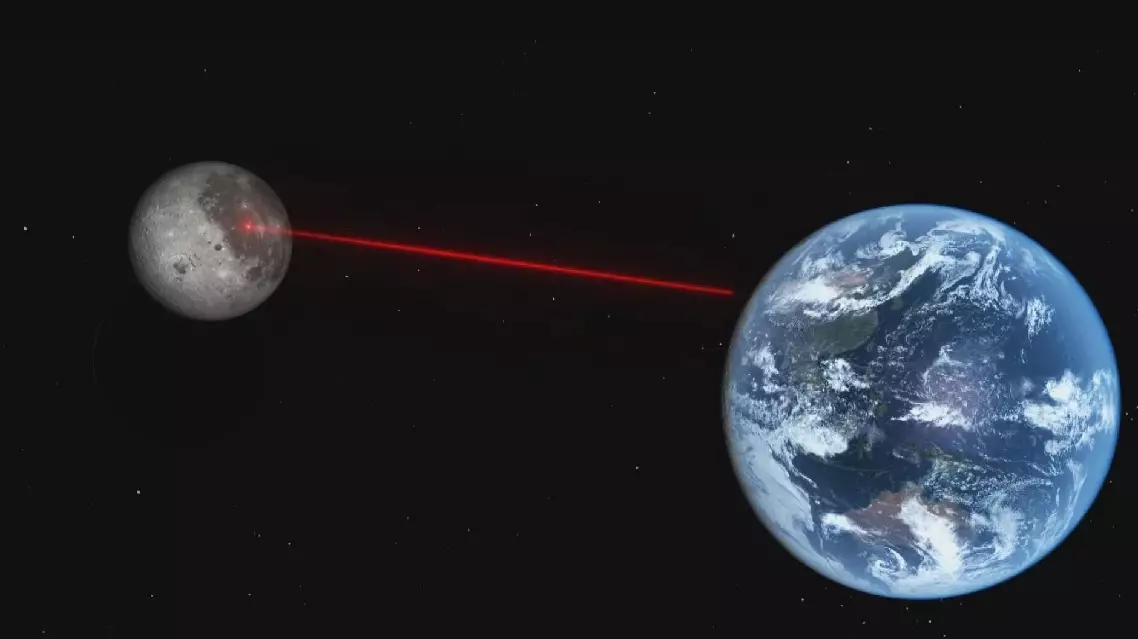
In the early hours of Wednesday, scientists at the Tianqin laser ranging station of Sun Yat-sen University in Zhuhai City, south China's Guangdong Province, detected the laser echo signal from the NGLR-1 and successfully obtained 38 distance measurements from the retroreflector several hours later, confirming the success of the ranging experiment.
Click to Gallery
Chinese scientists detect echo signal from next generation lunar retroreflector for 1st time
Chinese scientists detect echo signal from next generation lunar retroreflector for 1st time
Chinese scientists detect echo signal from next generation lunar retroreflector for 1st time

Chinese scientists detect echo signal from next generation lunar retroreflector for 1st time
Chinese scientists detect echo signal from next generation lunar retroreflector for 1st time
Their success makes China the fourth country to achieve such a measurement, following France, Germany, and the United States.
In the last century, the U.S. and the Soviet Union placed five laser reflector arrays on the moon for lunar measurements. The NGLR-1 was deployed to the moon by the U.S. in March this year.
"Using ground-based observatories, we sent laser pulses to the retroreflector placed on the lunar surface. By accurately measuring the round-trip time of these laser pulses, we can determine the distance between the Earth and the Moon. The new retroreflector can provide more accurate distance measurement data. The data we collected will provide important new support for testing general relativity and gravitational theories, lunar physics, and the dynamical evolution of the Earth-Moon system," said Lin Xudong, a professor at the Tianqin laser ranging station.
This achievement is part of the progress of the Tianqin project, a space gravitational wave detection project proposed in 2014. It is expected to deploy three satellites in an approximately 100,000-kilometer-high Earth orbit by around 2035, forming an equilateral triangle constellation with a side length of about 170,000 kilometers. This constellation will establish a space gravitational wave observatory for cutting-edge research in fundamental physics, astrophysics, and cosmology.
Chinese scientists detect echo signal from next generation lunar retroreflector for 1st time
Chinese scientists detect echo signal from next generation lunar retroreflector for 1st time
Chinese scientists detect echo signal from next generation lunar retroreflector for 1st time
Chinese scientists detect echo signal from next generation lunar retroreflector for 1st time
Chinese scientists detect echo signal from next generation lunar retroreflector for 1st time