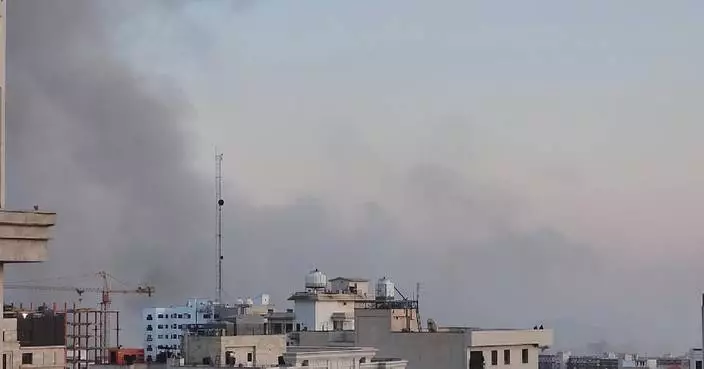
Poisonous air is affecting millions of lives in Delhi as emissions from vehicles and other sources fill India's capital city.
The air quality index (AQI) recently hovered above 400 at multiple monitoring stations across the country for days, ranking in the "severe" category. On Monday, Delhi's air quality remained severe, with an AQI of 382.
Fifth-grade student Rahul Dayal has been struggling to breathe for weeks as Delhi's air quality plunges into the hazardous range. His father says he feels helpless, with few options to ease his son's worsening condition.
"My child's studies are being affected because of his condition, which has worsened due to pollution, making it difficult for him to attend school. Pollution has a serious impact on our lives and causes significant harm," said Ram Dayal, the patient's father, after taking his son to see the doctor on Nov 17, the day when the AQI reading exceeded 380.
"Some of the pollutants that enter your lungs may never come out of your lungs, so over a period of five, 10, 20 years, the situation remaining the same, your lungs will definitely be clogged with those elements," said Ashok Chakravarty, a pediatrician.
The smog that has engulfed Delhi consists of vehicular emissions, construction dust, industrial emissions and particles from open fires to burn waste or clear agricultural lands.
"The pollution problem has become worse in the last few years or I would say in the last one and half decade, mainly because the number of people living in this area have gone up and you have actually uncontrolled emissions from almost all sources. So emission is increasing at a much faster rate," said Prof. Sagnik Dey, head of the Center for Atmospheric Sciences under the Indian Institutes of Technology.
"We don't have an emission tax, we don't have congestion taxes, we don't have low-emission zones. So there is nothing because everything that the city's doing is for the cars. It's not prioritizing people; it's not prioritizing trees. So that approach needs to change," said Bhavreen Kandhari, an environmental activist.
Authorities have also blamed Delhi's geography and weather conditions for the worsening AQI.
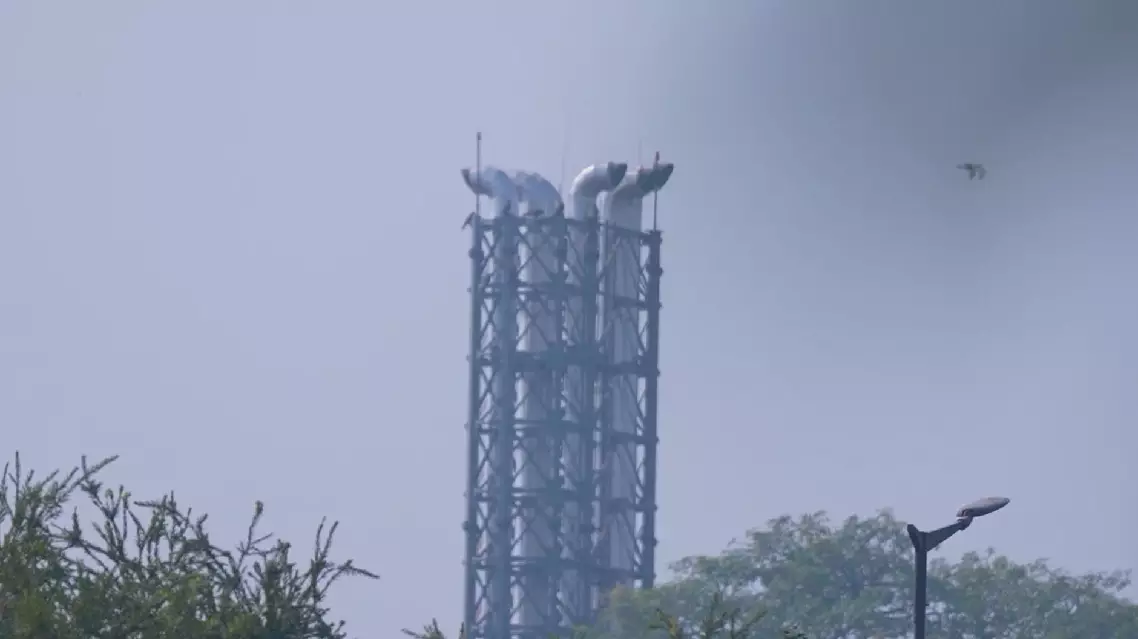
Health concerns rise in Dheli as air pollution worsens