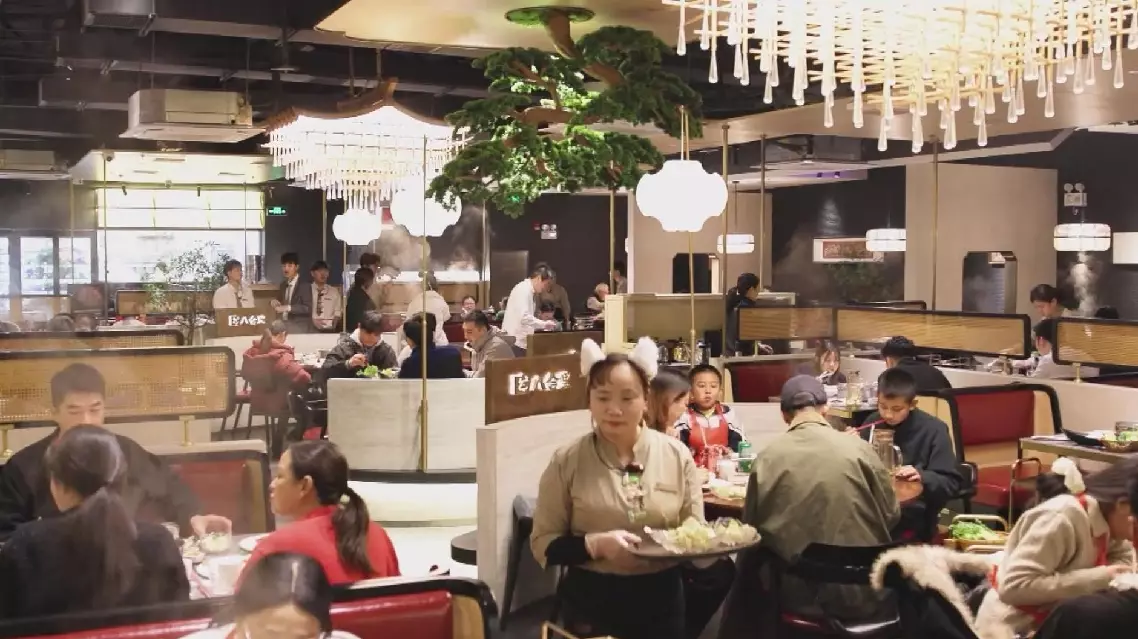
As the year of 2026 approaches, restaurants in south China's Guangdong Province have witnessed a booking craze for New Year's Eve dinners, demonstrating the vigorous vitality and resilience of the local consumer market.
The year-end spending heat has swept over not only popular restaurants but also local specialty food stores.
At a bustling restaurant in Guangdong's capital city of Guangzhou, the front desk phone was seen ringing incessantly with reservation inquiries, while staff busily verify orders and confirm seating arrangements. In the kitchen, chefs have already begun prepping ingredients, fully prepared for the impending rush of customers.
"Reservations for New Year's Eve and New Year's Day have been completed, with booking rates up 50 percent compared to regular days. In addition to local residents and tourists from other provinces, many international guests have also made reservations in advance. The customer traffic on New Year's Eve is expected to increase by 30 percent to 40 percent over daily averages," said Huang Yue, a restaurant manager.
The convenient online reservation combined with attentive service at stores has made restaurants increasingly popular for celebrating special occasions. A New Year's Eve dinner has long transcended mere dining needs. It embodies people's hopes for welcoming the new, as well as their cherishing of moments spent with loved ones.
Industry insiders say that holiday spending is emerging as an important engine driving market growth.
"As the holiday draws near, people's enthusiasm for consumption at the turn of the year has kept surging. It is expected that on New Year's Eve, the sales of chain restaurants on our lifestyle service platform will reach a new peak. Compared with regular days, the dine-in consumption will increase by about 60 percent, while the order volume is anticipated to double compared to last year," said Yu Xiaowen, head of an online platform.
Guangdong restaurants witness booking craze for New Year’s Eve dinners
Panchen Erdeni Chos-kyi rGyal-po, more commonly known as Panchen Rinpoche and a leader of Tibetan Buddhism, has completed a six-month tour of southwest China's Xizang Autonomous Region, during which he performed regular duties, conducted research and surveys, and participated in various Buddhist and social activities.
During his tour, Panchen Rinpoche, a member of the Standing Committee of the National Committee of the Chinese People's Political Consultative Conference and vice president of the Buddhist Association of China, attended celebrations marking the 60th anniversary of the founding of the Xizang Autonomous Region in the regional capital Lhasa in August.
He then visited the prefecture-level cities of Qamdo, Nagqu, and Xigaze to conduct field research, gaining insights into rural revitalization, the development of harmonious and beautiful highland villages, and the advancement of Tibetan medicine.
He also traveled to Dingri County in Xigaze to learn about post-quake reconstruction progress and assess local residents' living conditions after a 6.8-magnitude earthquake hit the county in January.
At the Tashilhunpo Monastery in Xigaze, his traditional seat, Panchen Rinpoche presided over the Kalachakra (wheel of time) ritual and attended both the 30th-anniversary commemoration of his enthronement and a symposium on the reincarnation system of Tibetan Buddhist Living Buddhas.
Over the past three decades since his enthronement, Panchen Rinpoche has upheld Tibetan Buddhism's proud tradition of patriotism and devotion to faith. His Buddhist scholarship has grown ever more profound, earning him deep affection and respect from monastics and devotees alike.
He has made significant contributions to promoting ethnic unity, religious harmony, and Xizang's social stability and development.
As president of the Xizang branch of the Buddhist Association of China, Panchen Rinpoche also convened a series of work meetings of the branch, visited major monasteries including the Jokhang Temple in Lhasa, and held extensive discussions with leaders and practitioners across the Tibetan Buddhist community.
He encouraged monastics to actively engage in the new journey toward Chinese modernization, and to play a greater role in advancing the adaptation of Tibetan Buddhism to socialist society, fostering a stronger sense of the Chinese nation as one community, and jointly writing a new chapter for a more beautiful Xizang.
Panchen Rinpoche concludes six-month tour of Xizang