A23a, once the world's largest iceberg, has entered the final stage of its life, having shrunk to less than one-eighth of its original size, according to the China Meteorological Administration (CMA).
The latest true-color imagery from the Fengyun-3D (FY-3D) satellite reveals that the main body of A23a now covers an area of only 503 square kilometers. This is a dramatic reduction from just a few weeks ago when it measured 948 square kilometers. Since breaking off from the Antarctic ice shelf in 1986 with an area of 4,170 square kilometers, A23a has spent nearly four decades journeying from its birth to its impending demise.
In the cold waters approximately 250 kilometers west of South Georgia Island, at 52.75 degrees south latitude and 41.34 degrees west longitude, the nearly 40-year evolution of the iceberg is drawing to a close. Experts from the National Satellite Meteorological Center (NSMC) of the CMA have been continuously tracking the drift path of A23a since 2023 and its disintegration process since the beginning of 2025, utilizing the Medium Resolution Spectral Imager aboard China's FY-3 series satellites.
The latest monitoring indicates a significant split that occurred at the start of 2026. On Jan. 8, the main body of the iceberg was still largely intact, with only minor surface cracks. By Jan. 9, it had clearly fractured into four main parts. Debris and ice that toppled into the ocean quickly filled the gaps, pushing the main body and its fragments further apart. The separation accelerated in the following days. By Jan. 14, clear channels of water had formed between the main body and the three largest sub-icebergs, signaling their complete separation.
Experts pointed to a process known as hydrofracturing as the primary cause of the iceberg's rapid structural failure.
"Meltwater continuously accumulates, creating immense pressure at the edges and forcing new cracks onto the ice body. The meltwater then seeps down along the cracks, scouring them, and even cascades down the ice walls. This continuous scouring widens the cracks, acting like a wedge that constantly splits the ice body. This is the key factor leading to the rapid disintegration of the iceberg's structure. At the same time, the water temperature of 3-4 degrees Celsius, carried by ocean currents, scours the bottom of the iceberg, thinning it and accelerating its instability," said Zheng Zhaojun, chief expert of the NSMC's International User Service Center.
The A23a iceberg will likely disintegrate completely within the next few weeks. The remaining iceberg fragments and floating ice, currently scattered over an area of approximately 1,439 square kilometers, now pose a significant navigational hazard in the coming months.
Currently, it is summer in the Southern Hemisphere. The relatively clear weather and rising air and water temperatures in the iceberg's vicinity are further accelerating its breakup.
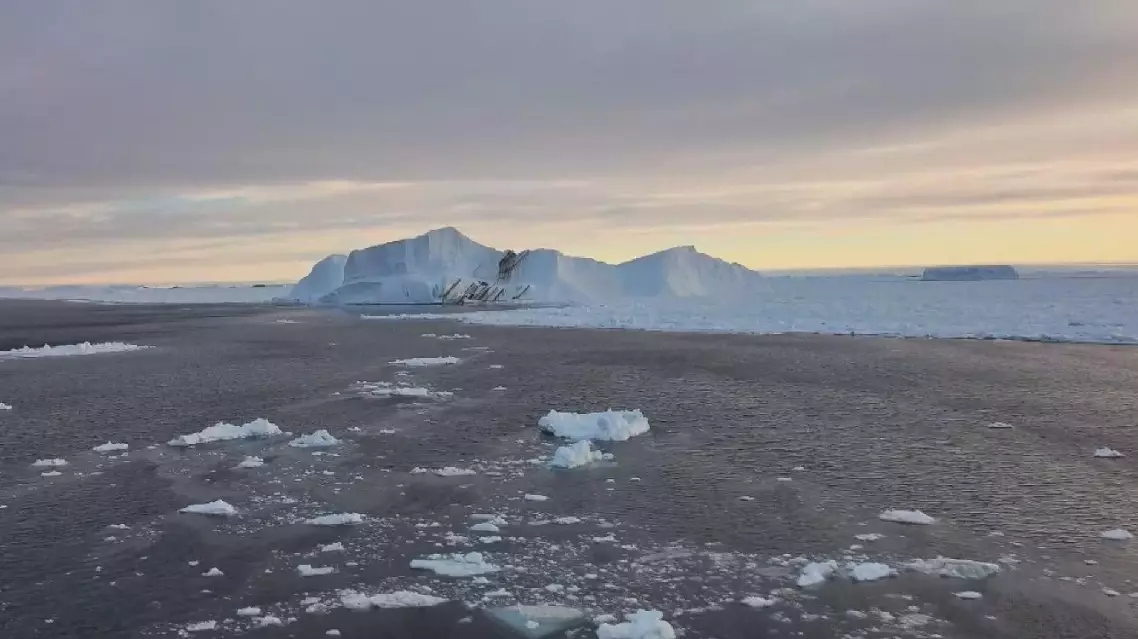
World's formerly largest iceberg enters final stage of disintegration
World's formerly largest iceberg enters final stage of disintegration