

Author: Member of the Legislative Council, Dr. Lee Hoey Simon
Under the joint initiative of Legislative Council Members Hon Maggie Chan Man-ki, Dr Hon Thomas So Shiu-tsung, Hon Wu Yingpeng, Dr Hon Hoey Simon Lee, law students from Kathmandu University and Tribhuvan University in Nepal recently came to Hong Kong to participate in the annual International Commercial Arbitration Moot Court Competition, and jointly organized the "A Young Chat of the Rule of Law and Social Development of Nepel since the BRI". Dr Bindeswar Prasad Lekhak, Consul-General of Nepal to HKSAR, attended the seminar. The event was supported by Regal Hotels Group, China Resources Group, Tseng Hin Pei Charity Fund Limited, and Basic Law Foundation, among other organizations.
Click to Gallery
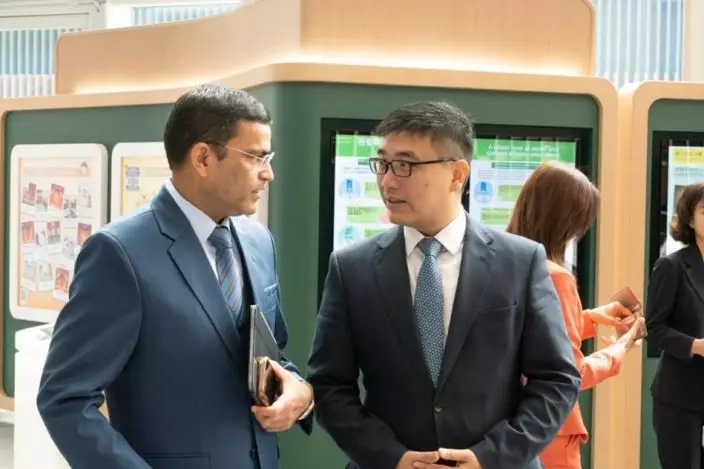
Legislative Councillor Dr Simon Lee and Consul-General Dr Lekhak (left) exchanged views at the Hong Kong Legislative Council
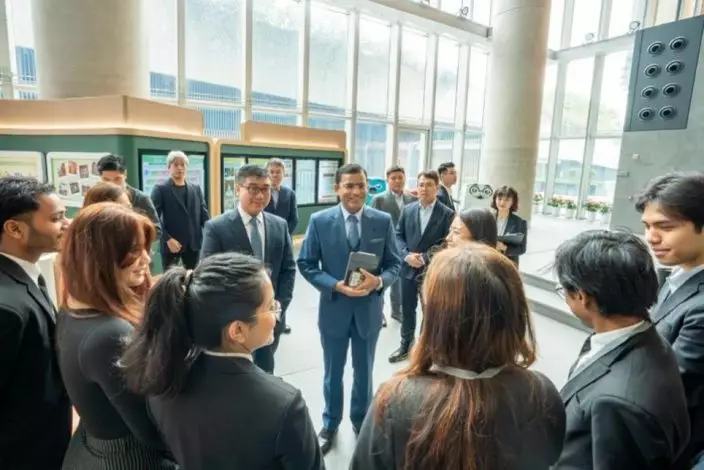
Legislative Councillor Dr Simon Lee and Consul-General Dr Lekhak (front row right) exchanged views with law students from two Nepalese universities at the Hong Kong Legislative Council
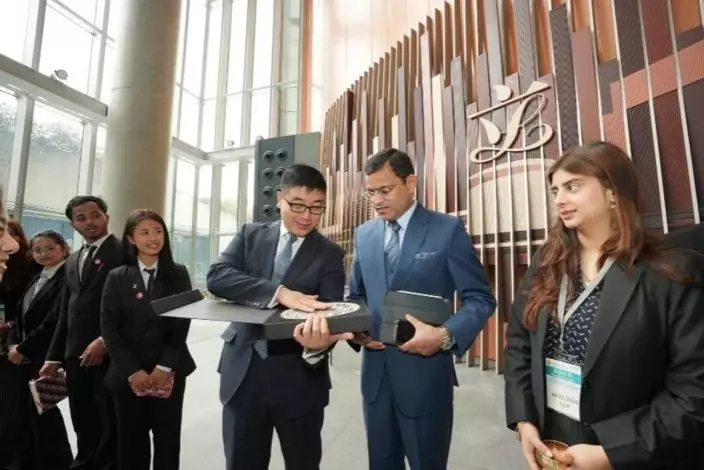
Councillor Dr Simon Lee presents Legislative Council souvenirs prepared for Consul-General Dr Lekhak (second from right)
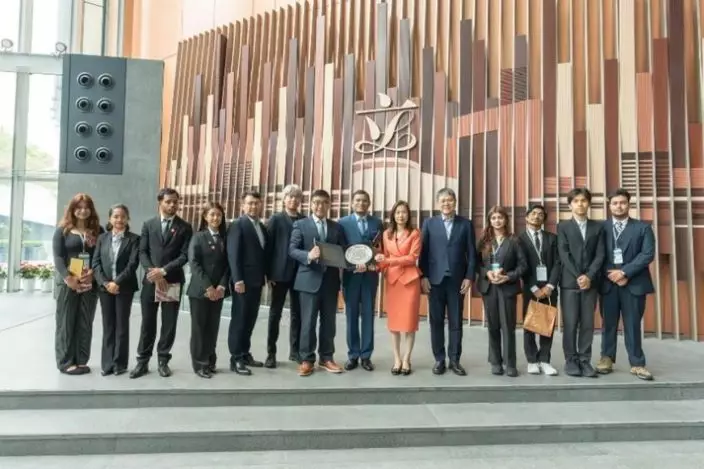
China Resources Group Senior Group Legal Counsel Johnny Ip Chun-yuen (fifth from left), Tseng Hin Pei Charity Fund Limited Representative Riley Tseng Fanwei (sixth from left), Legislative Council Member Dr Hon Hoey Simon Lee, Consul-General of Nepal to HKSAR Dr Bindeswar Prasad Lekhak (eight from left), Legislative Council Member Hon Maggie Chan Man-ki, Member of the Guangzhou Municipal Committee of the CPPCC and Chairman of the Supervisory Board of the Guangdong-Hong Kong-Macao Greater Bay Area International Maritime and Commercial Mediation Center Tan Guojian (tenth from left), pose for a group photo with law students from two Nepalese universities at the Hong Kong LegCo
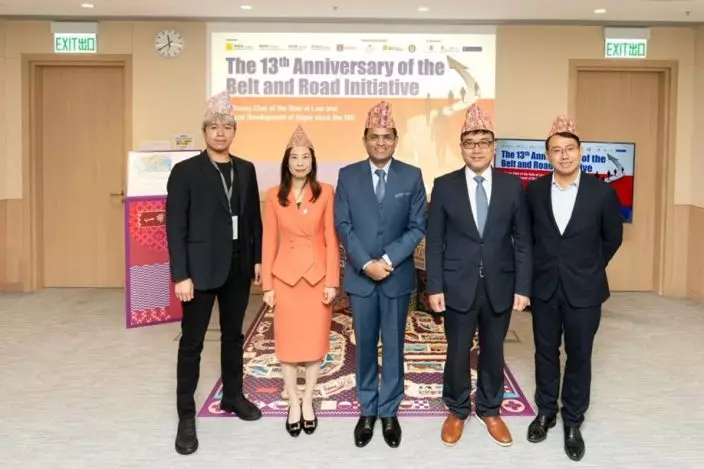
Tseng Hin Pei Charity Fund Limited Representative Riley Tseng Fanwei (first from left), Legislative Council Member Hon Maggie Chan Man-ki, Consul-General of Nepal to HKSAR Dr Bindeswar Prasad Lekhak (third from left), Legislative Council Member Dr Hon Hoey Simon Lee, China Resources Group Senior Group Legal Counsel Johnny Ip Chun-yuen (fifth from left) pose for a group photo wearing traditional Nepalese Dhaka topi
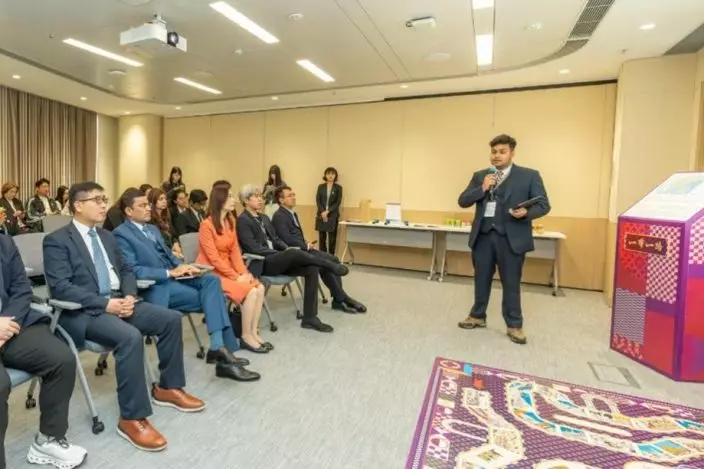
Kathmandu University law student representatives deliver presentation
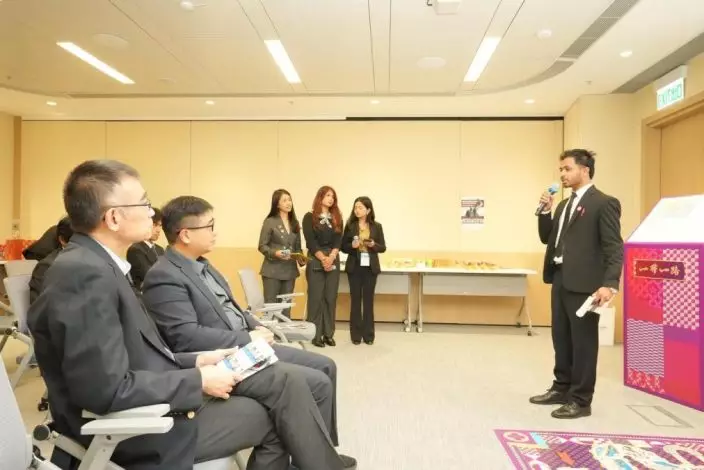
Tribhuvan University law student representatives deliver presentation
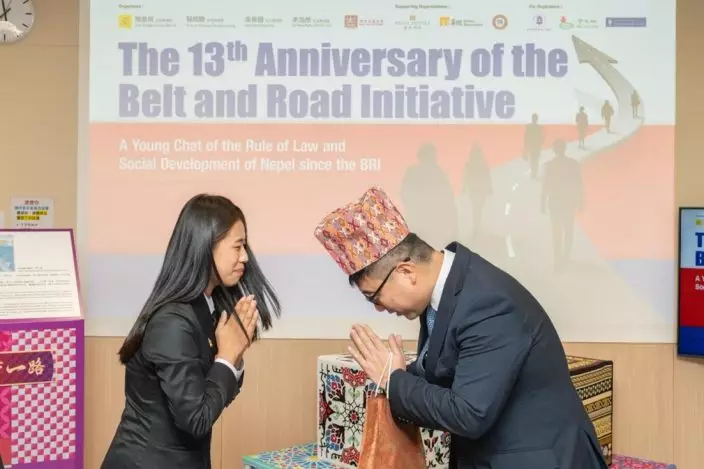
Tribhuvan University law student representative assists Legislative Council Member Dr Hon Hoey Simon Lee to wear the traditional Nepalese Dhaka topi
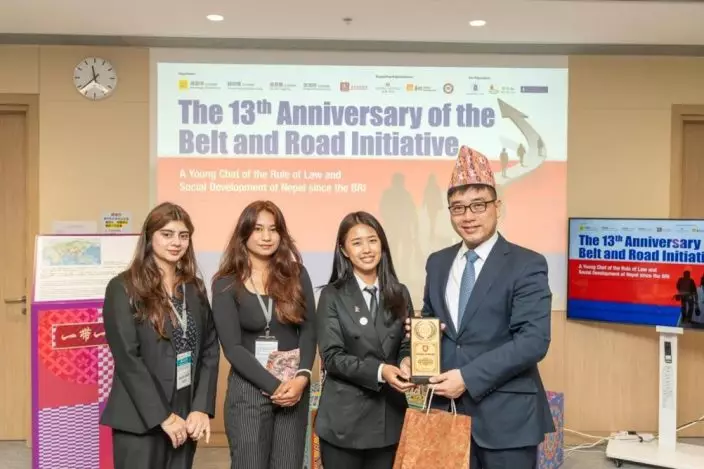
Tribhuvan University law student representatives present souvenirs to Legislative Council Member Dr Hon Hoey Simon Lee
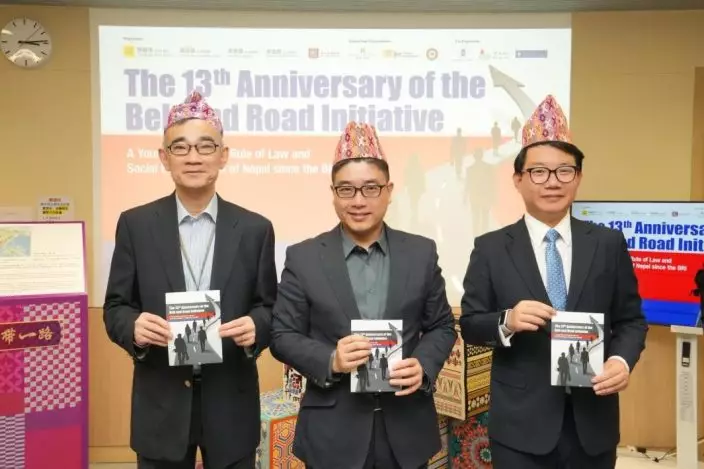
Legislative Council Members Dr Hon Thomas So Shiu-tsung, Dr Hon Hoey Simon Lee, Hon Wu Yingpeng pose for a group photo wearing traditional Nepalese Dhaka topi
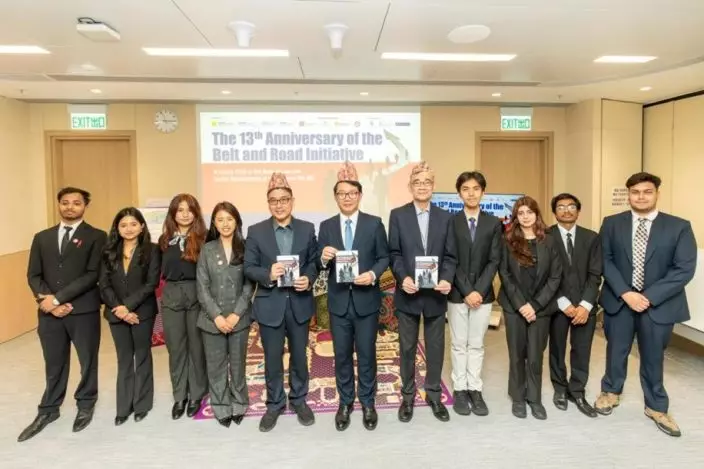
Legislative Council Members Dr Hon Hoey Simon Lee, Hon Wu Yingpeng, Dr Hon Thomas So Shiu-tsung pose for a group photo with law students from two Nepalese universities wearing traditional Nepalese Dhaka topi
This marks the fourth consecutive year that Legislative Council Member Dr Hon Hoey Simon Lee has gathered with young law students from BRI country in Hong Kong. This year, for the first time, the exchange was jointly organized with multiple Legislative Council Members, and for the first time, the Nepalese Consul-General in Hong Kong attended.
In his opening remarks, Dr Lekhak, Consul-General of Nepal to HKSAR, emphasized the long-standing and robust friendship between Nepal and China, reaffirming Nepal's steadfast commitment in upholding the one-China principle. Dr Lekhak pointed out that China is Nepal's second-largest trading partner, with close ties spanning trade, foreign direct investment, and tourism. Since Nepal participated in the BRI in 2017, collaborative projects have expanded across various sectors—including urban development, infrastructure, education, health, sports, and energy—providing significant opportunities for Nepal’s development. Nepal has a favorable investment environment and welcomes all sectors in Hong Kong to further strengthen economic and trade cooperation with Nepal.
During the seminar, the Nepalese law students shared profound insights into the positive changes the BRI has brought to their region, specifically discussing its tangible impact on improving local livelihoods and advancing the rule of law. They pointed out that during the pandemic, the BRI framework facilitated vaccine and medical assistance to Nepal, playing a significant role in humanitarian relief. In the long term, they have a positive vision for the BRI’s promotion of cross-border connectivity, bringing medical services, economic opportunities, trade efficiency, and cultural preservation to benefit local communities.
Local Hong Kong young leaders also participated in the exchange, engaging in in-depth discussions on how the BRI promotes the rule of law in Nepal, with particular focus on the critical role of alternative dispute resolution mechanisms, such as mediation and arbitration, in promoting regional legal cooperation. This exchange fostered mutual learning and deepened understanding and recognition, served as a vital communication bridge for young leaders from different cultural backgrounds.
To showcase their heritage, the Nepalese students presented traditional souvenirs, including Dhaka topi, handmade yak milk soaps, and traditional instruments singing bowls. The venue was also decorated with BRI-themed exhibition installations, enable attendees to experience the cultural charm of Nepal firsthand and further strengthening their friendship.
Legislative Councillor Dr Simon Lee and Consul-General Dr Lekhak (left) exchanged views at the Hong Kong Legislative Council
Legislative Councillor Dr Simon Lee and Consul-General Dr Lekhak (front row right) exchanged views with law students from two Nepalese universities at the Hong Kong Legislative Council
Councillor Dr Simon Lee presents Legislative Council souvenirs prepared for Consul-General Dr Lekhak (second from right)
China Resources Group Senior Group Legal Counsel Johnny Ip Chun-yuen (fifth from left), Tseng Hin Pei Charity Fund Limited Representative Riley Tseng Fanwei (sixth from left), Legislative Council Member Dr Hon Hoey Simon Lee, Consul-General of Nepal to HKSAR Dr Bindeswar Prasad Lekhak (eight from left), Legislative Council Member Hon Maggie Chan Man-ki, Member of the Guangzhou Municipal Committee of the CPPCC and Chairman of the Supervisory Board of the Guangdong-Hong Kong-Macao Greater Bay Area International Maritime and Commercial Mediation Center Tan Guojian (tenth from left), pose for a group photo with law students from two Nepalese universities at the Hong Kong LegCo
Tseng Hin Pei Charity Fund Limited Representative Riley Tseng Fanwei (first from left), Legislative Council Member Hon Maggie Chan Man-ki, Consul-General of Nepal to HKSAR Dr Bindeswar Prasad Lekhak (third from left), Legislative Council Member Dr Hon Hoey Simon Lee, China Resources Group Senior Group Legal Counsel Johnny Ip Chun-yuen (fifth from left) pose for a group photo wearing traditional Nepalese Dhaka topi
Kathmandu University law student representatives deliver presentation
Tribhuvan University law student representatives deliver presentation
Tribhuvan University law student representative assists Legislative Council Member Dr Hon Hoey Simon Lee to wear the traditional Nepalese Dhaka topi
Tribhuvan University law student representatives present souvenirs to Legislative Council Member Dr Hon Hoey Simon Lee
Legislative Council Members Dr Hon Thomas So Shiu-tsung, Dr Hon Hoey Simon Lee, Hon Wu Yingpeng pose for a group photo wearing traditional Nepalese Dhaka topi
Legislative Council Members Dr Hon Hoey Simon Lee, Hon Wu Yingpeng, Dr Hon Thomas So Shiu-tsung pose for a group photo with law students from two Nepalese universities wearing traditional Nepalese Dhaka topi
InsightSpeak
** 博客文章文責自負,不代表本公司立場 **