Skip to Content Facebook Feature Image

New Virginia law banning `assault firearms' prompts quick lawsuits from gun-rights groups

News

New Virginia law banning `assault firearms' prompts quick lawsuits from gun-rights groups
News

News

New Virginia law banning `assault firearms' prompts quick lawsuits from gun-rights groups

2026-05-16 02:54 Last Updated At:03:00

Virginia Gov. Abigail Spanberger has signed legislation banning the sale and manufacture of certain semi-automatic firearms, prompting immediate lawsuits from gun-rights groups.

The limits on “ assault firearms,” as they are described by the legislation, are among two dozen new restrictions and regulations on guns enacted by the Democratic governor in her first few months in office. That marks a sharp policy reversal from her Republican predecessor, who had vetoed many similar measures.

“Firearms designed to inflict maximum casualties do not belong on our streets," Spanberger said in a statement Friday. "We are taking this step to protect families and support the law enforcement officers who work every day to keep our communities safe.”

The new gun restrictions move Virginia closer to the likes of California, Illinois and New York, which similarly have full Democratic control of their legislatures and governors' offices. They also highlight a continued national divide on gun policy, as various Republican-led states have taken steps to relax firearm restrictions that they describe as an infringement on Second Amendment rights.

The new Virginia law, which takes effect July 1, will make it a misdemeanor, punishable by up to a year in jail and a $2,500 fine, for people to buy, sell, transfer, import or manufacture an “assault firearm.”

The measure defines that term to include semi-automatic rifles or pistols with a magazine capacity of more than 15 rounds. It also includes firearms with other characteristics, such as rifles capable of accepting a detachable magazine that have a second handgrip or a collapsible stock. The prohibition also applies to magazines capable of holding more than 15 rounds. For most people, there’s no penalty for merely possessing such weapons.

Eleven other states and Washington, D.C., already have laws prohibiting the sale an manufacture of certain semi-automatic firearms, though the details vary. Hawaii, for example, prohibits certain semi-automatic pistols and high-capacity magazines, but not semi-automatic rifles.

Legal challenges came swiftly after Spanberger signed the legislation Thursday. The National Rifle Association, joined by other groups, sued in both federal and state court, asserting violations of the right to bear arms.

“The firearms and magazines banned in this law aren’t bizarre and unusual outliers, they’re among the most commonly owned guns and magazines in the country," said Adam Kraut, executive director of the Second Amendment Foundation, which joined the NRA in the federal lawsuit. “They’re owned in the tens of millions by peaceable Americans who use them overwhelmingly lawfully.”

The U.S. Department of Justice also vowed to sue to block the Virginia law from being enforced.

The Virginia measure would “infringe on the Second Amendment rights of law-abiding citizens to enjoy and use AR-15 rifles for lawful purposes by making it a crime to purchase and sell them,” Harmeet Dhillon, assistant attorney general for the department’s civil rights division, wrote in an April letter to Spanberger.

So far, laws restricting certain semi-automatic firearms generally have been upheld, including by the 4th Circuit Court of Appeals, which covers Virginia, Maryland and several additional states.

That appellate court twice upheld a Maryland law banning dozens of types of semi-automatic weapons, describing them a 2024 ruling as “military-style weapons" that are ill-suited for self-defense. It concluded that “the Maryland law fits comfortably within our nation’s tradition of firearms regulation.”

The U.S. Supreme Court last year declined to hear a challenge in that Maryland case. But gun-rights advocates remain hopeful of a different outcome in future cases, noting that three conservative justices on the nine-member court disagreed with the decision and a fourth expressed skepticism that such firearm bans are constitutional.

Former Republican Virginia Gov. Glenn Youngkin vetoed legislation each of the past two years that would have prohibited the sale of certain semi-automatic firearms.

But Youngkin's term ended in January, and he was succeeded by Spanberger. The transition presented a huge opportunity for advocates of gun restrictions, who already had support within the Democratic-led Legislature.

Spanberger, a former CIA officer and U.S. House member, had previously been a volunteer with Moms Demand Action, a group founded after a shooting at Sandy Hook Elementary School in Connecticut claimed the lives of 26 people in 2012. The group lists 20% of the Democrats in the Virginia House as its past volunteers.

"The fact that a former Moms Demand Action volunteer just signed an assault weapons ban in the home state of the NRA speaks volumes about how dramatically the political calculus around gun safety has shifted,” said John Feinblatt, president of Everytown for Gun Safety, the umbrella organization for Moms Demand Action..

While Virginia tightens gun regulations, many Republican-led states have been expanding gun rights.

On the same day Spanberger signed the semi-automatic firearm restrictions, Missouri's Republican-led Legislature gave final approval to legislation creating a school ranger program that could let trained volunteers carry firearms in schools.

A law signed by Spanberger last month raised the age to purchase a handgun in Virginia from 18 to 21. By contrast, Republican West Virginia Gov. Patrick Morrisey signed a law last month lowering the age from 21 to 18 for carrying concealed guns without a state permit.

Yet another law signed by Spanberger last month opens new grounds for lawsuits against the firearms industry. That came shortly after Republican Utah Gov. Spencer Cox signed a law limiting liability lawsuits against the firearms industry.
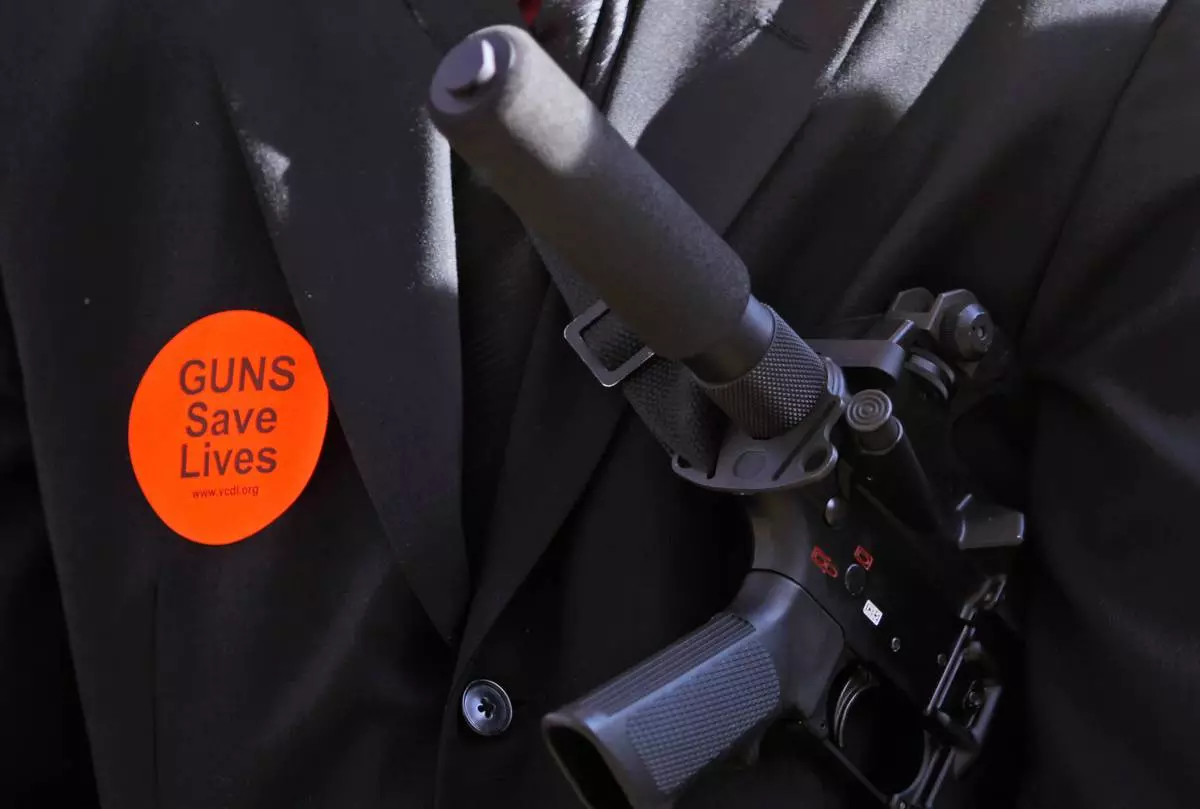
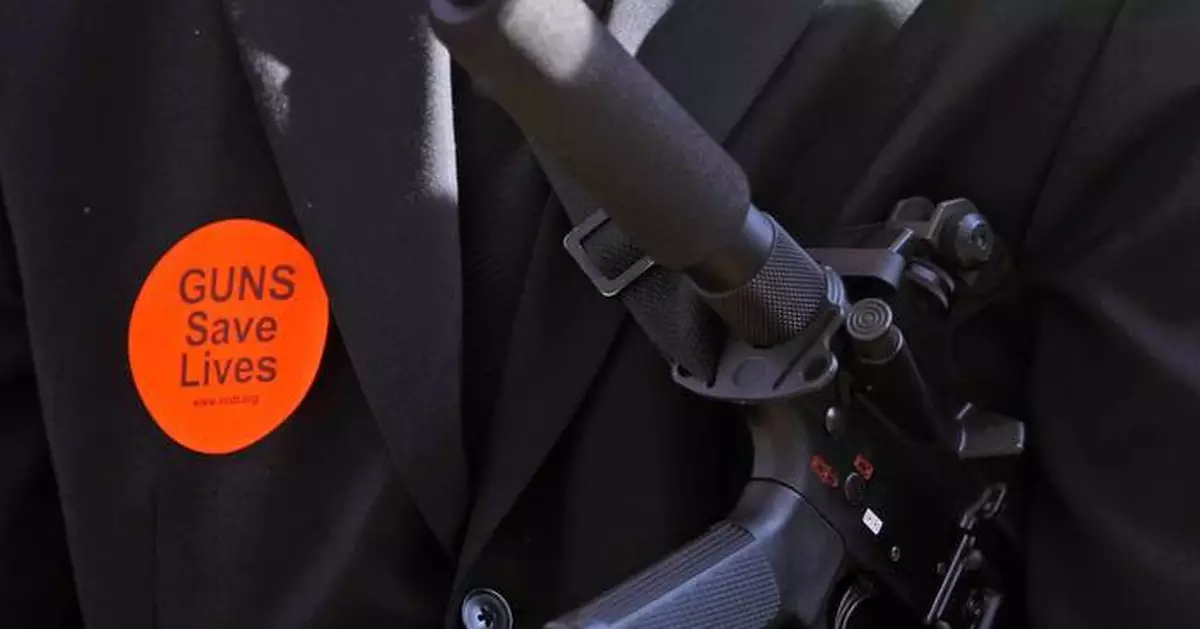
FILE - A demonstrator carries an AR-15 while wearing a "Guns Saves Lives" sticker during a gun rally at the Capitol in Richmond, Va., Jan. 16, 2012. (AP Photo/Steve Helber, File)

FILE - A demonstrator carries an AR-15 while wearing a "Guns Saves Lives" sticker during a gun rally at the Capitol in Richmond, Va., Jan. 16, 2012. (AP Photo/Steve Helber, File)
NEW YORK (AP) — North America’s largest commuter rail system is facing a potential shutdown as a deadline nears to reach a deal with unionized workers to avert a strike.

The Long Island Rail Road that serves New York City’s eastern suburbs has been negotiating for months on a new contract with labor officials representing locomotive engineers, machinists, signalmen and other train workers.

A strike was temporarily averted in September when President Donald Trump’s administration agreed to help. Those efforts ended without a deal, giving both sides 60 days — ending 12:01 a.m. Saturday — to again try to resolve their differences before the union was legally allowed to go on strike or the agency could lock out workers.

Five labor unions representing about half the train system’s 7,000-person workforce warned this week that Saturday’s deadline was approaching.

The LIRR is the busiest commuter railroad in North America, carrying about 250,000 customers each weekday. LIRR workers last went on strike in 1994, for about two days. Workers nearly walked out in 2014 before then-Gov. Andrew Cuomo reached a deal with unions.

The Metropolitan Transportation Authority, which oversees the LIRR and other area transit systems, has said it will provide free but limited shuttle buses during the morning and afternoon rush hours. The agency says the shuttles will depart from designated LIRR train stations to subway stops in the New York City borough of Queens.

Gov. Kathy Hochul has urged LIRR riders to work from home, if possible, as the free shuttles are meant for essential workers and those who cannot telecommute. The Democrat, months earlier, slammed the LIRR unions for “greedy asks” that threaten to “destabilize the local economy.”

The contract talks have stalled on the question of worker’s salaries.

The MTA argued that the union’s initial demands would lead to fare increases and impact contract negotiations with other unionized workers. The union has said more substantial raises were warranted to help workers keep up with inflation and rising living costs.

Both sides have so far agreed to contract terms calling for the same 9.5% in pay raises over three years already given to other unionized workers. But the unions have been holding out for another yearly salary increase of 6.5% — for a total raise of 16% over four years.

The MTA said earlier this week that it offered the unions what would effectively amount to a 4.5% raise in year four, in line with what federal officials had recommended. But the unions dismissed the lump sum payments as “a one-time gimmick” rather than the true wage increases they’d sought.

“The difference between those two positions is not unbridgeable,” Gary Dellaverson, the MTA’s chief negotiator, suggested during a press conference Wednesday.

Spokespersons for MTA declined to provide an update Friday, but the unions confirmed that the two sides met late into Thursday and then reconvened Friday morning at MTA headquarters in lower Manhattan.

Nick Peluso, national vice president for the Transportation Communications Union, said in a statement that the unions have lowered their initial ask of a 6.5% raise to “the upper 4s,” whereas the MTA's offer is “in the mid-3s.”

“The key question is: Will MTA and Gov. Hochul create frustration and gridlock for commuters, spend millions on buses during a strike and lose millions in revenue over what amounts to roughly a one percent difference in wages?” he said.

Susanne Alberto, a personal trainer from Long Island, said she’s already made plans with her Manhattan clients to hold virtual sessions in the event of a shutdown.

She said the union likely has the upper hand, even if she believes raises should be based on job responsibilities and not made across the board.

“The MTA is going to cave, and they know that,” Alberto said. “Why don’t they just do it now instead of waiting until virtually millions of people get inconvenienced?”

Rob Udle, an electrician who takes the LIRR at least five days a week, said he’ll likely use his vacation days rather than navigate the “nightmare” of commuting into Manhattan if the rail service shuts down.

A union member, he sympathized with the unions’ affordability concerns, but said he didn’t agree with their strong-arm tactics.

“I get it, the cost of living is going up and stuff like that,” Udle said while waiting at Penn Station for a train home. “But they shouldn’t hold everybody hostage to do it. There’s a better way. You’re affecting a lot of other people.”

The first reference to the rail system has been updated to correct to Long Island Rail Road, from Long Island Railroad.

Follow Philip Marcelo at https://x.com/philmarcelo

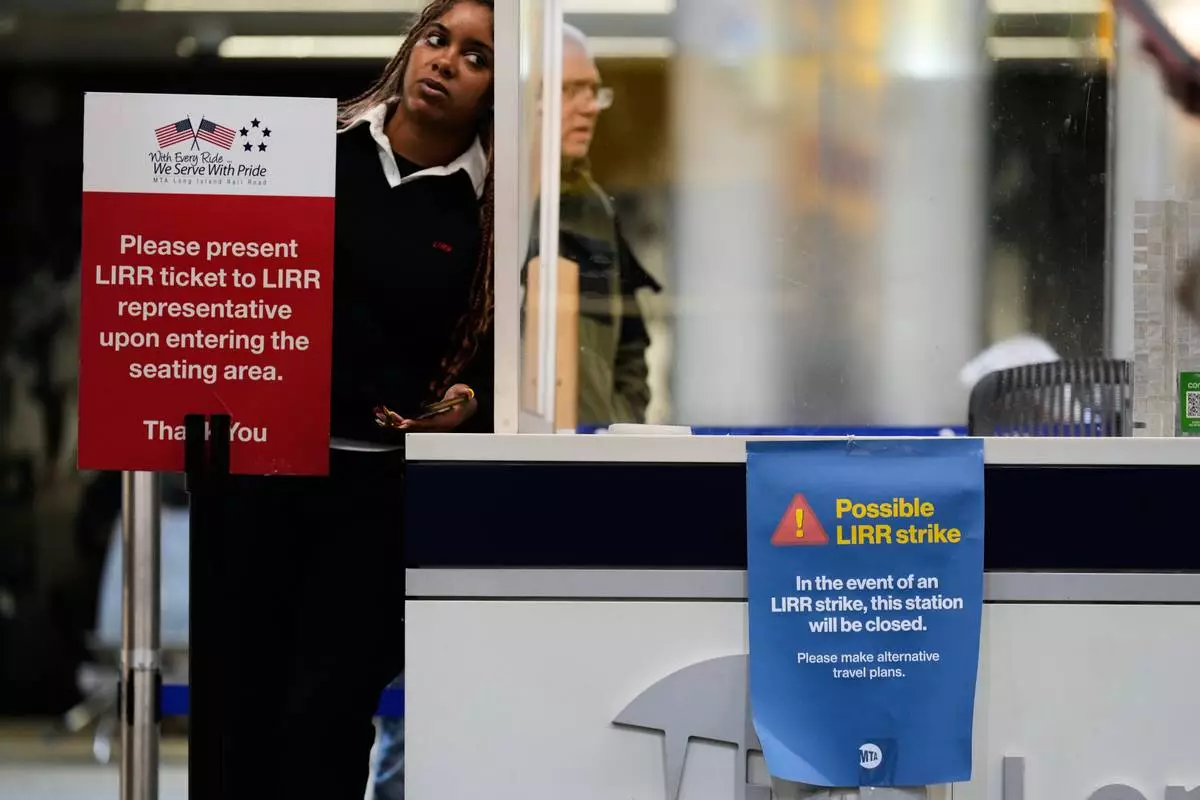
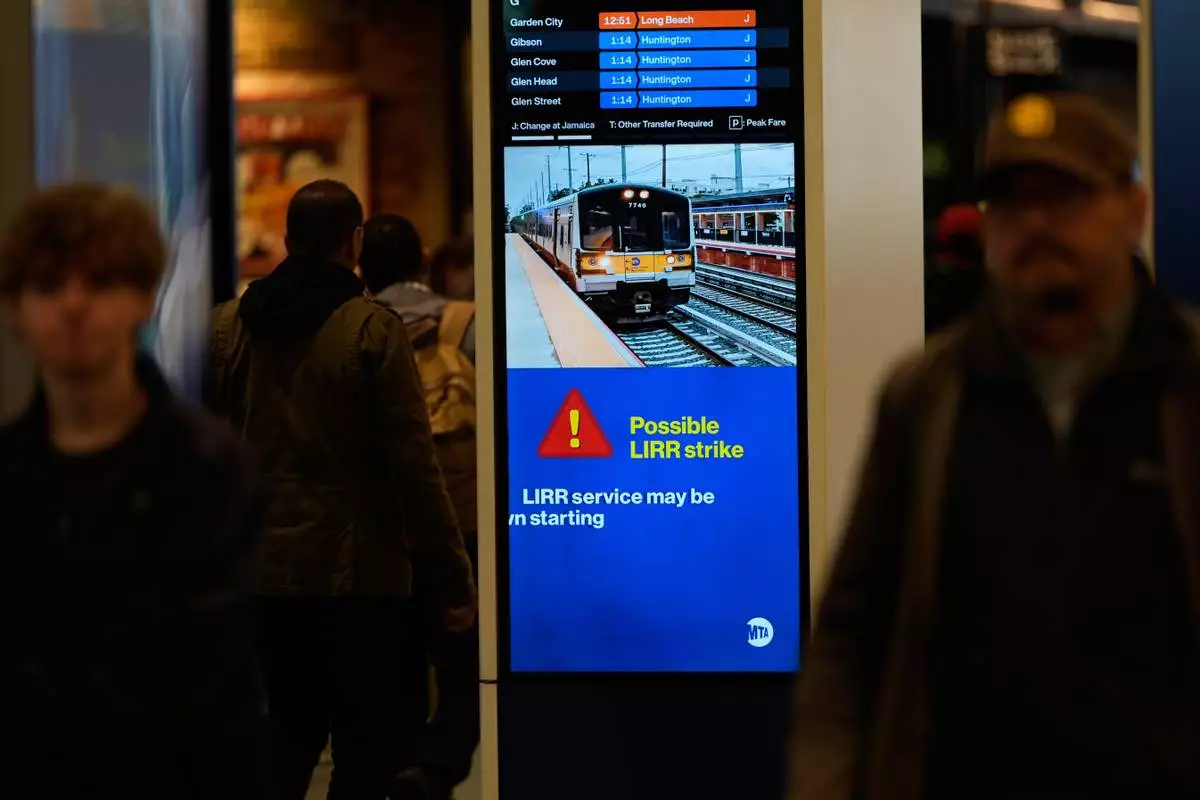
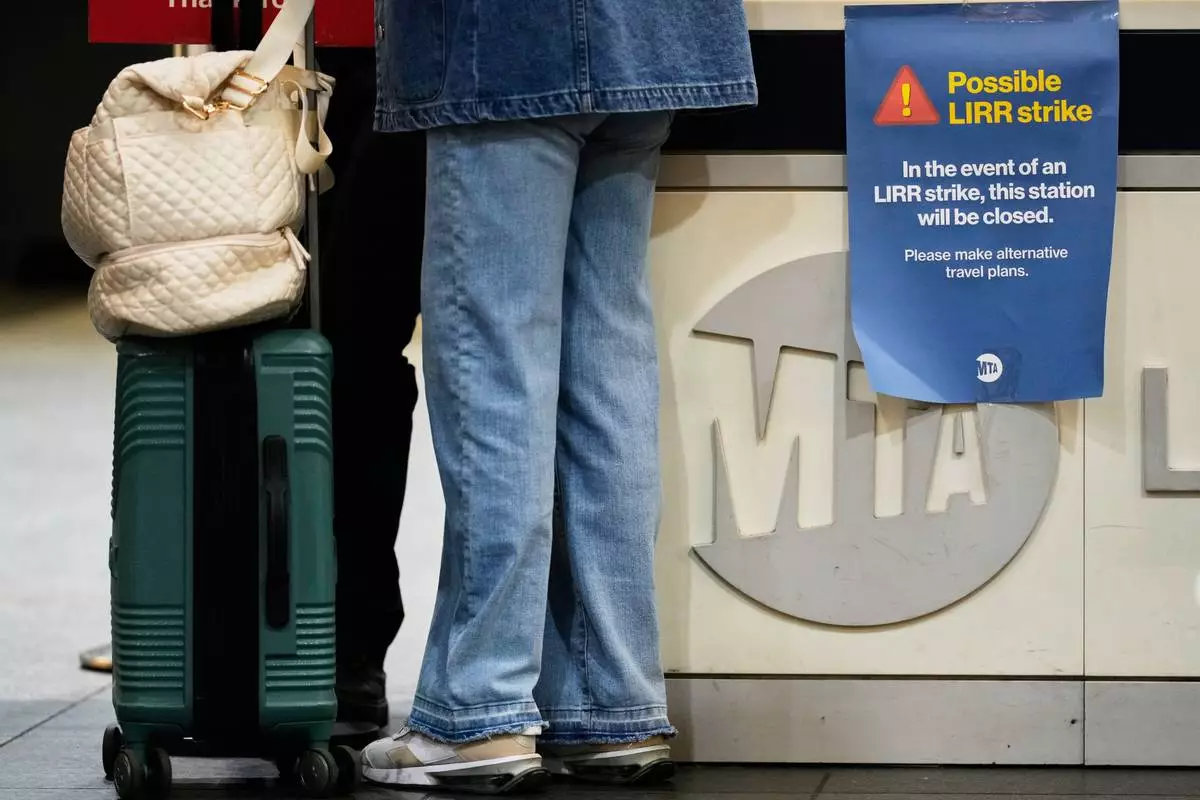
A sign warns commuters of a potential Long Island Rail Road strike at Penn Station in New York, Thursday, May 14, 2026. (AP Photo/Seth Wenig)

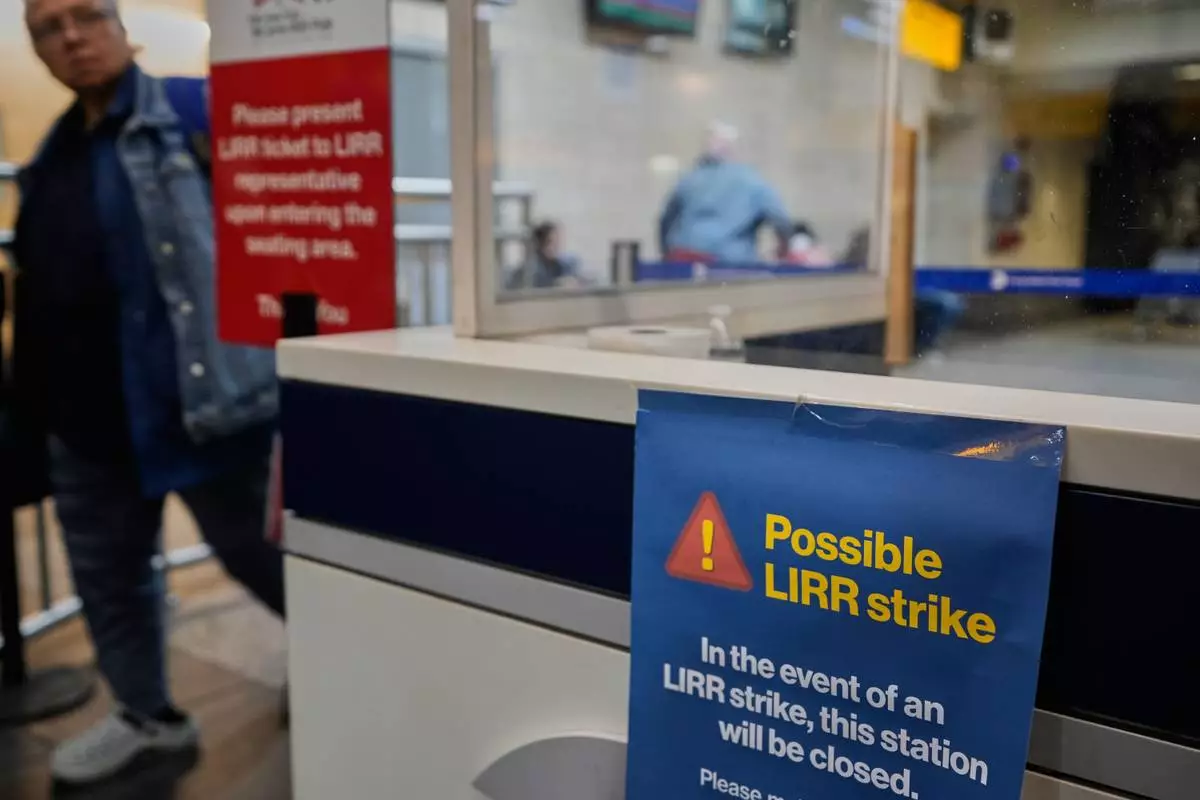
A sign warns commuters of a potential Long Island Rail Road strike at Penn Station in New York, Thursday, May 14, 2026. (AP Photo/Seth Wenig)

A sign warns commuters of a potential Long Island Rail Road strike at Penn Station in New York, Thursday, May 14, 2026. (AP Photo/Seth Wenig)

A sign warns commuters of a potential Long Island Rail Road strike at Penn Station in New York, Thursday, May 14, 2026. (AP Photo/Seth Wenig)

A sign warns commuters of a potential Long Island Rail Road strike at Penn Station in New York, Thursday, May 14, 2026. (AP Photo/Seth Wenig)

A sign warns commuters of a potential Long Island Rail Road strike at Penn Station in New York, Thursday, May 14, 2026. (AP Photo/Seth Wenig)

A sign warns commuters of a potential Long Island Rail Road strike at Penn Station in New York, Thursday, May 14, 2026. (AP Photo/Seth Wenig)

A sign warns commuters of a potential Long Island Rail Road strike at Penn Station in New York, Thursday, May 14, 2026. (AP Photo/Seth Wenig)

Recommended Articles