From sky to deck, drone deliveries to vessels on the move are transforming life along China's busiest waterway, marking a key advance in the nation's drive to build its low-altitude economy into a pillar of future growth.
Aboard one of the thousands of vessels navigating the Yangtze River, Captain Pu Shenggao recently experienced what he once thought impossible. A drone hovered above his ship, gently lowering a package onto the deck. Inside was KFC and milk tea, a treat he had not enjoyed for a long time.
"In the past, we could only buy vegetables and fruits. It was almost impossible if we wanted a particular food," he said.
The entire delivery process takes about five minutes. The service has brought an unprecedented level of convenience and freedom, allowing sailors to order what they want anytime they want to.
The Nanjing section of the Yangtze River sees around 2,000 vessels pass through daily. Previously, sailors could only purchase supplies at designated anchorages or docks, with limited choices available. The growing demand for onboard delivery inspired Zhai Haifeng, whose team began testing drone deliveries to anchored ships in 2024. By last year, they had successfully extended the service to vessels in motion.
At the heart of the innovation is a "black box" installed on the drone, which locates targets, tracks them, and drops the delivery accurately.
"Using edge computing and visual recognition technology, the device coordinates the drone to locate the specific vessel that placed the order without making any mistakes. After exchanging data with the black box, the drone maintains a steady, relatively stationary position alongside the vessel, traveling in the same direction and at the same speed. Once well positioned, it uses a locking and lowering system to gently place the delivery onto the deck," Zhai said.
The service has been operating smoothly for about a year, with around 300 orders delivered to ships on the Yangtze River every day. A range of supporting measures has been put in place to ensure its efficient operation, including 5G base stations for stable connectivity, a mini meteorological station providing minute-level weather forecasts, and the country's first set of traffic regulations governing low-altitude logistics over waterways.
"In the guidelines, we specify the vessels, airspace, and meteorological conditions for delivery operations to ensure their safety," said Li Maofei, head of the Patrol and Law Enforcement Detachment at the Nanjing Maritime Safety Administration.
Beyond the river, the low-altitude economy is taking off across China. In Nanjing's low-altitude services center, a large screen displays the city's entire commercial drone flight activity, which transports agricultural products, fresh goods, and life-saving blood.
"We've launched the first delivery route for agricultural products using drones, regularly supplying fresh goods to nearby kindergartens and schools. And then there's our 'blood route', a drone corridor that has dramatically cut transport time," said Fan Liang, general manager of Nanjing Air-Ground Digital Intelligence Industry Development Co., Ltd.
This reflects a broader trend across China, where cities are opening up more airspace to accelerate the development of the low-altitude economy. To support this growth, China's top economic planner established a dedicated department at the end of 2024. Today, the low-altitude economy is increasingly woven into daily life, from delivering mail to remote rural areas to transporting critical, life-saving medicines and equipment to hospitals.
China has designated the low-altitude economy as one of its emerging pillar industries for the next five years. Its market size is expected to exceed 3.5 trillion yuan, or roughly 511 billion U.S. dollars, by 2035, more than twice the entire annual revenue of China's express delivery industry last year.
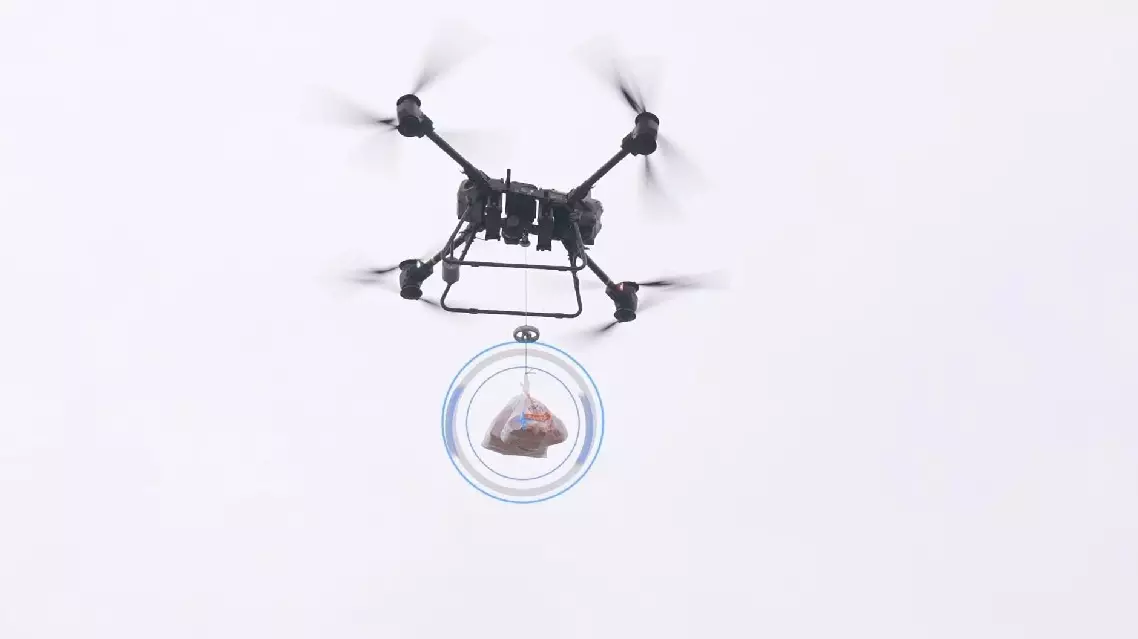
Drone deliveries bring takeouts to moving ships on Yangtze River