

News broke in the small hours of Wednesday that former Chief Executive Tung Chee-hwa had passed away. Many friends in my chat groups shared their condolences. One message read: "Back in the day, he had a grand blueprint for Hong Kong's development. Sadly, the times did not favor him. Britain had planted many landmines, and people on the inside were pulling him back too. His lofty ambitions went unfulfilled. Such a pity." Someone promptly replied: "Mainly because of Anson Chan."
Look back at Mr. Tung's predicament in the early post-handover years, and that verdict holds up. Those dire straits were no accident. The last governor, Chris Patten, nicked name Fat Pang, had long since set a "Trojan horse" trap. The figure hidden inside that horse, bent on tying Mr. Tung's hands, was none other than the then Chief Secretary for Administration, Anson Chan. Fat Pang also went to great lengths to embolden anti-government forces. He conjured up turmoil to drag Mr. Tung back and stymie his governance. That was the seed of even greater unrest in the years to come.
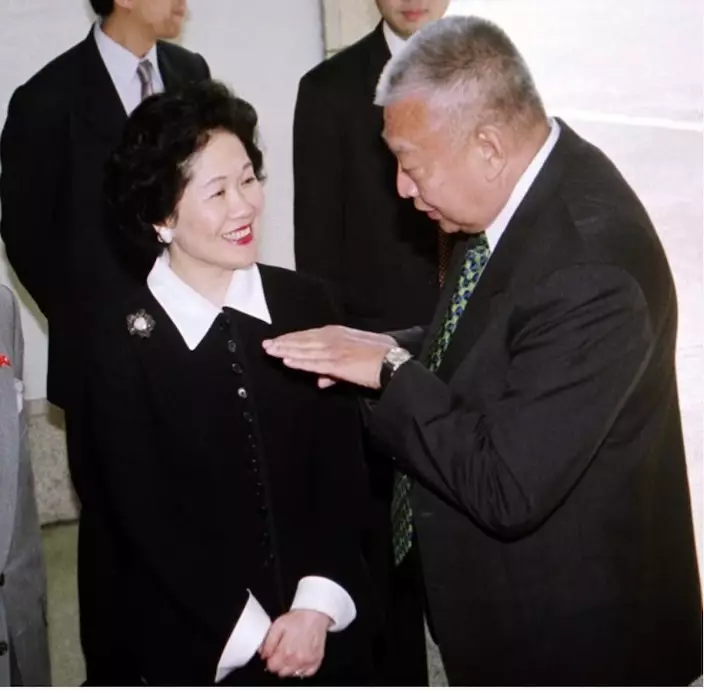
Britain's "Trojan horse" Anson Chan tied Mr. Tung's hands.
Landmines Planted Before the Handover
When Mr. Tung was elected the first Chief Executive before the handover, he was brimming with ambition for governing Hong Kong. A friend who knew him well said he hoped to lead the city into a new era. He wanted to overhaul the entrenched mindset of "AO rule," the model of governance dominated by the administrative officer grade. Yet from the very outset, he ran into obstacle after obstacle. All of them were tied to the landmines Britain had planted, above all Fat Pang's "Trojan horse" ploy.
Those landmines were laid even before the Sino-British Joint Declaration was signed. In July 1984, the colonial government published its Green Paper on the further development of representative government in Hong Kong. A year later, it held the first indirect elections to the Legislative Council, all in the name of "returning power to the people." From then on, electoral politics flourished in Hong Kong. It spawned an increasingly powerful opposition that became a counterweight to the government. That was precisely the outcome the British had engineered from the start.
In the final years before the handover, the last governor, Chris Patten, was sent to Hong Kong to raise hell. He promptly started playing dirty.
Patten devised a system of universal suffrage in all but name and tore up the tracks of the political "through train" meant to carry the legislature across 1997. At the same time, he colluded with the opposition, including Next Media boss Jimmy Lai. Together they whipped up a wave of radicalism and erected barrier after barrier for the future SAR government.
Mr. Tung was, at heart, a businessman. He was untempered by the wiles of politics, and in the early days he did not grasp how treacherous the terrain was. He gave no thought to countering each hostile move as it came, and he failed to rein in the growth of radical politics. All he did was earnestly exhort the opposition not to go astray. Meeting the leading lights of the pro-democracy camp, he urged them to stop holding the June 4 candlelight vigils.
Tung also spoke pointedly to Martin Lee. He had lived in the United States for many years, he said, and some people there harbored ill intent, so they had to be careful. "Don't be so naive," he told them. But they could not have cared less. It shows that he had long seen the United States was secretly plotting to throw Hong Kong into chaos.
The First Detonation: 2003
Mr. Tung was an upright man. As one friend who knew him put it, he did not know how to fight dirty. He failed to strike hard in time to root out the agents of turmoil. By the middle and later years of his administration, the opposition and the radicals had grown ever stronger, battering his governance time and again.
When the then Financial Secretary, Antony Leung, downsize the civil service to bring down the fiscal deficit and shield the financial system from predatory speculators, massive street protests promptly erupted. Reform became an uphill battle.
The tide reached its crest over the Article 23 legislation. Demonstrations swelled ever larger, with rioting ready to erupt at a single spark. The pro-establishment Liberal Party, daunted by the situation, declared it would not back the bill. Caught between pressure from within and without, Mr. Tung had no choice but to withdraw it. The episode dealt him a crushing blow. Trace it to its roots, and the source of the calamity lies squarely with the landmines Britain had planted.
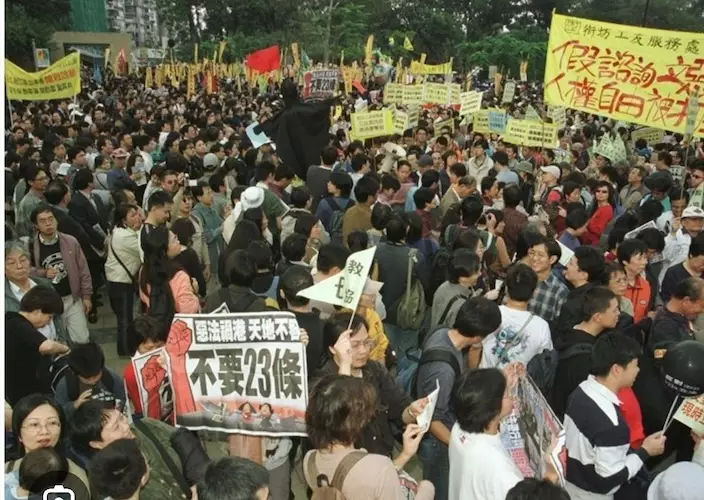
The 2003 Article 23 march: Britain's first landmine detonated.
The Rider Inside the Horse
The other half of Fat Pang's "Trojan horse" ploy was to plant people loyal to him in key posts in the governing team that would straddle the handover. Among them was the government's "No. 2 figure," Chief Secretary for Administration Anson Chan.
Soon after taking office, Fat Pang began picking his "champions" among the senior ranks. He set his sights on Anson Chan, elbowed aside Chinese officials more senior than her, and hoisted her into the seat of chief secretary, the colonial forerunner of today's chief secretary for administration. He also took care to install Donald Tsang as the first ethnic Chinese Financial Secretary.
The governing team of the early post-handover years was made up entirely of colonial-era AOs. They presided over a bureaucracy dominated by the AO grade. As the undisputed "big sister of the AOs," Chan effectively had the government under her thumb. Mr. Tung became a marshal without generals or soldiers at his command.
In these circumstances, Chan grew ever more assertive in decision-making, becoming the chief executive officer who held real power. Mr. Tung may have had a bellyful of grand designs, but not long after the handover, he began hitting walls.
Take long-term development planning. Keen to show he could get things done, Mr. Tung proposed setting up a strategic development commission and chairing it himself. But once the proposal landed on Mrs. Chan's desk, it died a silent death, shelved and left to gather dust. Such episodes were commonplace at the time.
Major policy changes were likewise dogged by Mrs. Chan's obstruction. On mother-tongue education in schools, she saw things differently from Mr. Tung. She also clashed repeatedly with Antony Leung, the Executive Council member then in charge of education reform.
The result: the policy was never fully implemented. What is more, she bristled at the very notion of "one country." She drew a clear line between Hong Kong and the mainland at every turn and repeatedly poured cold water on cross-border cooperation.
On political controversies, too, Mrs. Chan did not stand by Mr. Tung. Take the "Robert Chung affair". Within the government, she pressed hard to have Andrew Lo, the Tung aide embroiled in the affair, shown the door. Worse still, her confidants routinely leaked to friendly media, feeding them stories damaging to Mr. Tung.
Grandpa Finally Stepped In
Such protracted infighting within the government naturally took its toll on Mr. Tung's governance. Faced with this internal crisis, Beijing finally stepped in. When Chan went up to the capital to report on her duties in September 2000, the then Vice Premier Qian Qichen and the then Director of the Hong Kong and Macau Affairs Office, Liao Hui, received her separately. Their message was to support Mr. Tung. In other words, no more infighting.
Beijing's displeasure with Chan could not have been clearer. By early 2001, she knew the game was up. She finally resigned, leaving the government a year ahead of schedule.
Not long afterwards, Mr. Tung brought in Antony Leung as Financial Secretary. Senior financier Frederick Ma followed close behind, joining the government as Secretary for Financial Services and the Treasury. The AO stranglehold on the governing team began to be broken.
Fresh winds may have blown through the government. But the anti-government forces Britain had so painstakingly cultivated before the handover, and the radical tide they rode, were still very much in the ascendant. Battered by the storm of 2003, Mr. Tung finally stepped down in dejection just over a year later.
When Mr. Tung took office as Chief Executive, his heart was set on soaring ambitions. But he fell victim to the last governor Fat Pang's "Trojan horse" ploy. Forces inside and outside the government clung fast to his legs. In the end, his lofty aspirations went unfulfilled. A truly lamentable fate.
Lai Ting-yiu
What Say You?
** 博客文章文責自負,不代表本公司立場 **