France has traded on some golden brands for a century: fine food, fine wine, great art. And then there is "democracy." But the recent riots have exposed what many refused to see. That brand is wobbling, the democratic machinery has seized up, and voters are not just disappointed. They are disgusted.
A Golden Brand Tarnished
The New York Times weighed in on the unrest yesterday with a pointed question: why are young people and the working class turning on France's democratic system? It cited a Pew Research Center poll showing 69% of French people are dissatisfied with democracy, up 11 percentage points from six years ago. More and more voters, in other words, feel democracy has failed.
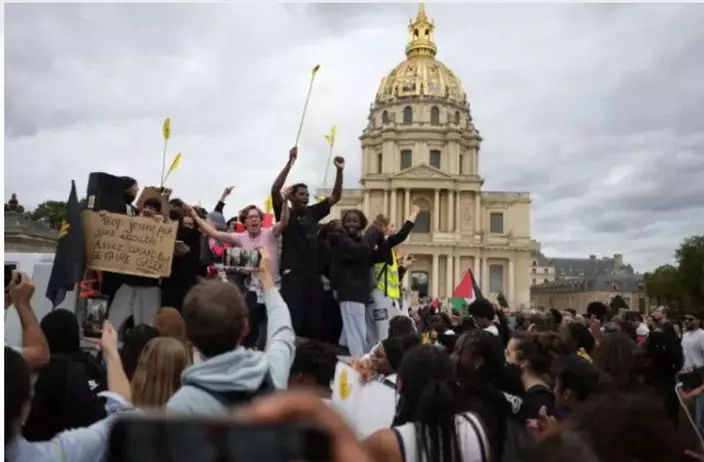
NYT: French riots fueled by disillusionment with democracy.
France is hardly alone. In the United States, the share dissatisfied with democracy is also 69%. The golden brands are crashing down together, and that mindset will shape election after election. No one should take it lightly.
Post-mortems on the riots are now rolling in. The New York Times argues that centrist parties in Europe's largest country are in deep trouble. Slow growth, high inflation, mountains of government debt and bleak prospects for the young are fueling an anger that keeps the protests coming.
The latest riots are a case in point. People believe the democratic system has failed to deliver on its promise of a better future. So the anger boiled over.
Disappointment with "democracy" is curdling into suspicion and outright rejection. That is pushing voters to the extremes and feeding the rapid rise of far-right and far-left parties. The New York Times cited the latest Pew Research Center poll: 69% of French people are dissatisfied with democracy, against 68% in Spain and 62% in Italy. The United States is neck and neck with France at 69%.
The result is startling. If most people no longer see the current democracy as a "good system," how can the leaders it elects, or the decisions they make, command the public's trust?
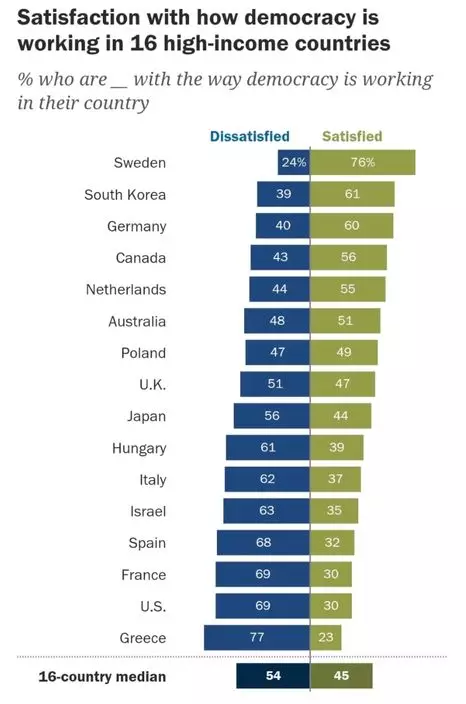
Pew: 69% in France, US dissatisfied with democracy.
A friend who read the piece dug up a similar survey from 2020. The shift is stark: back then, 58% of French people were dissatisfied with democracy; the figure has since climbed 11 percentage points. Among Americans, it rose 10 points.
Two Failures, One Reckoning
Why are Americans and the French growing so fed up with democracy? The article cites MIT professor Daron Acemoglu, who pins the malaise on two failures.
The first is the failure to deliver on shared prosperity. The working class has taken the hardest hit, and leaders have forgotten their contract with voters: keeping the infrastructure of daily life running smoothly.
The second failure runs deeper. Ruling elites dominate the traditional parties, yet they look down on the issues their supporters care about, or simply ignore them. The result? Working people have drifted to far-left or far-right populist parties, above all in France and Germany.
For ordinary people, democracy is not just a lofty slogan hung high on the wall. It is supposed to solve their problems and improve their lives.
Yet France's parties of every stripe have long been trapped inside the system, elbowing and tripping one another while the country's problems pile ever deeper.
Trapped in a Doom Loop
One columnist reached back 20 years to recall former French Prime Minister François Fillon warning that he was a leader facing national collapse, and that this could not go on. At the time, France owed 1.2 trillion euros, or 64.2 percent of GDP.
His urgent warning changed nothing. Instead of turning around, the crisis went into overdrive. Today the debt has swollen to 3.6 trillion euros, or 119.3 percent of GDP, and interest costs have climbed to nearly 5 percent. Money that should go to better public services and education now goes to paying interest. How can the public not be furious?
France's centrist parties must keep their core voters happy, so 32 percent of the education budget goes to paying civil servants' pensions. That leaves little left to improve classrooms and teaching facilities.
France is not alone. Other Western European countries suffer from the same disease: governments must control spending to shrink their deficits, but cutting welfare and education inevitably ignites public anger. So they keep spinning in a doom loop.
The result is a deeper hole. Voters grow more disillusioned with their governments, and their patience is running out even for the haloed "democratic system" itself.
The Bill Comes Due
Europe's four most populous countries go to the polls next year.
Public anger with traditional democracy will shape the results, and it will spread to other countries.
At a time when people in many countries are fed up with and disappointed in "democracy," some of Hong Kong's yellow camp are still beating the drum. Isn't that ridiculous?
Lai Ting-yiu
What Say You?
** 博客文章文責自負,不代表本公司立場 **
France this year seems to have run straight into the calamity of the 'Crimson Horse and Red Goat,' with misfortunes arriving one after another. On the economy, its debt has worsened and is on the verge of blowing up. Economist Paul Krugman says France may have reached the point of being 'too big to save.'
Debt, Chaos, and a Warning for Hong Kong
Politically, the country is in utter chaos. The largest student unrest in recent years has erupted, and the flames keep spreading. It’s hitting hard across the country.
A friend who lived through the 2019 Hong Kong Black Riots finds France's turmoil familiar. He points out five major similarities between the two, though the outcomes are very different.
The Macron government, constrained by far-left and far-right forces, cannot and is powerless to quell the chaos. The 'political terminal illness' it suffers from is beyond cure.
Hong Kong, by contrast, is fortunate to have successfully stopped the violence and rebuilt effective governance, ultimately avoiding a great calamity. Why France has fallen ill to this extent is worth taking as a warning.
From School Funding Protest to Nationwide Inferno
France is a century-old brand of "democracy and freedom." Yet political turmoil is continuous: a small disturbance every year, a major one every three years, endlessly.
The latest unrest was triggered in September by middle school students. At first, they only protested insufficient education funding, teacher shortages, and dilapidated school buildings.
The fire then burned ever fiercer. It erupted in multiple cities and is now spiraling out of control.
Yesterday the situation deteriorated further. Nationwide, 550,000 people took to the streets, and violence escalated across the board.
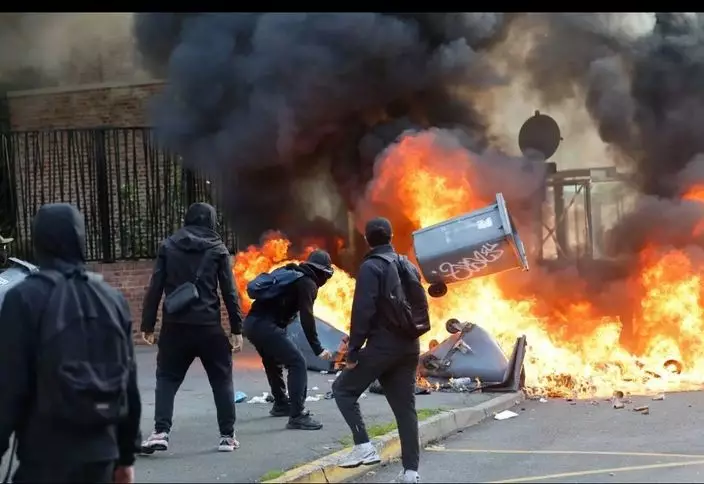
France burns: 550,000 people rioting, violence escalates.
"Rioters" set fires, looted, and attacked police officers in many places. Bustling districts became battlefields.
Some precious historic buildings, such as the Lyon tourism bureau and the Limoges city hall, were tragically burned down. It’s heartbreaking.
More than 1,200 people were arrested in the unrest and 150 police officers were injured. The flames have still not weakened.
Five Parallels: Youthful Rioters and the Hong Kong Déjà Vu
A friend watched France's student unrest and spotted five similarities with Hong Kong's 2019 Black Riots. The sense of déjà vu hit hard.
First, France's current unrest began in middle schools, and the demonstrators are defined by their youth. In the past they were adults or university students; now they are barely teenagers.
Among those arrested in clashes with police, most are minors. Yet their ferocity and brutality match adults, and often exceed them.
When the Black Riots erupted in Hong Kong back then, large numbers of secondary school students likewise took to the streets as a battlefield. Their radicalism was in no way inferior to that of their older brothers and sisters.
A friend once witnessed a group of secondary school students in a certain district violently taunting police officers, then scattering and running off, excited as if it were all a game. Some students were even rehearsing on building rooftops how to fight police officers, preparing to join the ranks of the "valiant."
Violent Elements Hijack the Movement
Second, violent elements who were not students joined in large numbers shortly after the French secondary school student protests broke out. From that point on, the actions were no longer peaceful. Demonstrators blocked roads everywhere, set fires, and attacked public facilities, especially landmark buildings, including a city hall with a hundred-year history.
Hong Kong's Black Riots had the same pattern. Multiple groups of "black-clads" mixed into the demonstrator ranks and launched "fire attacks" across busy districts. They damaged public facilities such as MTR stations, and even targeted the Government Headquarters, the Legislative Council Complex, and the Liaison Office of the Central People's Government.
Social Media as a Weapon of Mobilization
Third, French secondary school students used social platforms and messaging apps to mobilize the masses and paralyzed the schools' servers. Later, when more people joined the unrest, the destructive power of these systems became even greater.
The masterminds of Hong Kong's Black Riots likewise used social media and messaging apps (such as Telegram) for communication, incitement, command, and mobilization. They controlled and issued orders from behind the scenes.
At the time, the use of mobile phones among secondary school students was already very widespread. Mobile phones had become an important tool for organizing actions.
Political Parties Exploit the Chaos
Fourth, the French secondary school students' "rebellion" was exploited by political parties and political organizations almost as soon as it began. It became a bargaining chip in their contest with the government.
President Macron pointed out that the movement was clearly manipulated by political forces. Prime Minister Lecornu was even more blunt, saying the far-left party leader Mélenchon was fanning the flames behind the scenes, using the unrest to attack the ruling party and create advantages for his own bid for the presidency next year.
This shows that the secondary school students who took to the streets were merely pawns in the contest between political forces.
During the Black Riots of those years, Hong Kong's radical organizations, the opposition camp, and the anti-China media tycoon Jimmy Lai and others likewise used street riots to attack the government. Their goal was to seize governing power, exactly the same calculation as that of France's far-left parties at present.
Musk, Trump, and the Shadow of Intervention
Fifth, beyond internal political forces, this unrest in France also carries the shadow of foreign intervention. French Foreign Minister Barrot earlier said directly at an international conference that US tech giant Musk used his social media platform to wildly badmouth Macron in order to destabilize France and thereby influence next year's presidential election. Barrot also said that the MAGA movement led by Trump is likewise pushing French society toward polarization, with the ultimate goal of seizing political power.
Trump and Musk are indeed working hard to boost France's far-right leader Le Pen into the presidency. For this purpose, the more chaotic France is, the better. The possibility that they had a hand in this unrest is therefore extremely high.
That there were foreign black hands behind Hong Kong's Black Riots is now conclusively proven. The clearest example is media boss Jimmy Lai playing the role of a US agent, instigating a color revolution to subvert Hong Kong's regime.
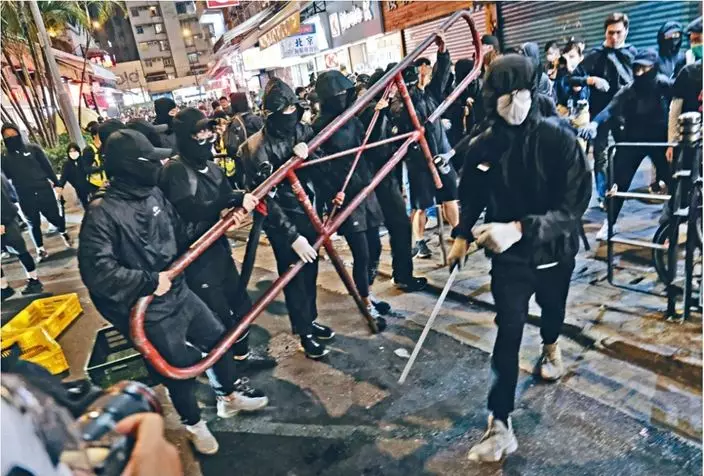
Hong Kong riots drew many students, backed by political forces.
Divergent Outcomes: Hong Kong Recovers, France Spirals
The two riots share five similarities, yet the outcomes are vastly different. Hong Kong stopped the violence, restored order, and internal strife gradually subsided. The city is returning to the track of stable governance.
France, by contrast, is mired in endless political chaos. France holds its presidential election next April. The far right has the greatest chance of winning, the far left comes second, and the ruling centrists are the weakest.
At this stage, the ruling party simply cannot govern effectively. Social contradictions will only continue to intensify, and peaceful days will be hard to come by.
Misfortunes never come singly: France is deeply mired in a debt crisis. Liabilities reach 3.6 trillion euros (4 trillion US dollars), equivalent to 119% of GDP. To refinance, France would have to implement severe fiscal austerity amounting to 4% of GDP.
If the government resorts to such harsh measures, society will become even more turbulent. The economy will slide further, and the country will ultimately head down a dead end.
A friend sees France stricken with a "terminal illness" while Hong Kong has dodged the calamity. The relief runs deep, and the friend is all the more convinced that Hong Kong is a "blessed land."
Lai Ting-yiu
Captions: