
Skip to Content Facebook Feature Image

The Black Bloc Inside France's Masked Riot Squads

Blog

The Black Bloc Inside France's Masked Riot Squads
Blog

Blog

The Black Bloc Inside France's Masked Riot Squads

2026-10-25 11:43 Last Updated At:11:43

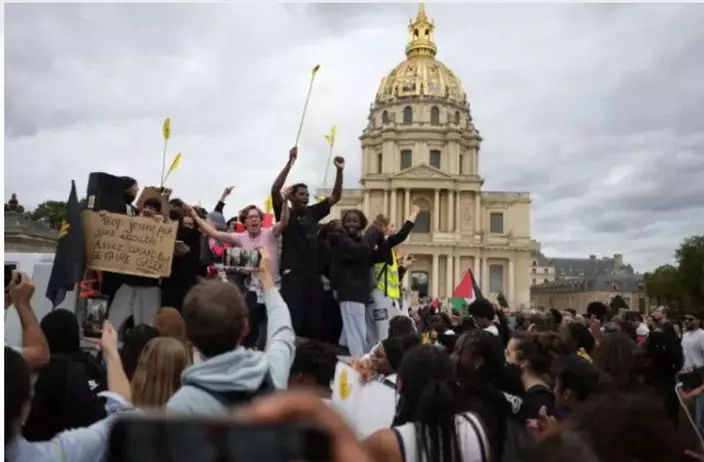
A massive upheaval has turned France upside down. Emmanuel Macron's government badly misjudged the situation beforehand and failed to contain the unrest, and it took a huge political hit.

France Caught Off Guard

Once the storm passed, several mysteries remained. Why did a student protest spiral into full-scale rioting? Who was pulling the strings? Luxury stores were looted, and every sign points to someone orchestrating events from behind the scenes. Could organized crime be involved?

On the first mystery, the Financial Times has named the culprit: a mysterious squad of "men in black." Their methods, tactics and equipment are strikingly similar to those of Hong Kong's black-clad rioters of years past. The difference? The French squad is still active on the protest front lines, while its Hong Kong counterparts have vanished without a trace.
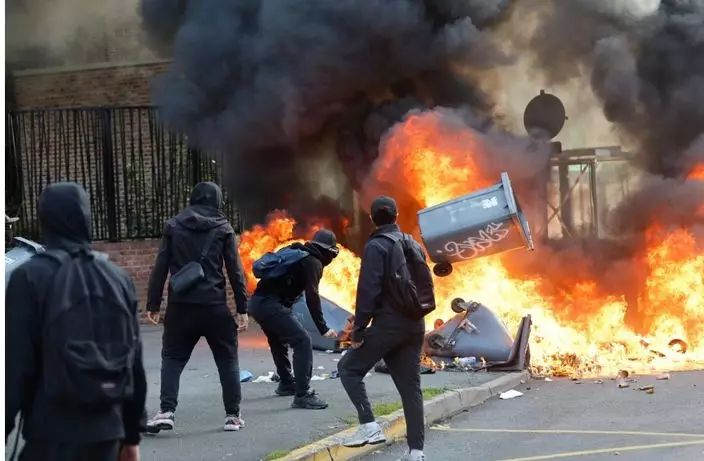
FT: mysterious 'men in black' squad behind France riots. Similar to what Hong Kong had experienced.

FT: mysterious 'men in black' squad behind France riots. Similar to what Hong Kong had experienced.

The French police made their biggest blunder last time by underestimating the crowds. They deployed just 2,350 officers around Paris. That left them vastly outnumbered by the troublemakers, completely on the back foot and powerless to control the situation.

Worse still, the police misjudged who they were up against. Their opponent was a black-clad squad with real tactics, strong organization, ample equipment and hard-earned riot experience. Traditional policing simply could not cope.

Inside the Black Bloc

The Financial Times has unmasked the background of this 'squad.' They have no formal organization. They have surfaced at major demonstrations before, bearing the name 'Black Bloc.'

This time, the group swarmed into the protest ranks in large numbers. Their hallmarks: black clothing, masked faces, gas masks and goggles, plus iron rods and petrol bombs. Full gear, ready for violent destruction.

On the ground, during the mass demonstrations, they moved with practiced skill. They built barricades to block roads, dug up paving bricks and hurled them at police, and set fires with petrol bombs, smashing and wrecking wherever they went.

They organized through social platforms and messaging apps, moving fluidly, much like an orchestra without a conductor in which every player knows exactly how to position and coordinate. The police, by contrast, stuck to traditional tactics. They held a single defensive line and stayed on the back foot the whole time.

Anarchists Without Leaders

The Black Bloc has no hierarchy, no leadership and no party ties, the report said. But its ideology is crystal clear. It preaches anarchism, opposes capitalism and glorifies attacking the establishment by radical means, including violence. Its membership is now estimated at 5,000.

The group first rose in Germany in the 1980s. It later hoisted the anti-globalization banner and incited riots at several demonstrations. It mobilized during the 1999 WTO summit and the 2007 G8 summit, leaving those cities in an uproar.

That leaderless setup is the group's best armor. With no ringleaders to hunt down, police find it hard to break the organization apart.

So to this day, the Black Bloc stays active across protest movements, waiting for its chance to stir trouble.

Echoes of Hong Kong

After reading the Financial Times report, a friend noticed how closely the Black Bloc resembled Hong Kong's black-clad rioters in 2019. The similarity led him to suspect that the two groups had long maintained some kind of connection, and that the riot methods and tactics had been transplanted to Hong Kong.

Fortunately, Hong Kong's "men in black" have since disappeared without a trace. Whether the "brothers and sisters" who fled to the United Kingdom will travel to France to join their ranks remains unknown.

The Looting Mystery

Another mystery hangs over these riots: did a crime syndicate plan and direct the looting of luxury stores? The authorities still have no hard proof. But the signs are hard to miss.

First, once the luxury stores were hit, large batches of expensive goods surfaced online for sale within an extremely short time. That points to a behind-the-scenes organization taking in bulk stolen goods, then moving them fast through 'fencing channels.' It does not look like the work of individual teenage robbers.

Second, French law enforcement authorities strongly suspect that a criminal syndicate used the unrest to incite teenagers in poor neighborhoods to loot. It then quietly took in the stolen goods behind the scenes and sold them below market price for huge profits.

Organized crime behind luxury store lootings, goods fenced fast.

Organized crime behind luxury store lootings, goods fenced fast.

A Lesson for Police

These two mysteries expose just how fragile and slack France's security system really is. Riot control and robbery prevention both fall short, and the gaps are everywhere.

By comparison, the Hong Kong Police Force is more than a cut above.

Still, the police would do well to treat France's chaos as a cautionary tale.

Lai Ting-yiu


What Say You?

** 博客文章文責自負,不代表本公司立場 **

France has traded on some golden brands for a century: fine food, fine wine, great art. And then there is "democracy." But the recent riots have exposed what many refused to see. That brand is wobbling, the democratic machinery has seized up, and voters are not just disappointed. They are disgusted.

A Golden Brand Tarnished

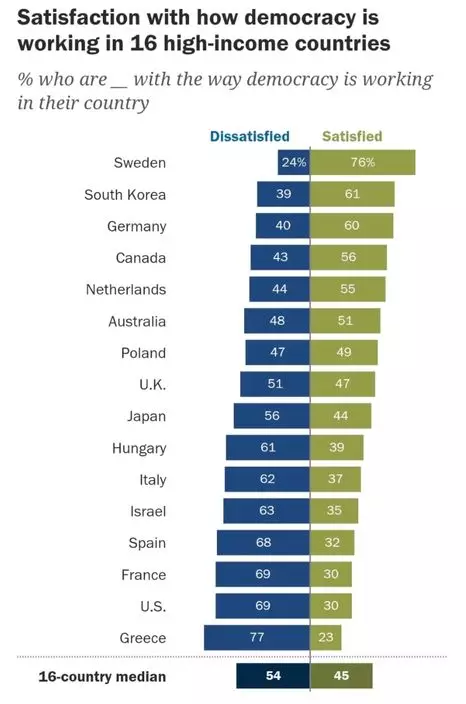
The New York Times weighed in on the unrest yesterday with a pointed question: why are young people and the working class turning on France's democratic system? It cited a Pew Research Center poll showing 69% of French people are dissatisfied with democracy, up 11 percentage points from six years ago. More and more voters, in other words, feel democracy has failed.

NYT: French riots fueled by disillusionment with democracy.

NYT: French riots fueled by disillusionment with democracy.

France is hardly alone. In the United States, the share dissatisfied with democracy is also 69%. The golden brands are crashing down together, and that mindset will shape election after election. No one should take it lightly.

Post-mortems on the riots are now rolling in. The New York Times argues that centrist parties in Europe's largest country are in deep trouble. Slow growth, high inflation, mountains of government debt and bleak prospects for the young are fueling an anger that keeps the protests coming.

The latest riots are a case in point. People believe the democratic system has failed to deliver on its promise of a better future. So the anger boiled over.

Disappointment with "democracy" is curdling into suspicion and outright rejection. That is pushing voters to the extremes and feeding the rapid rise of far-right and far-left parties. The New York Times cited the latest Pew Research Center poll: 69% of French people are dissatisfied with democracy, against 68% in Spain and 62% in Italy. The United States is neck and neck with France at 69%.

The result is startling. If most people no longer see the current democracy as a "good system," how can the leaders it elects, or the decisions they make, command the public's trust?

Pew: 69% in France, US dissatisfied with democracy.

Pew: 69% in France, US dissatisfied with democracy.

A friend who read the piece dug up a similar survey from 2020. The shift is stark: back then, 58% of French people were dissatisfied with democracy; the figure has since climbed 11 percentage points. Among Americans, it rose 10 points.

Two Failures, One Reckoning

Why are Americans and the French growing so fed up with democracy? The article cites MIT professor Daron Acemoglu, who pins the malaise on two failures.

The first is the failure to deliver on shared prosperity. The working class has taken the hardest hit, and leaders have forgotten their contract with voters: keeping the infrastructure of daily life running smoothly.

The second failure runs deeper. Ruling elites dominate the traditional parties, yet they look down on the issues their supporters care about, or simply ignore them. The result? Working people have drifted to far-left or far-right populist parties, above all in France and Germany.

For ordinary people, democracy is not just a lofty slogan hung high on the wall. It is supposed to solve their problems and improve their lives.

Yet France's parties of every stripe have long been trapped inside the system, elbowing and tripping one another while the country's problems pile ever deeper.

Trapped in a Doom Loop

One columnist reached back 20 years to recall former French Prime Minister François Fillon warning that he was a leader facing national collapse, and that this could not go on. At the time, France owed 1.2 trillion euros, or 64.2 percent of GDP.

His urgent warning changed nothing. Instead of turning around, the crisis went into overdrive. Today the debt has swollen to 3.6 trillion euros, or 119.3 percent of GDP, and interest costs have climbed to nearly 5 percent. Money that should go to better public services and education now goes to paying interest. How can the public not be furious?

France's centrist parties must keep their core voters happy, so 32 percent of the education budget goes to paying civil servants' pensions. That leaves little left to improve classrooms and teaching facilities.

France is not alone. Other Western European countries suffer from the same disease: governments must control spending to shrink their deficits, but cutting welfare and education inevitably ignites public anger. So they keep spinning in a doom loop.

The result is a deeper hole. Voters grow more disillusioned with their governments, and their patience is running out even for the haloed "democratic system" itself.

The Bill Comes Due

Europe's four most populous countries go to the polls next year.

Public anger with traditional democracy will shape the results, and it will spread to other countries.

At a time when people in many countries are fed up with and disappointed in "democracy," some of Hong Kong's yellow camp are still beating the drum. Isn't that ridiculous?

Lai Ting-yiu

Recommended Articles