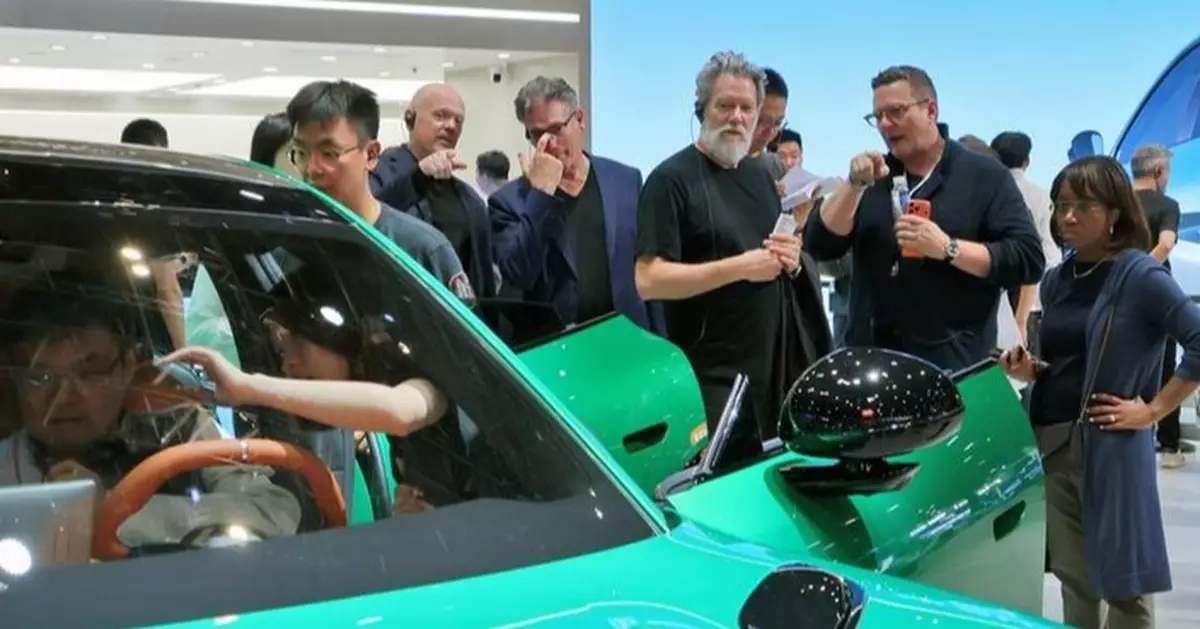
/wp-content/uploads/blogger/2026/08/WhatsApp-Image-2026-08-13-at-12.21.36.jpg.webp)
Among the many dimensions of the "Chinamaxxing" experience, Chinese electric vehicles are perhaps the ultimate game-changer for overseas perception. In the past, foreign observers might have dismissed Chinese cars under the label of "cheap knockoffs." Today, smart EVs outfitted with in-car refrigerators, multi-screen setups, and AI voice assistants are completely reshaping global perceptions of China's industrial prowess.
A YouTuber's Pilgrimage to the EV Mecca
Click to Gallery
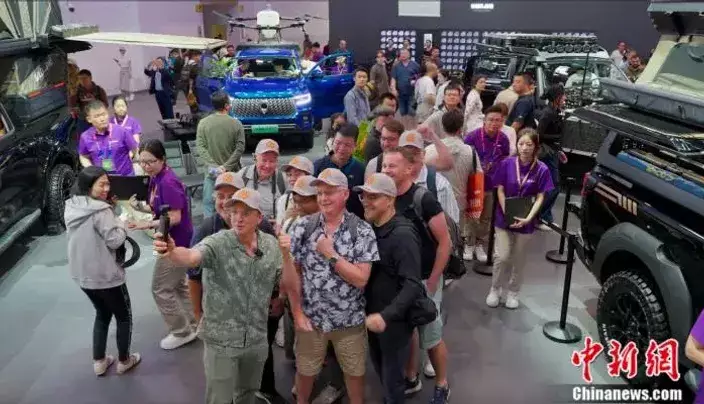
An influencer tours foreign visitors through Chinese new energy vehicles currently unavailable to American buyers. (Source: China News Service)
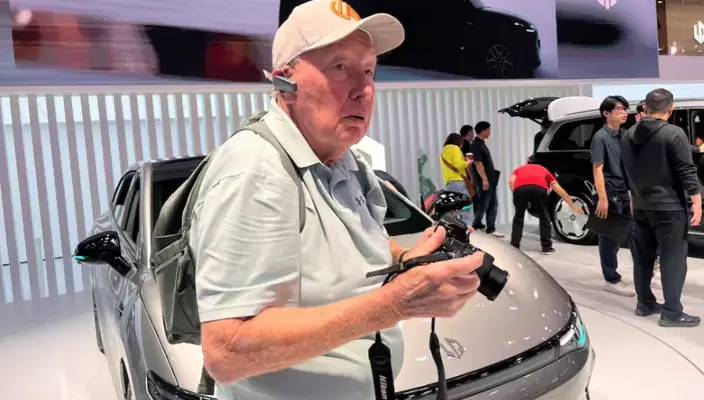
John Cordell snapped photos while touring the auto show. (Source: Reuters)
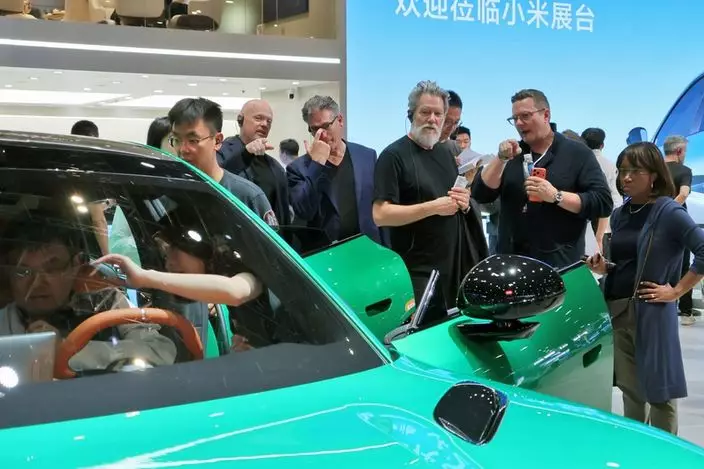
Foreign attendees exploring the Beijing Auto Show. (Source: Guancha.cn)

Chinese new energy vehicles have become a common sight on the streets of Thailand. (Source: Dazhong News)
In April 2026, at the Beijing International Automotive Exhibition, 34-year-old American YouTuber Ethan Robertson—known to his Chinese fans as "Wheelsboy"—led a delegation of over a dozen followers from Australia, New Zealand, the UAE, and beyond through the bustling exhibition halls. This marked his sixth installment of the "Wheelsboy EV Tour," a hands-on journey through China’s electric vehicle landscape.
An influencer tours foreign visitors through Chinese new energy vehicles currently unavailable to American buyers. (Source: China News Service)
John Cordell, a 77-year-old retired engineer from New Zealand, found himself captivated by a Deepal S07. He showered praise on its interior ergonomics, head-up display (HUD), massive infotainment touchscreen, and 360-degree panoramic camera system. Cordell revealed that he already owns a BYD Atto 3 back home: "Hardcore tech is the single biggest selling point of Chinese cars."
John Cordell snapped photos while touring the auto show. (Source: Reuters)
Robertson also showcased a luxury all-electric SUV from Leapmotor to his group, complete with a massive central display and a built-in rear-seat refrigerator. Its top-tier trim carries a price tag of just around $30,000. "In the US, $30,000 will barely get you a decent entry-level EV," Robertson noted bluntly. This stark price gap left his fan group—predominantly made up of Americans—both awestruck and frustrated.
Foreign attendees exploring the Beijing Auto Show. (Source: Guancha.cn)
Social Media's Wave of "EV Envy"
This sense of awe isn't confined to those visiting China in person. Across TikTok and Xiaohongshu, Chinese EVs are sparking a global phenomenon of "EV envy."
One American TikTok user put it frankly: "I want a BYD Dolphin. It’s around $15,000, super affordable, and packed with features." She then added a wry self-mockery: in the US, a country that constantly preaches "free and fair trade," these cars are barred from the market simply because of their origin.
A German netizen expressed disbelief after discovering that a Volkswagen ID.3 retails for only 110,000 RMB ($15,500 USD) in China: "It costs double that in Germany. That's pure madness." Another American user lamented: "I think our government knows we simply can't compete with the quality and value of Chinese EVs. It breaks my heart!"
The "Green Wave" Sweeping Overseas Markets
The disruption caused by Chinese EVs has long migrated from mobile screens to real-world streets.
In Thailand, Chinese automakers led by BYD command over 80% of the battery-electric vehicle (BEV) market. In Europe, sales of Chinese-brand EVs surged by 94% year-on-year in early 2026, driving their market share up from 4.2% to 8%. In Australia, Chinese-made vehicles surpassed Japanese imports for the first time in February 2026, dismantling Japan’s 28-year dominance. In Brazil, the BYD Dolphin topped monthly sales charts as Chinese brands captured a staggering 78% of the pure EV market share.
Chinese new energy vehicles have become a common sight on the streets of Thailand. (Source: Dazhong News)
Forbidden Fruit: The Allure of the Unobtainable
According to Bloomberg, a survey conducted by US automotive consulting firm Cox Automotive revealed that—under the hypothetical scenario where Chinese cars were available in the US market—nearly 40% of American drivers would consider buying one. Among Gen Z respondents, that number soared to 69%.
This presents a fascinating paradox: the US government imposes tariffs exceeding 100% on Chinese EVs, effectively slamming the door on these brands. So why do 40% of Americans still want one?
Part of the answer lies in human psychology: hefty tariffs have ironically transformed these vehicles into forbidden fruit. When TikTok feeds are flooded with videos of $15,000 BYD Dolphins and luxurious interiors featuring built-in fridges, American consumers contrast that with a domestic reality where "no new car exists under $20,000." The disparity is jarring. For Gen Z, Washington’s ban has served as an accidental seal of quality, making these cars all the more desirable.
The global expansion of Chinese EVs is, at its core, a quiet revolution powered by sheer industrial capability. It relies on no grandiose slogans and no forced cultural agenda. Instead, it lives in the satisfied nod of a Thai driver taking the wheel, the delighted reaction of an Australian family opening a car door, and a million-like TikTok video featuring a BYD Dolphin.
These scattered moments assemble a new map of the world—one where "Made in China" no longer signifies cheap contract manufacturing, but stands for intelligence, value, and driving pleasure. When global consumers vote with their wallets and their steering wheels, the market's preference becomes the most persuasive language of all.
Chinamaxxing
** 博客文章文責自負,不代表本公司立場 **