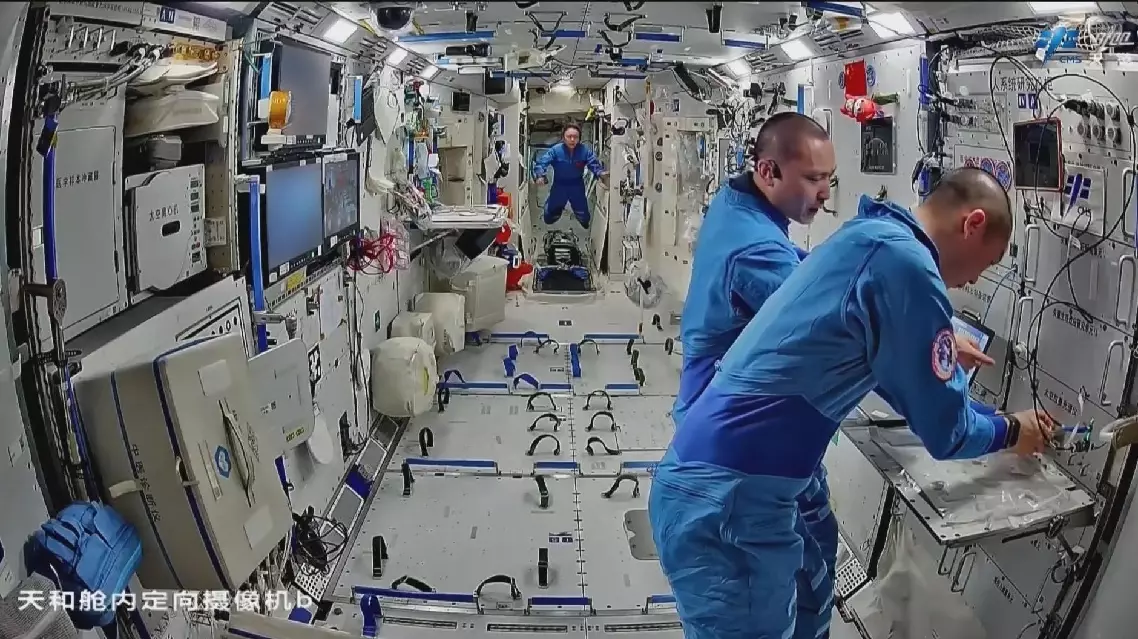
The Shenzhou-23 crew aboard China's Tiangong space station carried out space science experiments, station upkeep and health checks over the past week, according to the China Manned Space Agency (CMSA).
Commander Zhu Yangzhu and his crewmates Zhang Zhiyuan and Lai Ka-ying were launched aboard the Shenzhou-23 spaceship late on May 24 and have been in orbit for more than four months.
Last week, the crew used a space Raman spectrometer to analyze metabolic components in urine samples and conducted research on microbiota and nutritional metabolism. They carried out planned studies on brain activity and human-machine adaptation during multi-tasking scenarios. They also adjusted cabin lighting to conduct performance tests to explore how the lighting environment affects psychological perception and work efficiency.
In the field of microgravity physical science, the crew installed the inertial particle experiment module in the online maintenance and adjustment control cabinet, replaced samples in the fluid physics experiment cabinet, and maintained electrodes for the axial mechanism.
In addition to scientific research, the trio inspected and maintained the space station's life support system, replacing relevant components as scheduled, and conducted routine cleaning of the cabin environment.
The astronauts also completed medical examinations, including neck ultrasound scans, bone density measurements, intraocular pressure and fundus examinations, and body mass measurement.
Shenzhou-23 crew conduct space science experiments, equipment maintenance, health checks
Chinese is increasingly popular in schools in the central European country of Slovakia, as many students start learning the language in high schools or even earlier.
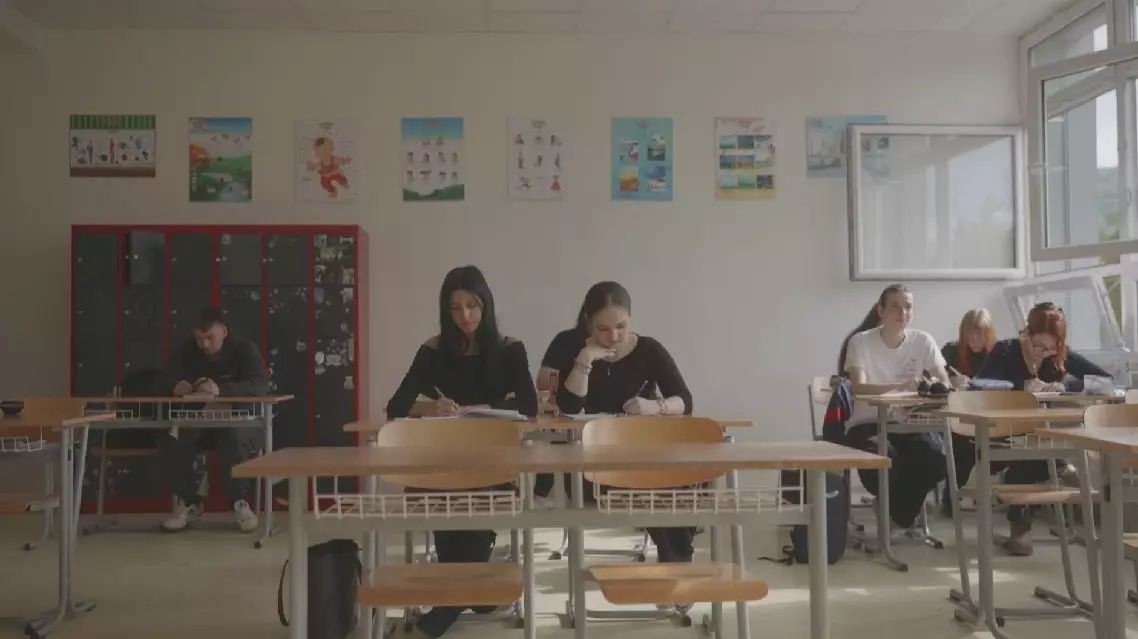
At the Mikulas Kovak High School in Banska Bystrica, a bilingual program was launched in 2016. Participating students spend five years studying Chinese as part of their regular education.
For Anna Marina Vidova, a fifth-year student of the high school, the decision to learn Chinese started with a book when she was just nine years old.
"I read about Chinese culture and history, and I do like history, so I just gave it a try," she said, adding that she is planning to apply to Chinese universities, so she is studying hard right now.
She wants to study international relations, and sees communication between China and Europe as key to their future ties.
"I believe the relations between China and the European Union are very important to us. And I think also the European Union has a lot to offer to China as well," she said.
At school, Chinese learning extends beyond language lessons, with students learning subjects such as mathematics, geography and history in Chinese.
"From the second grade, they are beginning to learn mathematics, physics, biology, geography and chemistry, partly in Chinese, so partly in Slovak language and partly in Chinese language, so it's bilingual," said Jan Durica, a Chinese language teacher of Mikulas Kovac High School.
For Vidova, learning other subjects in Chinese means learning about China beyond vocabulary and grammar.
"I can understand how Chinese think. And like we have Chinese lectures here, teachers, so they also help us," she said.
For graduates like Michaela Cholvadova, the language can also open paths for exchange between Slovakia and China.
"There are many work opportunities I'm looking forward to, maybe China, making some contracts with Slovakia, maybe so I can work in between the two countries," said Cholvadova.
Interest in learning Chinese is also reaching Slovak children.
In Bratislava, Moli Chinese Studio introduces Chinese through play, where children listen to Chinese teachers and learn words through activities.
Natalia Turchin, the studio's co-founder, said the approach helps children get early exposure to the language.
"The idea is that we are playing with them in Chinese. So we have a Chinese lecturer who is here with them, and she's playing with them in Chinese. So they're listening to the Chinese language," said Turchin.
Chinese language learning gains popularity among young Slovakian students