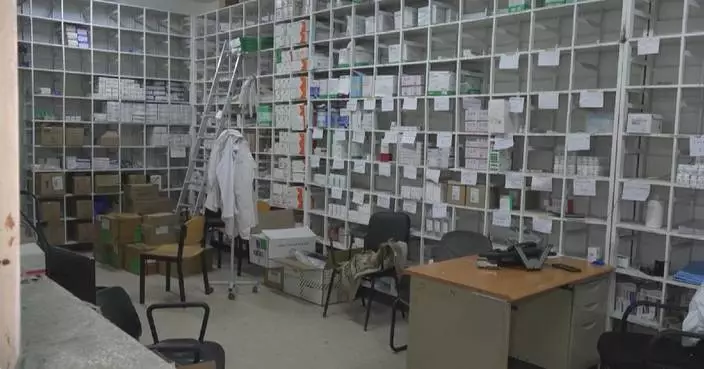
Foreign investors sold more than 20 trillion won (about 15 billion U.S. dollars) worth of local stocks of the Republic of Korea (ROK) over the past month, the country's Yonhap News Agency reported on Sunday.
According to the Korea Exchange (KRX) on Sunday, from Sept. 1 to Oct. 2, foreign investors achieved net buying on only seven trading days. On Sept. 28 alone, foreigners' net selling exceeded three trillion won (about 2.2 billion U.S. dollars), according to the report.
During the period, foreigners sold the most shares of SK hynix and Samsung Electronics. SK hynix net sales were 12.009 trillion won (about 8.9 billion U.S. dollars), and Samsung Electronics' net sales were 5.186 trillion won (about 3.9 billion U.S. dollars).
By market capitalization, as of Oct. 2, foreign investors' shareholding on the KOSPI had fallen to 39.66 percent. Foreign shareholding in SK hynix stood at 49.76 percent, the lowest level in more than three years.
The report said that the sell-off may have been driven by investors taking profits after semiconductor stock prices surged earlier this year. In addition, rising interest rates in major global markets such as the United States also fueled the selling.

Foreign investors dump 20 trillion won worth of ROK stocks in Sept
The Shenzhou-23 crew aboard China's Tiangong space station carried out space science experiments, station upkeep and health checks over the past week, according to the China Manned Space Agency (CMSA).
Commander Zhu Yangzhu and his crewmates Zhang Zhiyuan and Lai Ka-ying were launched aboard the Shenzhou-23 spaceship late on May 24 and have been in orbit for more than four months.
Last week, the crew used a space Raman spectrometer to analyze metabolic components in urine samples and conducted research on microbiota and nutritional metabolism. They carried out planned studies on brain activity and human-machine adaptation during multi-tasking scenarios. They also adjusted cabin lighting to conduct performance tests to explore how the lighting environment affects psychological perception and work efficiency.
In the field of microgravity physical science, the crew installed the inertial particle experiment module in the online maintenance and adjustment control cabinet, replaced samples in the fluid physics experiment cabinet, and maintained electrodes for the axial mechanism.
In addition to scientific research, the trio inspected and maintained the space station's life support system, replacing relevant components as scheduled, and conducted routine cleaning of the cabin environment.
The astronauts also completed medical examinations, including neck ultrasound scans, bone density measurements, intraocular pressure and fundus examinations, and body mass measurement.
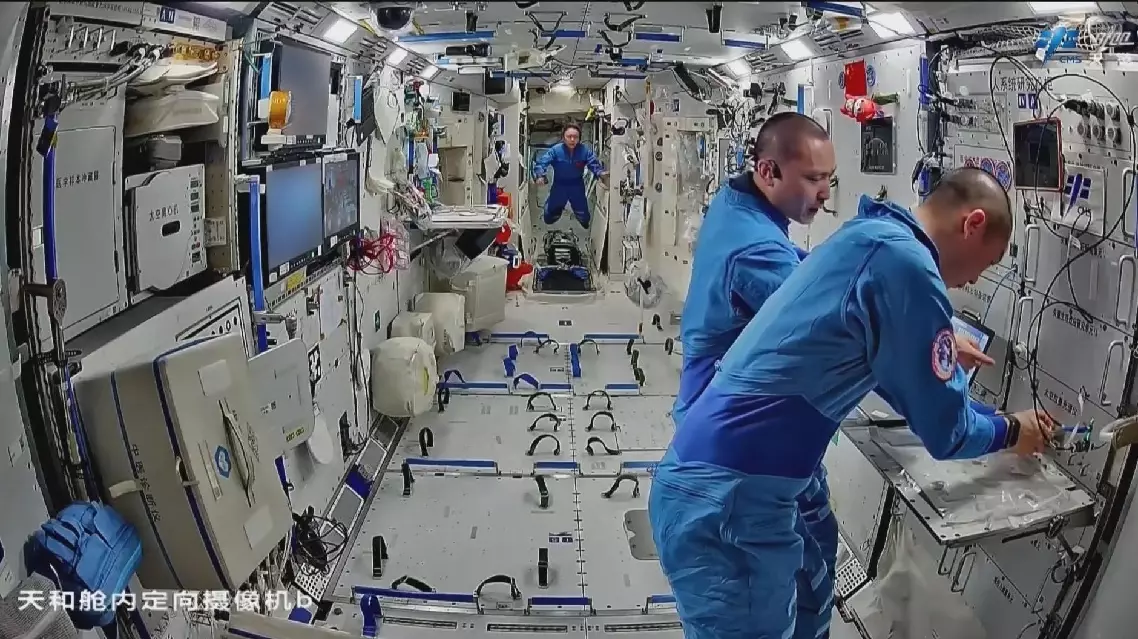
Shenzhou-23 crew conduct space science experiments, equipment maintenance, health checks