Skip to Content Facebook Feature Image

Trump's Surveillance State: When "America First" Meets Orwell's Nightmare

Blog

Trump's Surveillance State: When "America First" Meets Orwell's Nightmare
Blog

Blog

Trump's Surveillance State: When "America First" Meets Orwell's Nightmare

2025-06-09 20:37 Last Updated At:20:40

George Orwell's dystopian masterpiece 1984, painted a chilling picture of Big Brother's all-seeing eye, where every citizen lived under constant surveillance. Now, it seems America might be getting its own version of this nightmare, courtesy of none other than Donald Trump himself.

Trump has been exposed for planning to collaborate with tech giants to establish an AI system for "monitoring the entire nation." Will the totalitarian "Big Brother" from the novel 1984 descend upon America?

Trump has been exposed for planning to collaborate with tech giants to establish an AI system for "monitoring the entire nation." Will the totalitarian "Big Brother" from the novel 1984 descend upon America?

WikiLeaks Drops the Bombshell

WikiLeaks has dropped yet another bombshell, revealing that the Trump administration is reportedly working with tech giant Palantir to build what can only be described as a "national surveillance system" that covers the entire population. And here's the kicker – even some of Trump's most ardent supporters are calling it a betrayal.

The revelations from WikiLeaks and Newsweek paint a disturbing picture of just how far this surveillance apparatus could reach. According to the reports, Trump has allegedly authorized Palantir – a company with deep ties to US and Israeli intelligence – to create a comprehensive AI database that would make Big Brother look like an amateur. We're talking about integrating citizen data from across government departments, tracking everything from political views to behavioral patterns and personal information.

Think about that for a moment. If this system goes live, the government could theoretically identify anyone deemed "anti-American" or "anti-Semitic," or check whether public officials are sufficiently loyal to Trump. It's the stuff of authoritarian regimes, not the "land of the free."

According to the revelations, technical personnel involved in this project have already held discussions with the Social Security Administration and Department of Education about integrating the personal data these agencies hold on citizens.

When Trump's Own Base Turns Against Him

Here's where it gets really interesting – and frankly, quite telling. Even some of Trump's most vocal right-wing supporters are crying foul. When your own base starts accusing you of becoming the very thing you claimed to fight against, you know you've crossed a line.

Newsweek quoted a post by conservative influencer "Patriot's Voice" on X saying, "People are so quick to suggest that I flipped on Trump...No, no, no...I didn't flip on Trump. TRUMP FLIPPED ON US. I'm just not willing to continue living in a LIE, and I will tell you the unfortunate TRUTH about it."

Another influencer, Nicholas Fuentes, didn't mince words either, calling the plan "the ultimate betrayal of his own people." His most cutting criticism? That the plan hands everyone's data over to databases controlled by the CIA and Mossad. "Seriously, if Palantir isn't the deep state, then what is?" he asked.

And that's the million-dollar question, isn't it? Trump spent years railing against the "Deep State," promising to drain the swamp. Instead, it looks like he's just building his own version – one that's potentially even more invasive than what came before.
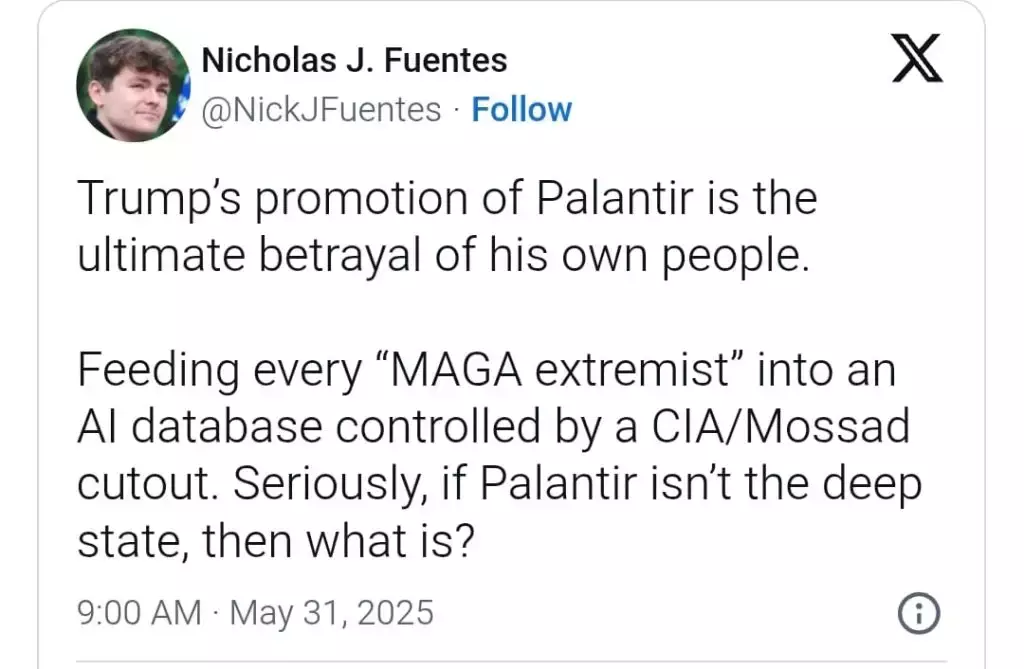
A group of right-wing influencers who were once "Trump fans" have roared in anger at this plan, accusing Trump of betraying his own people and establishing another "Deep State."

A group of right-wing influencers who were once "Trump fans" have roared in anger at this plan, accusing Trump of betraying his own people and establishing another "Deep State."

Tech Giants Enable the Surveillance State

Trump's surveillance ambitions aren't happening in a vacuum, of course. This ties directly into his broader authoritarian playbook, including his recent strong-arm tactics against Harvard, demanding private data on international students and their political activities. When Harvard refused to comply, they faced the predictable Trump tantrum and threats of retaliation.

This whole scheme also aligns perfectly with the infamous "Project 2025" blueprint, which called for purging liberal elements from government and replacing them with Trump loyalists. You need dirt on people to pull that off effectively – lots of it. And here's where it gets even more interesting: the Department of Government Efficiency (DOGE) has already been quietly hiring IT specialists whose job, quite frankly, is to "dox" government employees. It's like they're building the infrastructure for a political purge, one database at a time.

Big Tech's Faustian Bargain

For Trump to pull this off, he needs Big Tech on side, and that's where companies like Palantir come in. Peter Thiel, Palantir's founder, has clearly decided which way the wind is blowing – much like Meta's Mark Zuckerberg, he's chosen the pragmatic path of cozying up to power. For Palantir, helping Trump build his surveillance network could mean lucrative defense contracts and government deals.

Meanwhile, those tech bros who backed Elon Musk are finding themselves out in the cold as their champion fell from Trump's good graces. It's like rats deserting a sinking ship - quite a pitiful sight.

At the end of the day, when profit margins are on the line, questions about helping create an Orwellian surveillance state seem to take a back seat for these tech giants. Whether America becomes a place where "Big Brother is watching" appears to be less important than securing the next big government contract.

Lai Ting-yiu


What Say You?

** The blog article is the sole responsibility of the author and does not represent the position of our company. **

Think back to Hong Kong's turbulent years. Jimmy Lai had three brothers-in-arms, comrades he bankrolled through thick and thin – Cardinal Joseph Zen, Martin Lee, and Anson Chan. But their bonds weren't just ideological. Money changed hands, and plenty of it. Anson Chan pocketed HK$3.5 million from Lai's war chest. Cardinal Zen took in far more – at least HK$26 million in secret donations that the Hong Kong Diocese never knew about and never investigated. Where did all that cash go? That's the million-dollar question. Or rather, the 26-million-dollar question that remains unanswered.

Cardinal Zen met Pope Leo XIV in Rome, reportedly pushing for Jimmy Lai's release – but Vatican intervention looks unlikely.

Cardinal Zen met Pope Leo XIV in Rome, reportedly pushing for Jimmy Lai's release – but Vatican intervention looks unlikely.

Word broke earlier that Cardinal Zen just made a pilgrimage to the Vatican for a sit-down with the newly minted Pope Leo XIV. The private meeting lasted about an hour. On the agenda: the conviction of "Catholic" Jimmy Lai. Sources say Zen pressed the pontiff hard to "save Lai." What did the Pope say? Nobody's talking. But you can bet the Vatican knows all about the questionable financial ties between Zen and Lai – a relationship the Cardinal has never properly explained to his own Diocese. Did personal interests play a role? The doubts are real.

A Vatican Gambit

Cardinal Zen's "612 Humanitarian Relief Fund" case is still grinding through the courts, and authorities had confiscated his passport. But when the Vatican called its recent "Special Consistory" – bringing cardinals from around the world to Rome – the court granted him temporary travel privileges. During the gathering, Pope Leo XIV carved out time for a private one-on-one with Zen after a breakfast session. The topics? Whether the China-Vatican agreement should be renewed, and the fate of Jimmy Lai, now convicted under Hong Kong's National Security Law. But whether the Pope took any position on Lai remains under wraps.

Zen views Jimmy Lai as both a close friend and a comrade-in-arms, so naturally he's pushing the Vatican to intervene. But here's the Vatican's dilemma: it's not just about China-Vatican relations. It's about the unresolved financial relationship between Zen and Lai – a relationship that has seriously damaged the Cardinal's credibility.

The Secret Pipeline

October 2011 brought a massive leak. Jimmy Lai's secret donations to political parties, politicians, and organizations spilled into public view – and Joseph Zen, then Bishop of Hong Kong, was on that list. Between 2006 and 2010, he received HK$20 million from Lai over four years. From 2012 to 2014, another HK$6 million landed in his hands. The total: a staggering HK$26 million.

When the news broke, Zen went silent. Only after relentless media pressure did he offer an explanation, claiming the money went to support underground churches in the Chinese Mainland and other charitable organizations. With a casual smile, he described himself as a "spendthrift," saying most of the money had already been spent with only a few hundred thousand remaining – and even expressed hope that Lai would keep the donations coming.

Talk is cheap. He provided no concrete evidence to back up his claims. The Hong Kong Diocese knew nothing about his receipt of this massive sum from Lai – the entire "money pipeline" operated in secret. To this day, he has never given the Diocese a complete accounting.

Because this financial channel remained so deeply hidden, suspicions naturally arose that personal interests were involved. But given Cardinal Zen's position, the Diocese refrained from investigating him. The true destination of the funds? Still shrouded in doubt.

HK$26 million from Jimmy Lai to Cardinal Zen – Diocese in the dark, money's whereabouts still a mystery. The trio behind Hong Kong's unrest!

HK$26 million from Jimmy Lai to Cardinal Zen – Diocese in the dark, money's whereabouts still a mystery. The trio behind Hong Kong's unrest!

Vatican Cold Shoulder

Cardinal Zen's questionable relationship with Jimmy Lai, combined with his overly hawkish stance toward China, put him in the Vatican's bad books after Hong Kong's National Security Law took effect in late June 2020. Around that time, Zen traveled uninvited to the Vatican, demanding a meeting with then-Pope Francis to discuss Hong Kong's bishop selection and issues facing underground churches in the Mainland. The Pope gave him zero face. Francis refused to see him. After cooling his heels in Rome for four days with nothing to show for it, Zen returned to Hong Kong empty-handed.

Later, Zen and Lai joined forces on Jimmy Lai's "Live Chat" livestream program to blast the Vatican, accusing it of staying silent on underground churches, Tibet, and Hong Kong human rights issues. This clearly shows how the "Zen-Lai duo" consistently conspired to incite underground church activities in the Mainland, stir up religious conflicts, and undermine China-Vatican relations.

Cardinal Zen's latest Vatican trip for a private papal audience, where he lobbied to "save Lai" and reiterated his opposition to renewing the China-Vatican agreement, proves one thing: at 94 years old, the cardinal's anti-China, pro-chaos heart hasn't changed one bit.

Long Odds

The new Pope's willingness to meet him represents a slight thaw from his predecessor's icy attitude. But the chances of Vatican intervention to "save Lai"? Extremely low. The unresolved questions about Zen's financial relationship with Jimmy Lai have significantly diminished his influence with the Vatican.

From a legal perspective, his cardinal status currently shields him from serious consequences. But risks remain. Perhaps it's time for him to follow Anson Chan's example and retire from such activities while he still can.

Lai Ting-yiu

Recommended Articles