

The 50th anniversary G7 summit in Canada wasn't exactly the celebration organizers had in mind. Instead of marking half a century of Western cooperation, it highlighted just how irrelevant this old boys' club has become.
When Success Means "Trump Didn't Storm Out"
Bloomberg's Andreas Kluth really nailed it when he described how the summit's success was measured simply by "avoiding a rage quit by the American guest". Think about that for a moment – we're talking about the supposed premier forum of Western democracies, and their definition of victory is basically keeping one guy from having a tantrum and leaving early.
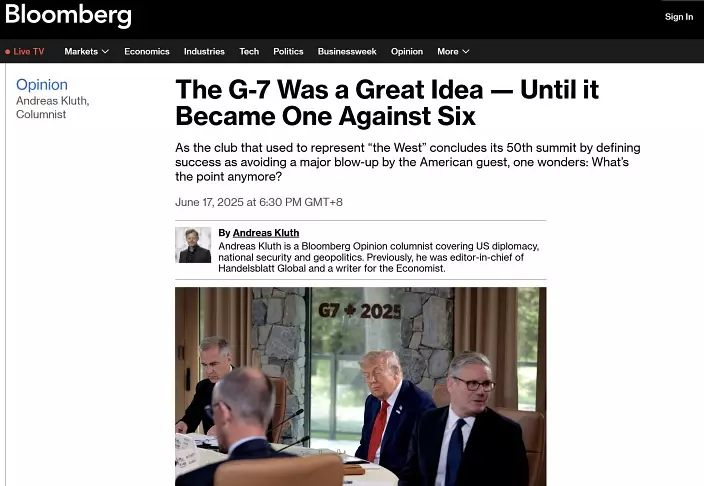
Bloomberg's brutal assessment says it all: the G7 has devolved into a dysfunctional family dinner where everyone's just hoping dad doesn't flip the table.
And yet, Trump did exactly that anyway, departing on June 16th citing "Middle East situation" as his excuse. The man literally couldn't even stick around for the full show. Canadian Prime Minister Mark Carney had to cancel the traditional final communiqué altogether – you know things are bad when you can't even agree on a piece of paper to wave around for the cameras.
The whole thing was so dysfunctional that a Canadian official reportedly described hosting the summit as "like preparing the red carpet for Godzilla". That's not exactly the diplomatic language you'd expect, but it perfectly captures the mood.
America First vs. Everyone Else
The fundamental problem here isn't just Trump's personality – though that certainly doesn't help. It's that American interests have diverged so dramatically from its supposed allies that they're basically operating in different universes.
Take the Middle East crisis. While French President Macron and others are pushing for Israel to dial down the escalation with Iran, Trump's over there cheerleading Israeli strikes as "excellent," showing how pleased he is with Israel for its “mission”. While Macron is working on UN conferences about the Two-State Solution, Trump's ambassador to Israel openly rejects the very concept.
On Ukraine, the gap between the US and G6 is even wider. Trump's promising to end the war "in one day" while European leaders are scrambling to figure out how to keep supporting Kyiv without American backing.
The personal dynamics didn't help either. Among those invited to the Summit, quite a number have had unpleasant experience with Trump. Ukrainian President Zelensky got into heated arguments with Trump right in front of White House media, and South African President Ramaphosa was ambushed by Trump, again, on live news cameras, with videos about alleged "racial genocide against whites". Not to say Trump’s open remarks about making Canada the 51st state of the US, and taking over Greenland.
And if all that wasn't enough, Trump's "reciprocal tariff" war against every trading partner has a July 9th deadline looming – talk about adding economic warfare to diplomatic chaos. This isn't exactly new territory either; back in 2018, Trump pulled the same stunt, refusing to sign the G7 joint communiqué and publicly trashing then-Canadian PM Trudeau as "dishonest and weak". Once is a tantrum, twice is a pattern.
The Numbers Don't Lie: G7's Shrinking Relevance
Here's where things get really interesting – and this is something Western media tends to gloss over. The G7's economic clout has been hemorrhaging for decades. But this decline isn't just about numbers – it's about the fundamental collapse of what the G7 was supposed to represent.
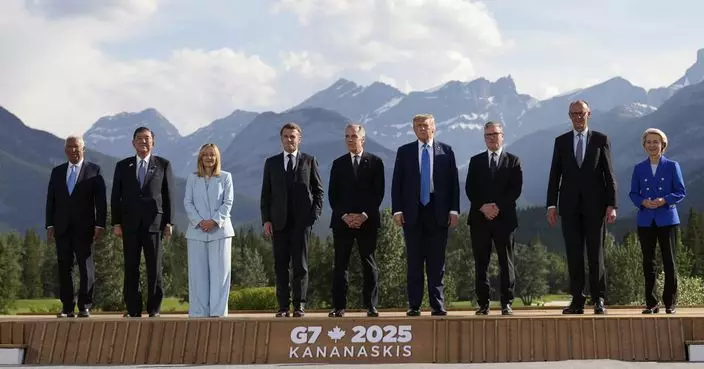
When you can't even manage a joint statement anymore, maybe it's time to admit your club's lost its purpose. The empty chairs tell the real story of Western "unity."
Remember, this club was born back in the 1970s to deal with oil crisis and huge economic problems. At the initiative of West Germany and France, the leading industrialized democracies convened their first regular meeting to manage a troubled world. It was meant to be Western countries coordinating their positions on major economic and strategic issues during genuine crises.
But that shared purpose? It's gone. As Bloomberg's analysis brutally puts it: "The underlying issue is that Trump doesn't share the values of the other six democracies and no longer has any checks on his whims. To the extent that the G-7 used to embody 'the West,' that common basis is gone." Those "Western values" the G7 once symbolized simply don't exist anymore when the biggest player is operating from a completely different playbook.
The conclusion is as stark as it gets: "That era is gone. So is the reason for having the G-7 at all." When your founding principles have evaporated, what exactly are you meeting about?
And the economic data backs this up perfectly. According to IMF data highlighted in the Nikkei analysis, the G6 (excluding the US) saw their combined share of global GDP crash from 35% in 2000 to just 18% in 2024. Japan's decline has been particularly brutal, dropping from 15% of global GDP in 2000 to a mere 4% in 2024. No wonder Trump's looking at these guys like yesterday's news.
Meanwhile, China's sitting pretty at 17% of global GDP in 2024 – almost matching the entire G6 combined. That's not just impressive; it's a complete reordering of global economic power that the G7 framework simply wasn't designed to handle.
The New Kids Are Taking Over
While the G7's been busy with its internal drama, the rest of the world hasn't been sitting idle. China and other emerging economies have been rising rapidly, with China becoming the "world's factory" and achieving high-speed growth that surpassed post-war Japan. In 2024, China's GDP accounted for 17% of the global total – almost matching the entire G6 combined.
Meanwhile, the BRICS mechanism led by China, Brazil, Russia, India, and South Africa continues to grow stronger. Saudi Arabia, Egypt, UAE, Iran, and Ethiopia all became official BRICS members at the beginning of last year, dramatically expanding the bloc's reach.
More than half the world's people and nearly half its economic output is now organized under a framework that explicitly positions itself as an alternative to Western-dominated institutions. While the G7 argues about communiqués, BRICS is quietly building the future.
Deep Throat
** 博客文章文責自負,不代表本公司立場 **