The RoBoLeague World Robot Soccer League will hold its final competition in Beijing on Saturday, showcasing autonomous humanoid robots in a cutting-edge event that merges artificial intelligence with the thrill of competitive sports.
As the first test competition for the upcoming inaugural World Humanoid Robot Games, the 3-on-3 humanoid robot football match will take place in the Beijing Economic-Technological Development Area, widely known as the Yizhuang Development Zone.
Following rounds of fierce qualifying games, four Chinese teams of humanoid robot footballers have been selected to take part in the finals on Saturday evening.
On Thursday, teams from Tsinghua University and Beijing Information Science and Technology University hit the pitch to demonstrate their robot players' football prowess during a pre-competition training session.
The finals' rules stipulated that each team consist of three players and one substitute, with each match comprising two 10-minute halves and a 5-minute break.
The matchup unfolded without any help from human controllers, as the two-legged robot players accurately kicked, ran after, moved around, and jostled for the ball, despite their slightly wobbly movement.
"The World Robot Soccer League will be the first test competition for the 2025 World Humanoid Robot Games and China's first-ever 3-versus-3 AI humanoid robot football match as well, which will put the participating robots' endurance and agility to the test," Dou Jing, an organizer for the RoBoLeagueWorld Robot Soccer League, told China Central Television (CCTV) in an interview Thursday.
According to Wang Yonghao, who is in charge of the operations of Saturday's competition, said the robots are equipped with sensors that enable them to nimbly maneuver on the pitch and the rules have specified the use of colors to minimize disturbance for the competition.
"At present, all the visual recognition and positioning abilities of the robot are accomplished through optical cameras. For instance, during the football match, it needs to first identify a white, round ball, or an object of a similar size. Then we make sure that the color white or any other similar color will not appear on the robots' feet, on the body of the on-site staff and referees, including their shoes or other objects on them," he told CCTV.
The fully autonomous soccer bots have been trained with deep reinforcement learning, which gives them humanlike agility and enables them to better sense and react to their surroundings, without the need for human control.
"The robot should be able to see the football nearly 20 meters away at an accuracy rate of over 90 percent. First, it should be able to tell what or where the ball, the goal, or the pitch is, and afterward it needs to make decisions about the role it is going to play based on all these inputs. The following step would be to kick the ball and try to score a goal. All these are the technological challenges we aim to address at the moment. Of course, as the technology evolves, all these capabilities can be achieved for the robot now," said Cheng Hao, founder and CEO of Beijing-based Booster Robotics.
Beijing will host the 2025 World Humanoid Robot Games from Aug 15 to 17, as part of the larger World Robot Conference. It will be the first global sporting event dedicated solely to humanoid robots.
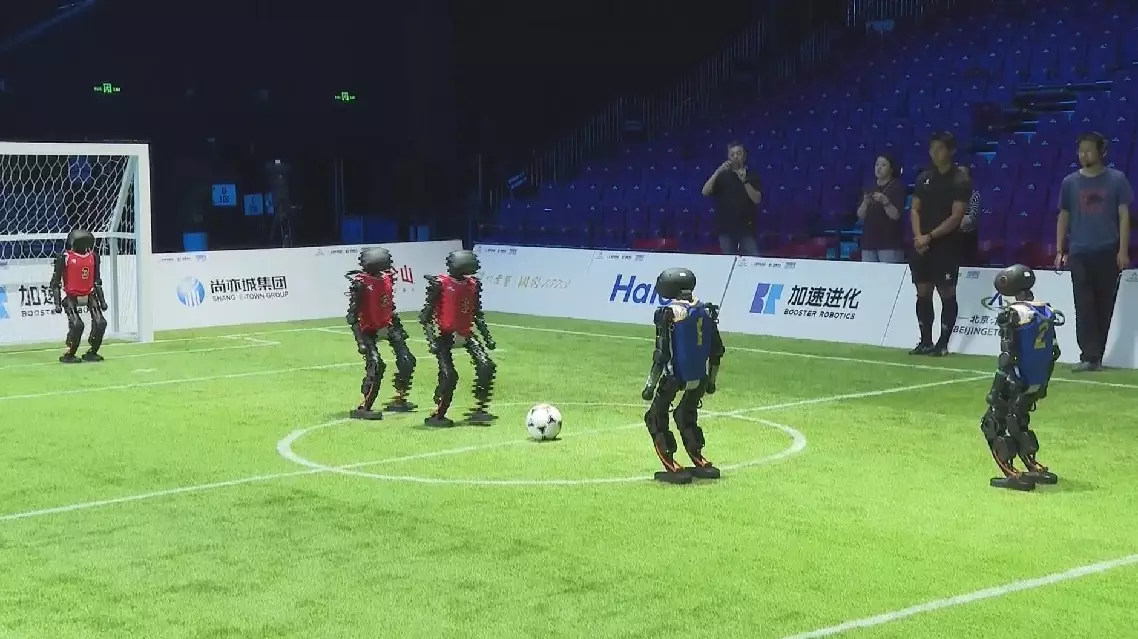
Fully autonomous soccer robots gear up for Beijing showdown in futuristic finale