Trump has once again stirred the pot by threatening to sue George Soros, the 95-year-old billionaire financier and lifelong Democratic mega-donor, as well as his son Alexander. Trump claims—without any solid proof—that the Soroses are behind violent protests sweeping across America, using the Racketeer Influenced and Corrupt Organizations Act (RICO) as his weapon of choice. Sound familiar? Critics are quick to label this move as another federal power play against political opponents.
On August 27, Trump fired off a post on Truth Social claiming he wants to indict both Soros and son for funding these nationwide protests. His messaging was classic Trump takedown style: “George Soros, and his wonderful Radical Left son, should be charged with RICO because of their support of Violent Protests, and much more, all throughout the United States of America.” He didn’t stop there, warning Soros’s “Crazy, West Coast friends” that “we’re watching you!”
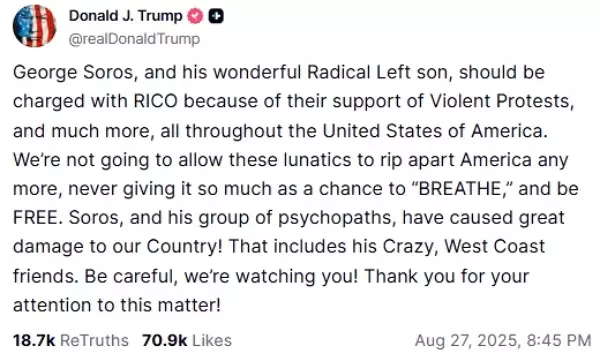
Trump’s latest social-media salvo: “Suing Soros and his boy for backing violent protests nationwide—watch out!”
Soros’s Legacy and the Political Battleground
The Financial Times notes how right-wing US media outlets have accused Soros’s Open Society Foundations—the massive charity he founded and which his son now chairs—of bankrolling protests against Trump’s troop deployments in Washington, D.C. The foundation firmly denied these claims, calling them “false.” Open Society Foundations is a huge player globally, disbursing about $1.5 billion a year to causes like human rights, government transparency, and public health.
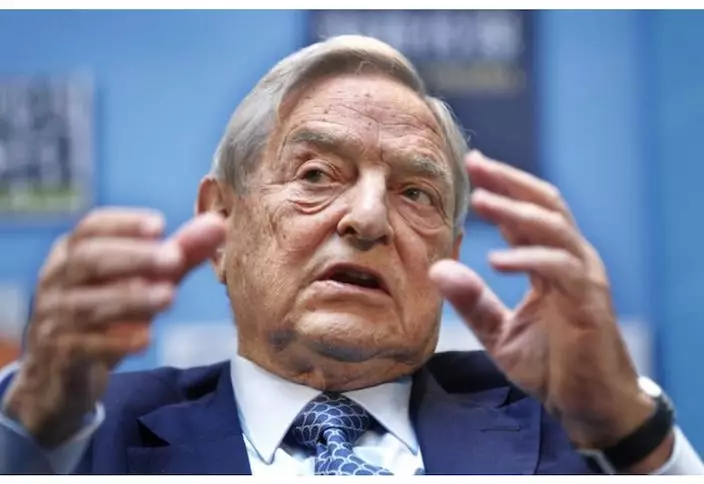
Right-wing outlets claim Soros’s Open Society Foundations bankrolled the D.C. protests against Trump’s troop deployments.
Trump’s attack drew backing from none other than Elon Musk, who posted that “It’s time to go after Soros directly.” Musk had previously accused Soros of financing protests outside Tesla stores. Meanwhile, data shows the Soros family was one of Kamala Harris’s biggest donors last election cycle, splashing out over $8.5 billion just in 2024. Just before leaving office, Joe Biden awarded George Soros the Presidential Medal of Freedom.
Soros reportedly handed over control of the foundation to Alexander in 2023, who describes himself as even more politically engaged than his dad and hints at opposing any Trump return to the White House. Soros is also known for pumping massive amounts of money into influential US media figures—Fox News once claimed over $32 billion has been spent promoting his “open society” agenda since the 1980s.

In 2023, George passed the Open Society torch to his son Alexander—who’s even more fired up about politics.
Of course, this is part of a bigger picture. Soros has been known for backing “color revolutions” worldwide—supporting regime changes in places like Ukraine, Georgia, and Kyrgyzstan by funding pro-democracy movements that also conveniently pave the way for his financial interests. His enduring antagonism to China is no secret either—calling it “the greatest threat to open society” and dubbing investments in China a “tragic mistake.” Not to mention his repeated attempts to influence Hong Kong, which mostly fizzled out.
Even some European countries have pushed back hard against Soros in recent years. Russia banned the Open Society Foundations in 2015, accusing it of undermining Russia’s security. By 2017, several countries including Hungary, Poland, Macedonia and Romania followed suit. Viktor Orbán, Hungary’s Prime Minister and Soros’s home turf, even hailed Trump’s victory as a major blow to Soros and his Democratic allies, calling for an EU crackdown on Soros’s “agents.”
So there it is: a mix of high-stakes political drama, financial power plays, and a narrative that divides opinion sharply. Trump’s move? A direct confrontation with one of the most controversial figures in global politics, just as the next US election gears up.
Deep Throat
** The blog article is the sole responsibility of the author and does not represent the position of our company. **
Trump just rolled out another tariff threat, and this time Iran's trading partners are in his crosshairs. On January 12, the US president announced a blanket 25% tariff on any country "doing business" with Tehran.
The international press immediately fixated on China—Iran's biggest trade partner. Reuters warned this could reignite the US–China trade war and shred the fragile truce both sides hammered out last year. But Chinese scholars aren't buying it. They say Trump lacks the nerve to slap Beijing with new tariffs, because China will hit back hard—and make him regret it.
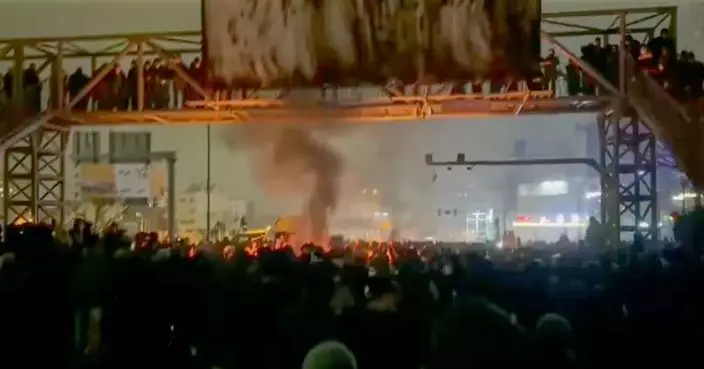
Anti-government protests erupt in Iran. (AP photo)
The Financial Times reported on January 12 that these tariffs—which took effect immediately—could slam China, India, Turkey, Pakistan, the UAE, Brazil, and Iraq. All of them trade heavily with Iran. Russia sealed a new free trade deal with Iran in 2025, making it another potential target.
CNN pointed out the stakes for Beijing. China trades with both Iran and the US, so if Washington applies these tariffs, Chinese goods entering America could see costs spike. The network recalled that after last year's summit in Busan, South Korea, the Chinese and US presidents agreed to pause portions of their tariff war—a temporary truce.
Iran as Flashpoint, Again
Reuters published a piece on January 13 titled "Trump's Iran Tariff Threat Risks Reopening China Rift." The article traced how Iran became a powder keg in US–China relations during Trump's first term (2017–2021).
Back then, Washington tightened sanctions on Tehran and blacklisted Huawei, accusing the Chinese telecom giant of selling tech to Iran. That led to the arrest of Huawei founder Ren Zhengfei's daughter, Meng Wanzhou, in Canada—triggering a diplomatic crisis and sending bilateral tensions through the roof.
Now Trump's targeting Iran again. If he follows through, total US tariffs on Chinese exports could exceed 70%—way higher than the rates both sides agreed to last October when they dialed down their trade fight.
It's still unclear which countries or entities Trump will actually target. He hasn't named China explicitly. But Reuters noted Trump has a track record of making bombastic statements that could upend US foreign policy—only to back off later.
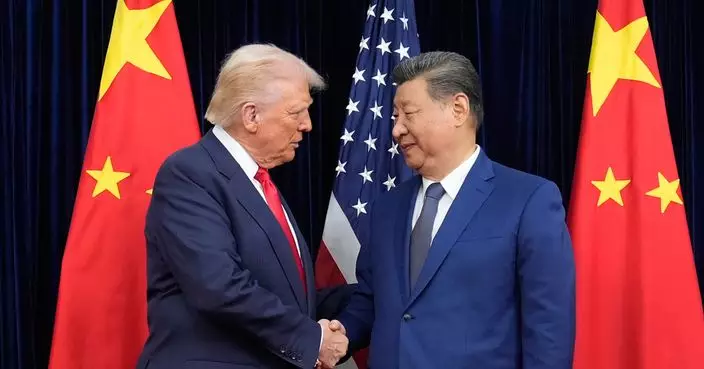
US–China "truce" forged in Busan last year now at risk if Trump's Iran tariffs target Beijing. (AP file photo)
Beijing Calls Trump's Bluff
Wu Xinbo, Dean of Fudan University's School of International Relations, told Reuters that China sees through Trump's posturing. "China will call (Trump's) bluff. I can assure you that Trump has no guts to impose the extra 25% tariffs on China, and if he does, China will retaliate and he will be punished," said Wu.
Another Chinese scholar pushed back on the narrative that China and Iran are economically intertwined, noting that "China and Iran are not as close as in the public imagination".
China Customs data backs that up. Beijing has dramatically reduced imports from Iran in recent years. Through November last year, China imported just 2.9 billion USD worth of Iranian goods—a far cry from the 21 billion USD peak in 2018, during Trump's first presidency.
Some sources claim China's major oil companies stopped doing business with Iran in 2022. Yet China's purchases from Tehran still run into the billions, thanks to independent refiners handling shipments.
China as Convenient Scapegoat
Wang Jin, a researcher at Beijing's Dialogue Think Tank, told reporters that "China is just an excuse, a kind of disguise for the Trump administration, to impose new pressure (on) Iran."
Chinese Foreign Ministry spokesperson Mao Ning responded to Trump's tariff threat on January 13. She stated that China's position on tariffs is crystal clear: tariff wars produce no winners. Beijing will firmly defend its legitimate rights and interests.
Analysts warn that Trump's renewed attempt to cut Iran off from global trade could heighten worries about the Belt and Road Initiative. Iran serves as a strategic hub for Chinese goods heading to the Middle East.
This tariff gambit has cast doubt on Trump's planned April visit to China. Observers had expected him to seal a comprehensive trade deal with Beijing during that trip.
The Wall Street Journal echoed Reuters' concerns, warning that new tariffs on Iran's trading partners could wreck the US–China trade truce.
But Reuters also cited Xu Tianchen, a senior analyst at the Economist Intelligence Unit, who questioned whether Trump's tariff policy is even enforceable. "Last year he announced tariffs related to 'illicit' Russian oil trade, but their implementation was patchy." Xu said.
He went on stating that "Trump is also the kind of person who likes bullying the weak," Xu said. "He should manage his actions to avoid these tariffs escalating into direct confrontation with China".