Elon Musk saw this coming. Right before Trump took office again, he clashed hard with the "MAGA crowd" over whether to tighten H-1B visas for tech workers, openly saying America desperately needs these experts. Musk feared Trump would overdo it and slam the door shut, so he sounded the alarm early.
Sadly, that warning proved true. Just last Sunday, the U.S. government announced a staggering jump in H-1B visa fees—from a baseline of $1,700 to a whopping $100,000 (about HK$780,000). It’s essentially a stealth ban designed to scare off foreign tech talent. While this only applies to new visas, foreign tech workers already in the U.S. are rattled, worried Trump's crackdown could sweep them away at any time.
A scholar friend of mine who’s lived in the States for years told me this shutdown could actually benefit Mainland China and Hong Kong by absorbing tech talent—and that Chief Executive John Lee should strike while the iron’s hot.
Why the U.S. Needs Foreign Tech Talent
Musk was dead set against limiting H-1B visas because the U.S. just doesn’t have enough homegrown tech talent. Big tech firms lean heavily on these "foreign reinforcements" — it’s vital to their business and growth. His Indian-American partner, Vivek Ramaswamy, pointed out that America has long celebrated mediocrity over excellence, which is why the country now depends so much on foreign tech workers. A heavy clampdown on these visas would be “mutually assured destruction” with serious fallout.
The loud, aggressive "MAGA camp", however, pummeled Musk and others’ views and pushed Trump toward this harsh decision. The end result? The government slammed the H-1B visa fees through, effectively shutting the door on foreign tech talent.
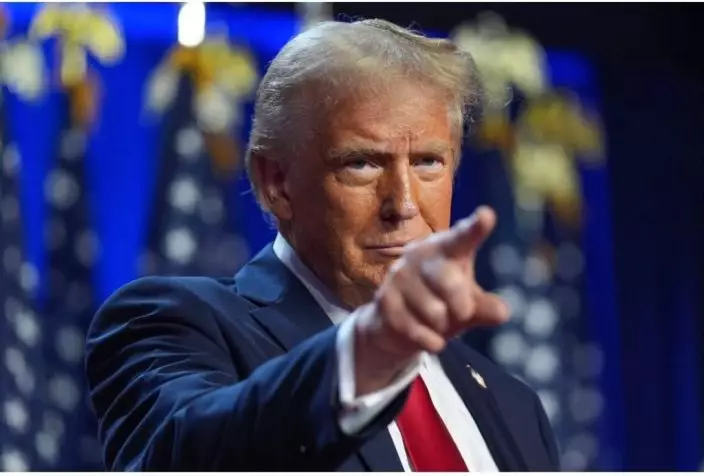
Trump’s visa hike scares off tech talent, stalling U.S. innovation.
Panic and Chaos Hit Tech Firms
The administration’s vague, last-minute change—announced early Monday—threw U.S. tech companies into turmoil. Firms pleaded with foreign staff to stay put, and those abroad raced home before the cutoff. Some even abandoned flights in mid-air, creating a “Dunkirk”–style exodus.
Such chaos left U.S. authorities scrambling to clarify that the fee hike only applies to new visas, doesn’t affect current visa holders, and is a one-time fee, not annual, hoping to ease the panic. But for many tech workers already in the U.S., trust has been shaken—they’re unsure when or if more changes could come and are already making backup plans.
Innovation Takes a Hit
Even if current workers are safe, this huge fee hike will definitely scare off foreign talents thinking of coming to the U.S., hitting tech firms hard.
A venture capitalist partner said this will weaken America’s ability to attract world-class talent, limiting innovation and economic growth. Industry insiders warn some companies might outsource jobs abroad, further diminishing the U.S.’s status as a global tech leader.
This new U.S. policy doesn’t just hit tech workers—it also shakes the confidence of Mainland and Hong Kong students thinking about studying in America. A recent Canadian education survey showed the U.S. has fallen to third place as the most attractive study destination for foreign students, behind the UK first and Canada second. When it comes to openness, safety, and welcoming attitudes, the U.S. dropped to sixth place, dead last in the ranking.
Clearly America’s appeal to international students is fading fast. The new visa fees only add to doubts about future job prospects, meaning fewer students will pick the U.S. anymore.
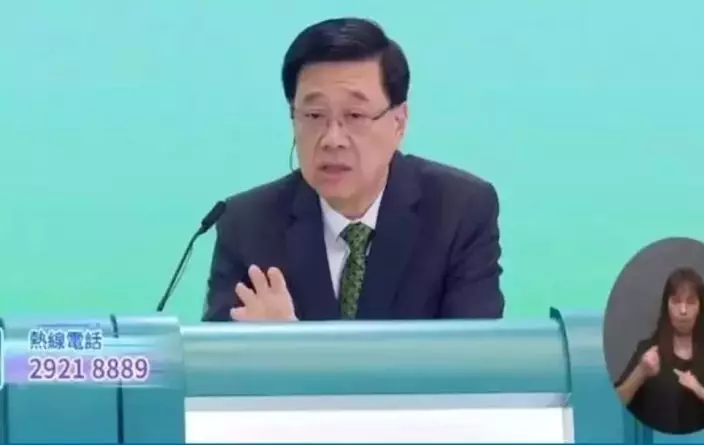
John Lee’s chance: Hong Kong’s moment to snatch top talent.
Hong Kong Stands to Gain
Trump seems unfazed by these downsides and looks set to keep pushing ahead recklessly. My scholar friend argues this is a huge win for Mainland China and Hong Kong, which are hungry for tech talent. Some who can’t stomach going to the U.S. anymore might head there instead, and unsettled tech workers already in the States could decide to come home. Chief Executive John Lee announced in his policy address a series of measures to attract foreign talent, and my friend thinks this is the perfect moment for Hong Kong to compete—and win.
Like I said before, Hong Kong’s entering a golden era and keeps getting better. With America shooting itself in the foot, now’s the perfect time for Hong Kong to steal the spotlight and attract top talent.
Lai Ting-yiu
What Say You?
** 博客文章文責自負,不代表本公司立場 **
Over the past few years, a few "troublemakers" have been busy stirring the pot and provoking foreign attacks against Hong Kong. The most notorious of these is the UK-based "Hong Kong Watch." In March 2023, the Hong Kong Police's National Security Department accused the group of violating the National Security Law and ordered it to take down its website, and put its founder, Benedict Rogers, on the wanted list. Yet, the group operates with impunity and has recently launched a series of malicious campaigns.
However, just like other anti-Hong Kong organizations, it's facing a serious funding crisis. While it might be doing slightly better than the National Endowment for Democracy (NED)—whose funding has been completely cut—its cash reserves will inevitably run dry. In a desperate scramble to survive, "Hong Kong Watch" is now putting on a big show, pretending to fight the UK government's potential change to the BNO path to residency from "5+1" to "10+1," hoping to squeeze money out of Hongkong BNO holders who've moved to the UK.
The problem is, with the UK economy in the doldrums, everyone is feeling the pinch, and when it comes to donations, the sentiment is a resounding "leave me alone."
A Calculated Performance
Following a petition signed by over 100,000 UK-based Hongkong BNO holders, the UK Parliament was prompted to debate changing the BNO "5+1" rule to "10+1." On the eve of this debate, "Hong Kong Watch" staged a grand performance right outside the Houses of Parliament. Not only did founder Benedict Rogers show up to wave flags and shout slogans, but several hawkish MPs were also invited for "friendly cameos" to demand the government stick to the "5+1" policy. The group even roped in the last Hong Kong Governor, Chris Patten, to put on a show of righteousness and speak out for Hongkong BNO holders in the UK.
An observant source noted that this elaborate performance by "Hong Kong Watch" is directly tied to its ongoing annual fundraising campaign. The "5+1" issue is a top concern for Hongkong BNO holders who have moved to the UK, and the group is betting that if it can appear to "successfully campaign" on their behalf, any donation would seem like a worthy investment. Once the cash starts flowing, it can continue to stir up trouble and push its "international front" in the UK, Canada, the US, and Australia.
However, a quick look at the crowdfunding progress posted by "Hong Kong Watch" on its social media tells a bleak story. Its 2025 fundraising drive has so far managed to pull in a mere £6,503 (about HK$68,000), a far cry from its annual target of £50,000 (about HK$530,000). With a massive £43,000 shortfall, reaching that goal looks to be an incredibly difficult task.
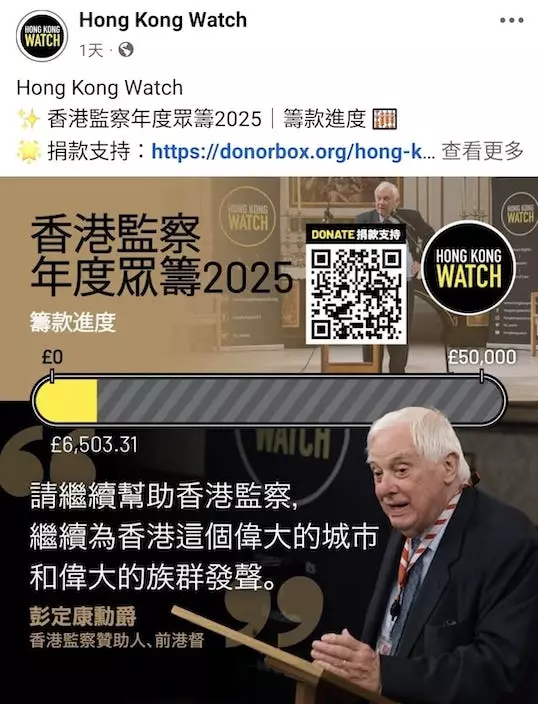
"Hong Kong Watch" is going broke. Its fundraiser is a flop, pulling in just £6,000 of a £50,000 goal, and even patron Chris Patten's pleas for cash have fallen flat.
Why the Money Dried Up
According to the source, a key reason for the group's dismal fundraising is that one of its former major backers was the Conservative Party government.
A few years back, when the Hong Kong Police's National Security Department accused the group of violating the law and blocked its website, then-Foreign Secretary Liz Truss publicly condemned the action, and even Prime Minister Boris Johnson made a statement. But since the Labour Party took power last year, the political support behind "Hong Kong Watch" has significantly weakened, and its ability to raise funds has taken a major hit.
Furthermore, Trump's return to power has led to a massive overhaul of the US federal government. State Department-affiliated agencies that fuel "color revolutions," like the US Agency for International Development and the National Endowment for Democracy, have had their funding taps turned off. They've laid off countless staff, and some have even shut down completely. The "revolutionary funds" they used to distribute, directly or indirectly, to political organizations around the world have also shrunk dramatically, and it's believed that "Hong Kong Watch" has likely felt the impact.
The group's other fundraising target is the Hongkong BNO holders who have moved to the UK. While they did make some donations in the beginning, life has become much harder.
In recent years, soaring inflation and economic stagnation in the UK, compounded by tax and tuition hikes under the new Labour government, have placed a heavy financial burden on them. Life is incredibly tough, and most simply don't have the spare cash to donate to these kinds of organizations. It's no surprise that the group has only managed to raise pocket change this year.
Stirring Trouble on an Empty Wallet
Even with its funds dwindling and the risk of going completely broke, "Hong Kong Watch" hasn't stopped its rabble-rousing. It recently teamed up with Hong Kong groups in the UK, as well as Tibet and Xinjiang independence activists, to continuously disrupt the expansion plans of the Chinese Embassy in the UK.
Another large-scale protest is slated for September 28, where Benedict Rogers is sure to be front and center as the flag-bearer. However, if its funding crisis isn't resolved, its political influence is bound to decline.
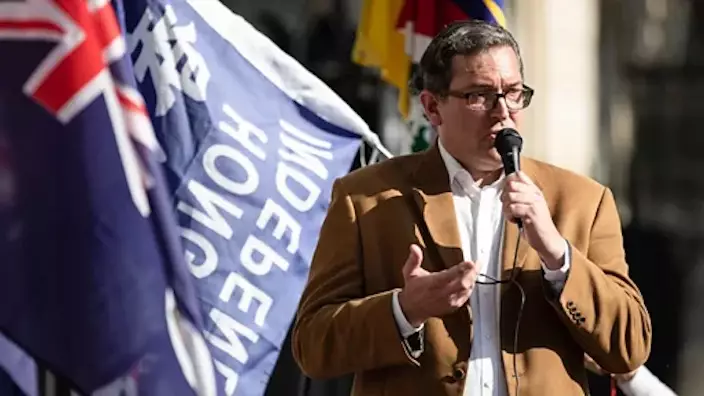
Founder Benedict Rogers, wanted by Hong Kong police, keeps stirring trouble by protesting the Chinese Embassy's expansion with his activist allies. But without cash, the group's political clout is set to vanish.
The source advises Hongkong BNO holders in the UK to be cautious. "Hong Kong Watch" is an openly anti-China organization that aims to destabilize Hong Kong. Donating to support it carries significant legal risks and could lead to trouble should they ever return to the city. It's best to steer clear.
Lai Ting-yiu