

Over the past few years, a few "troublemakers" have been busy stirring the pot and provoking foreign attacks against Hong Kong. The most notorious of these is the UK-based "Hong Kong Watch." In March 2023, the Hong Kong Police's National Security Department accused the group of violating the National Security Law and ordered it to take down its website, and put its founder, Benedict Rogers, on the wanted list. Yet, the group operates with impunity and has recently launched a series of malicious campaigns.
However, just like other anti-Hong Kong organizations, it's facing a serious funding crisis. While it might be doing slightly better than the National Endowment for Democracy (NED)—whose funding has been completely cut—its cash reserves will inevitably run dry. In a desperate scramble to survive, "Hong Kong Watch" is now putting on a big show, pretending to fight the UK government's potential change to the BNO path to residency from "5+1" to "10+1," hoping to squeeze money out of Hongkong BNO holders who've moved to the UK.
The problem is, with the UK economy in the doldrums, everyone is feeling the pinch, and when it comes to donations, the sentiment is a resounding "leave me alone."
A Calculated Performance
Following a petition signed by over 100,000 UK-based Hongkong BNO holders, the UK Parliament was prompted to debate changing the BNO "5+1" rule to "10+1." On the eve of this debate, "Hong Kong Watch" staged a grand performance right outside the Houses of Parliament. Not only did founder Benedict Rogers show up to wave flags and shout slogans, but several hawkish MPs were also invited for "friendly cameos" to demand the government stick to the "5+1" policy. The group even roped in the last Hong Kong Governor, Chris Patten, to put on a show of righteousness and speak out for Hongkong BNO holders in the UK.
An observant source noted that this elaborate performance by "Hong Kong Watch" is directly tied to its ongoing annual fundraising campaign. The "5+1" issue is a top concern for Hongkong BNO holders who have moved to the UK, and the group is betting that if it can appear to "successfully campaign" on their behalf, any donation would seem like a worthy investment. Once the cash starts flowing, it can continue to stir up trouble and push its "international front" in the UK, Canada, the US, and Australia.
However, a quick look at the crowdfunding progress posted by "Hong Kong Watch" on its social media tells a bleak story. Its 2025 fundraising drive has so far managed to pull in a mere £6,503 (about HK$68,000), a far cry from its annual target of £50,000 (about HK$530,000). With a massive £43,000 shortfall, reaching that goal looks to be an incredibly difficult task.
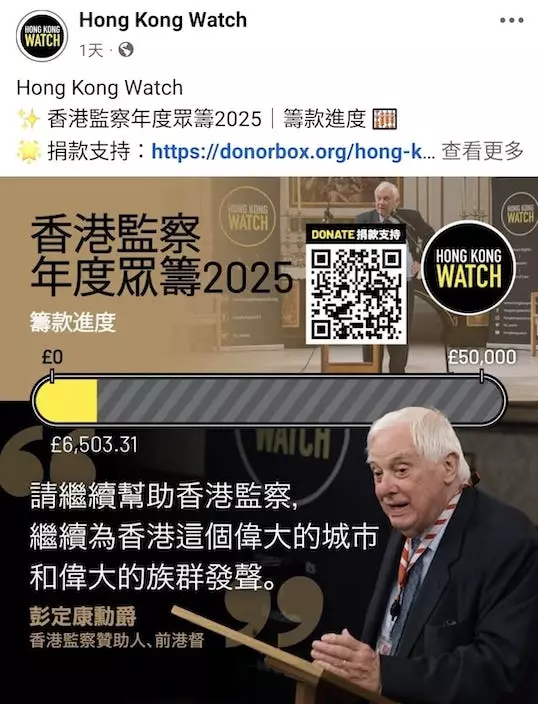
"Hong Kong Watch" is going broke. Its fundraiser is a flop, pulling in just £6,000 of a £50,000 goal, and even patron Chris Patten's pleas for cash have fallen flat.
Why the Money Dried Up
According to the source, a key reason for the group's dismal fundraising is that one of its former major backers was the Conservative Party government.
A few years back, when the Hong Kong Police's National Security Department accused the group of violating the law and blocked its website, then-Foreign Secretary Liz Truss publicly condemned the action, and even Prime Minister Boris Johnson made a statement. But since the Labour Party took power last year, the political support behind "Hong Kong Watch" has significantly weakened, and its ability to raise funds has taken a major hit.
Furthermore, Trump's return to power has led to a massive overhaul of the US federal government. State Department-affiliated agencies that fuel "color revolutions," like the US Agency for International Development and the National Endowment for Democracy, have had their funding taps turned off. They've laid off countless staff, and some have even shut down completely. The "revolutionary funds" they used to distribute, directly or indirectly, to political organizations around the world have also shrunk dramatically, and it's believed that "Hong Kong Watch" has likely felt the impact.
The group's other fundraising target is the Hongkong BNO holders who have moved to the UK. While they did make some donations in the beginning, life has become much harder.
In recent years, soaring inflation and economic stagnation in the UK, compounded by tax and tuition hikes under the new Labour government, have placed a heavy financial burden on them. Life is incredibly tough, and most simply don't have the spare cash to donate to these kinds of organizations. It's no surprise that the group has only managed to raise pocket change this year.
Stirring Trouble on an Empty Wallet
Even with its funds dwindling and the risk of going completely broke, "Hong Kong Watch" hasn't stopped its rabble-rousing. It recently teamed up with Hong Kong groups in the UK, as well as Tibet and Xinjiang independence activists, to continuously disrupt the expansion plans of the Chinese Embassy in the UK.
Another large-scale protest is slated for September 28, where Benedict Rogers is sure to be front and center as the flag-bearer. However, if its funding crisis isn't resolved, its political influence is bound to decline.
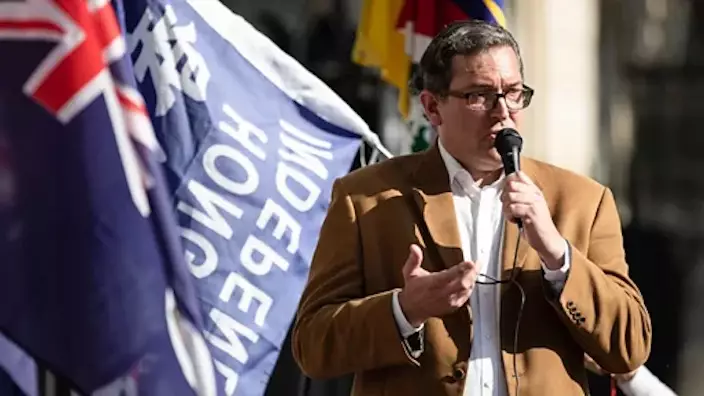
Founder Benedict Rogers, wanted by Hong Kong police, keeps stirring trouble by protesting the Chinese Embassy's expansion with his activist allies. But without cash, the group's political clout is set to vanish.
The source advises Hongkong BNO holders in the UK to be cautious. "Hong Kong Watch" is an openly anti-China organization that aims to destabilize Hong Kong. Donating to support it carries significant legal risks and could lead to trouble should they ever return to the city. It's best to steer clear.
Lai Ting-yiu
What Say You?
** 博客文章文責自負,不代表本公司立場 **