Sentencing pleas in the Jimmy Lai case took a stark turn on day two. Two of Apple Daily's most senior executives—publisher Cheung Kim-hung and deputy publisher Chan Pui-man—laid bare the brutal reality of working under Lai's thumb.
Through their lawyers, Cheung and Chan described an environment where dissent was futile, orders were absolute, and resistance meant risking everything. Both painted a picture of powerless lieutenants dragged down an illegal path by a boss who wouldn't budge.

Defense counsel argued Cheung Kim-hung held the CEO title but lacked real authority. He could only execute the "mastermind's" orders—objection achieved nothing.
During trial testimony, both executives recounted losing their free will under Lai's command. On Tuesday, Chan went further. She revealed she'd considered quitting but couldn't afford to walk away because of her own medical need. She told the court she deeply regretted failing to hold fast to journalistic principles.
Lai's Top Gun
Cheung Kim-hung was Lai's number one. He'd jumped ship from Apple Daily back in 2005, only to return five years later and climb to publisher and CEO. But when the anti-extradition protests erupted, Cheung became what his lawyer called an "execution tool"—someone who could only carry out the boss's orders.
Yesterday's plea hearing revealed a telling example. Lai wanted to bring former US Army Vice Chief of Staff Jack Keane onto his interview show. Cheung pushed back, asking whether it "might be too sensitive." Lai ignored him. After the Hong Kong National Security Law took effect, Cheung tried again—this time urging Lai and colleagues not to break the law. The evidence speaks for itself: despite repeated warnings, Lai pressed on, only tweaking his methods slightly.
Defense counsel made it clear: Cheung wanted to limit the damage but had no real control. Yes, he held the CEO title. But actual power? Limited. He could only follow the "mastermind's" instructions and try to minimize the fallout from the coverage.
In court testimony, Cheung didn't mince words about being trapped. He called himself a "tool." Lai constantly issued editorial directives and had the final say on everything. Refusing wasn't really an option. Editorial autonomy existed only in the gaps—those rare moments when Lai hadn't issued orders. At the infamous "lunchbox meetings," Lai would spell out his political stance and tell everyone to fall in line.
About a month after the National Security Law came into force, both Cheung and Chan worried they were heading into legal danger. They opposed some of Lai's moves. Lai went his own way and dismissed their concerns.
Chan's Impossible Choice
Deputy publisher Chan Pui-man faced the same crushing dynamic. When Lai proposed using Apple Daily to mobilize a "one person, one letter" campaign urging Trump to intervene, Chan did raise objection. Lai pushed ahead anyway.
During her testimony, Chan revealed Lai went even further. He ordered her to compile a "Shit list"—a sanctions target list naming HKSAR officials and political figures. This dragged her beyond editorial work into outright political action.
The mitigation hearing added new details about Chan's predicament. Her lawyer said she tried blocking controversial articles from publication, had even considered resigning early to escape Apple Daily. But serious illness and mounting treatment costs trapped her. She faced financial hardship and needed the paycheck to survive. So she stayed.

Chan Pui-man expressed deep regret for abandoning journalistic principles. She'd wanted to quit Apple Daily, but mounting medical bills for serious illness left her no choice but to stay.
In her mitigation letter, she expressed profound regret for failing to stand firm on journalistic principles.
The pleas from Cheung and Chan expose the human cost of working under Lai's boulder-like pressure. Unable to uphold their principles, they were dragged onto an illegal path and ended up behind bars. Little wonder both pleaded guilty and turned prosecution witnesses against their former boss. After years of submission, testifying became their final act of resistance.
Lai Ting-yiu
What Say You?
** 博客文章文責自負,不代表本公司立場 **
The world is getting more chaotic. Someone who benefits you today may hurt you tomorrow, and not just a little. The damage can be catastrophic.
The Strike and the Immediate Fallout
Amazon boss Jeff Bezos is a living example. Not long ago, he and a group of tech giants became Donald Trump's honored guests. They figured that with the president covering them, they were bound to cash in.
But then Donald Trump suddenly went to war against Iran, and Amazon took collateral damage. Its large data center in a Gulf country came under Iranian attack. The damage was severe.
Reuters reported yesterday that the center in Bahrain was almost completely destroyed. Cloud services across the entire region were paralyzed, and customers had to relocate on a large scale to other regions. Amazon suffered heavy losses, and its AI money-making plan went up in smoke.
Other tech giants had been ambitiously preparing to make big money in the Middle East. That dream has also shattered. Donald Trump truly harms people without limit.

Iran destroyed Amazon’s Bahrain cloud hubs, wrecking regional expansion plans.
The report said Amazon Web Services assessed the damage to the data center and said cloud services in the Bahrain area could no longer be repaired.
That center was one of three 'data hosting zones' the company had built in the United Arab Emirates. With one zone paralyzed, the impact already exceeded the load capacity the system was originally designed for. Operations across the whole region became difficult to maintain.
The customer base using services in the region is huge, and banking operations have taken the most direct hit. The situation is catastrophic.
According to reports, Amazon Web Services has sent notices to customers advising them to relocate operations to other regions. The company will provide assistance.
War is merciless. One attack threw the entire system into chaos. The company is suffering, customers are suffering too. The UAE government is suffering even more. They are all left in tears.
Why Iran Hit the Cloud and How Tech Giants Froze
The disaster began shortly after the US-Iran war broke out. Iran launched large-scale drone strikes on two of the three large data centers Amazon had set up in the UAE. The center in Bahrain took the heaviest damage.
The Iranian military said it targeted the data centers because the United States was using AI to formulate combat plans. Amazon's centers had provided support to US forces. That put them on the strike list.
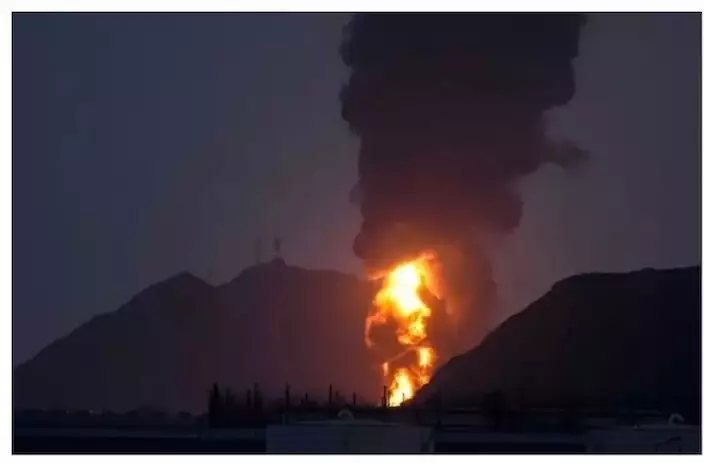
Targeted data-center airstrikes now terrify tech giants eyeing Gulf AI.
That was only the stated reason. Iran had another strategic calculation. Destroying digital infrastructure in the UAE would strike the country's economy and force it to pressure the United States to end the war as soon as possible.
The move was ruthless. Gulf states such as the United Arab Emirates, Saudi Arabia, and Qatar have been racing to transform their economies. They are investing heavily in high-tech sectors, with AI as the centerpiece, and courting American tech giants.
They knew this was a super gold mine. The giants were drooling, rubbing their hands, and ready to march in.
Amazon led the charge. Amazon Web Services quickly built three large data centers in the UAE, betting on the first taste of the broth and a fortune to follow.
At that time, OpenAI, Oracle, and Nvidia were also preparing to build mega AI campuses in the Gulf states. Shortly after Donald Trump took office, the giants accompanied him on a visit to the Middle East and signed a series of investment plans. Nvidia moved to supply its most advanced chips to AI companies in Saudi Arabia.
They all saw it as a sure-fire path to wealth.
But when the US-Israeli coalition launched its war against Iran in late February, their get-rich dreams went up in the flames of war. Iran immediately struck Amazon's large data center in the UAE and scored a direct hit, causing severe damage.
The Islamic Revolutionary Guard Corps (IRGC) then released an attack list. Amazon, Google, Microsoft, Nvidia, Oracle, and others were all named, identified as accomplices of the United States.
With the Gulf states suddenly engulfed in war and danger, the giants immediately shrank back. Every plan was frozen.
Gulf Stalls, Hong Kong Contrast
The reality is the Gulf states suffer most. Their grand plans to develop innovation, technology, and AI industries just took a heavy blow. After this data center attack, finding brave investors will be even harder.
Some US media commentaries have already drawn a blunt conclusion. The Gulf can no longer become a major AI hub, and critical technology infrastructure will not be built in the Middle East.
After reading this Reuters report, a friend immediately thought of Hong Kong's Five-Year Plan. It stresses that "Security is the prerequisite for development, whereas development reinforces security." The plan will strengthen top-level design and efficiently safeguard national security.
That naturally includes a safe business environment. If data centers were located in Hong Kong, they would be a hundred times safer than in the war-torn Gulf region.
Lai Ting-yiu