Skip to Content Facebook Feature Image

Vanuatu to Australia: Learn What Respect Means

Blog

Vanuatu to Australia: Learn What Respect Means
Blog

Blog

Vanuatu to Australia: Learn What Respect Means

2025-09-30 09:20 Last Updated At:09:20

Vanuatu's Minister of Internal Affairs, Andrew Napuat, just dropped a bombshell that’s reverberating across the Pacific: Australia should learn what respect means.

Andrew Napuat, Vanuatu's Minister of Internal Affairs, who is tired of Australia's attitude.

Andrew Napuat, Vanuatu's Minister of Internal Affairs, who is tired of Australia's attitude.

As policing cooperation between China and Vanuatu forges ahead, Australia’s claims to "respect autonomy" ring hollow as it publicly questions and tries to undermine the partnership, exposing a glaring contradiction in its regional security rhetoric.
 
Following a recent visit to China, Napuat announced that he would work with Beijing to formalize the development of his country's policing capabilities, revealing that a new memorandum of understanding was on the verge of being signed to lock in Chinese police assistance. The ink was barely dry on the news when the Australian government scrambled to react, with Minister for the Pacific Pat Conroy dismissively framing it as merely comments from "one particular minister" - A blatant attempt to downplay its significance.
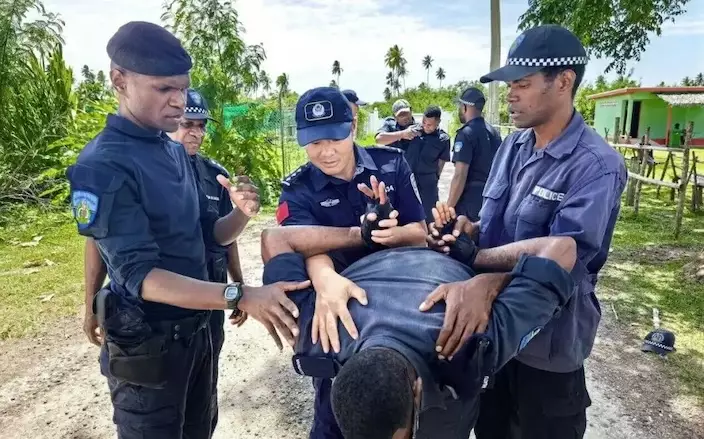
Chinese police experts conducting training in Vanuatu, much to Australia's dismay.

Chinese police experts conducting training in Vanuatu, much to Australia's dismay.

In an exclusive interview with the Australian Broadcasting Corporation (ABC), Napuat hit back hard, slamming Conroy's statement as both "arrogant" and "ignorant." He stressed that this wasn't a solo act but a collective decision by the Vanuatu government, reminding Canberra to get its facts straight before commenting. "I respectfully understand his freedom and his right to make those kind comments, but he also needs to respect the internal processes happening here… This is my piece of advice to my friend in Australia."

Canberra's Condescension Backfires

This whole spat perfectly illustrates the increasingly assertive stance Pacific island nations are taking in their foreign policy. Napuat noted that while Vanuatu respects the 2022 Pacific Islands Forum (PIF) communiqué championing a "Pacific family first" approach, this doesn't mean surrendering its sovereign right to make its own decisions.
 
"Whatever is decided at that (PIF leaders) level is something that all the Pacific island countries respect, but at the end of the day those kinds of agreements don’t limit what each sovereign country wants to do in terms of its relationships", he stated.
 
Regarding the upcoming memorandum, Napuat clarified that it’s no conspiracy; rather, it was simply "formalising what we’re already working on together". It doesn't signal a long-term or permanent presence but serves as a "guiding" document to outline the framework for police training and capacity-building.

He also made a point to add that Australia had already been directly informed. "Australia knew very well, and we were up front with them when we told them we are just wanting to sort out the way we manage our relations with our partners, and we are going to sign an MoU (with China)."
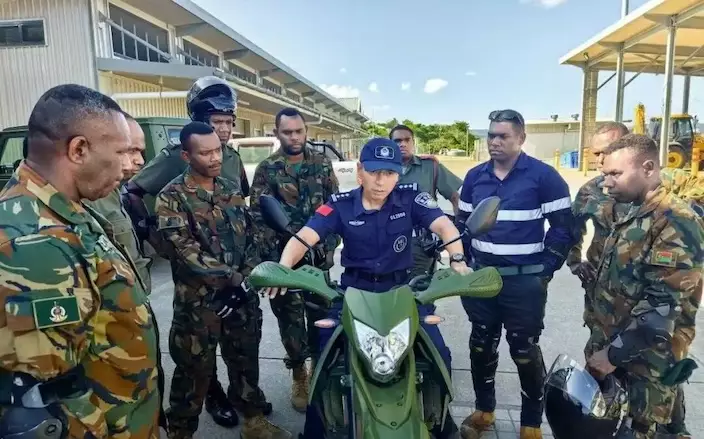
Chinese police experts conducting training in Vanuatu, much to Australia's dismay.

Chinese police experts conducting training in Vanuatu, much to Australia's dismay.

Sovereignty, Not Submission

As it turns out, Vanuatu has its own core concerns, like building up its policing capacity and tackling climate change, which don't always align with the security-first priorities of its traditional partners.
 
Napuat's call to action was clear: "Our development partners need to come and sit with us and talk with us so they can fully understand what our needs are, and then we can work together to address the needs which are more relevant to our people.”
 
Let's be real: this all stems from Australia's deep-seated anxiety over China’s growing influence in the Pacific. Canberra frequently insists it is the region's security partner of choice, scrambling to lock down this status with various agreements. But as the minister from Vanuatu has made crystal clear, its cooperation with China isn’t aimed at Australia, nor is it exclusive. It is simply an independent choice based on Vanuatu's own needs.
 
Meanwhile, in Beijing, the response was a masterclass in diplomacy. Foreign Ministry spokesperson Guo Jiakun stated that China-Vanuatu cooperation is built on mutual respect, equal consultation, mutual benefit, openness, and inclusivity. He affirmed that China will continue to provide support based on Vanuatu's wishes and needs to strengthen friendly exchanges and bring benefits to both peoples.
 
The message couldn't be plainer: China respects Vanuatu's sovereignty, and its cooperation isn't about targeting anyone else.
 
Three Key Takeaways
This episode reveals three undeniable trends.
 
First, Pacific island nations are taking charge and are done being pushed around.
 
Second, Australia's hypocritical double-speak has been publicly exposed.
 
And finally, China’s transparent, needs-based cooperation shows up the competitive, zero-sum games played by others.
 
Napuat didn't give a specific timeline for signing the memorandum but confirmed that both sides are near the "final state" and could sign it at any moment. This shows that regardless of the external noise, the China-Vanuatu partnership is moving forward on its own terms. For Australia, the real takeaway isn't to fret about China's presence, but to seriously reflect on its own posture and learn how to engage with its island partners as equals who deserve respect.
 
In today's complex world, Pacific nations will not be ignored; they want partners who respect their sovereign priorities—from security to climate change and development. If Australia continues to see the region only through a paranoid, zero-sum lens of "permanent competition" with China, it will only succeed in shredding what's left of its own credibility.
 
The Vanuatu Minister of Internal Affairs’ parting shot says it all, and it’s a message that resonates far beyond just Australia: "I understand his freedom and his right to make these kinds of comments, but also, he needs to respect the internal processes that are happening here."


Deep Throat

** The blog article is the sole responsibility of the author and does not represent the position of our company. **

Last Friday, Trump flat-out torpedoed a much-anticipated zero-emissions deal for the global shipping industry, smashing it apart at the United Nations' International Maritime Organization (IMO). The Financial Times lays it all bare: to kill the net-zero shipping pact, Trump didn’t just lean on the usual diplomatic muscle—Washington went full gangster. Think raised port fees, outright bans on ships passing through America, and direct threats, and even personal intimidation of diplomats and their families, with entry bans waved in their faces like warning flags.

The Financial Times lays it out: over a dozen diplomats, foreign officials, and industry insiders watched the US throw diplomacy in the mud at last month’s London summit. Washington came armed with bullying tactics, determined to smash the net-zero shipping pact by brute force.

US Bullying Blocks IMO’s Green Shipping Deal—Vote Delayed a Year. IMO website image.

US Bullying Blocks IMO’s Green Shipping Deal—Vote Delayed a Year. IMO website image.

US officials didn’t bother with backroom deals—they stalked the halls, cornering diplomats from Africa, the Pacific, and the Caribbean. The message was simple: cross the United States, and your ships might not reach America. Rock the boat, and your family could be locked out. These weren’t idle whispers. The intimidation played out in broad daylight during coffee breaks.

Social Media Taunts, Policy Upends

Trump didn’t bother hiding his true feelings. On social media, he slammed the agreement as a “global green shipping tax scam.” But this wasn’t just venting. In April, most countries had already green-lit the framework. It was set to become real policy—until Trump’s team blew it up, forcing a one-year “pause.” The global momentum froze on the spot.

One diplomat cut to the heart of it: “It’s like the streets of New York.” His country got the warning firsthand—keep backing the deal, and watch your sailors’ visas disappear. US port fees? Those would rise too. Another attendee was even more blunt: IMO bigwigs were left gobsmacked. “It’s like dealing with the mafia,” they said. “You don’t need details. You just know: cross us, and you’ll pay.”

The US State Department kept mum on the intimidation claims. Instead, American officials handed out praise to Greece and Cyprus. Those two broke rank from the rest of the EU—they cast abstention votes in the big one-year adjournment, even after they already gave the framework the green light back in April.

Secretary of State Marco Rubio, ahead of the IMO meeting in London, issued a joint statement with senior Trump officials warning that the administration was "evaluating sanctions on officials sponsoring activist-driven climate policies that would burden American consumers, among other measures under consideration." As Greece and Cyprus sided with the U.S., much of Europe—and the world—reacted with surprise.

Global Rules or American Muscle?

Chatham House’s head of global economy Creon Butler didn’t mince words. The US, he said, has ditched long-standing diplomatic etiquette. Instead, Washington's now muscling countries into backing its stance—especially on climate.

America Threatens: Support This, Your Crews and Ports Pay.

America Threatens: Support This, Your Crews and Ports Pay.

“In the very short term this might work, but in the medium term it increases the chances that non-US countries will conclude they cannot work with the US, making agreements independently among themselves which simply work around the US,” he said. Sooner or later, the rest of the world will ink deals that leave America in the dust.

The pushback reached fever pitch at the IMO. Brazil, among others, called out the methods “that should not ever be used among sovereign nations”. Washington wasn’t just rattling individuals—entire capitals, from Bangladesh to Japan and Indonesia, got notes threatening diplomatic smackdowns.

But let’s step back. The drive for a net-zero shipping pact isn’t about feel-good climate slogans.

As Niu Tanqin from Xinhua puts it: The pact itself is a brass-tacks response to global warming’s mounting cost. Whether you like it or not, global warming is simply an undisputable fact. Everyone is scrambling to stall off the climate catastrophes looming on the horizon.

So, in order to squeeze carbon emission: if your ship emits less than the set limit, you’re rewarded. Above the cut-off, you pay. China, the EU, Japan, India, Brazil—all were in. Even the big shipping companies joined the chorus.

Only a handful of oil states—think Saudi Arabia, Russia, the UAE—pushed back. Pacific island nations, unconvinced the pact was tough enough, simply abstained.

Trump Says Global Warming’s a Scam—US Walks Out.

Trump Says Global Warming’s a Scam—US Walks Out.

Then, everything changed. Once Trump 2.0 manifested, the US flipped from supporter to saboteur. In his mind, climate change is a hoax—or worse, a Chinese plot to corner American interests. Stopping this agreement wasn’t just policy—it was personal. He didn’t mind stooping low—pulling out every trick in the high school bully’s playbook: pressure, threats, and outright intimidation to make sure America got its way.

One official wasn’t shy: “It was completely exceptional. I have never heard of anything like this in the context of an IMO negotiation. These people [being threatened] are just bureaucrats, they are civil servants.”

If international law becomes a mere cheap disguise, you can bet real power will be the one pulling the strings.

Pause Button Pressed—World Left Reeling

Now, the deal waits on ice for another year, while “the world stares, shell-shocked”—witnesses to a new era of American brinkmanship.

Not the first time, either. Just look at tariffs: if Washington’s unhappy, it writes its own tax bill—no debate required. Venezuela and Nigeria have both fielded threats of military action; Canada and Panama know the taste of territorial intimidation. Lawless? That’s par for the course.


But payback, as always, has a funny way of coming due. Today, the US bullies island nations and slaps down climate claims. Tomorrow, who’s next? When “might makes right” replaces rules, every nation that depends on order will lose out. True justice may come late—but it never skips its date. Chip away at the pillars of fairness, and sooner or later, you bury the very house you live in.

The real question: how long can America’s strong-arm show go on before the world walks out?

Recommended Articles