Skip to Content Facebook Feature Image

Britain Calls Trump's Bluff: Starmer Takes 60 CEOs to Beijing

Blog

Britain Calls Trump's Bluff: Starmer Takes 60 CEOs to Beijing
Blog

Blog

Britain Calls Trump's Bluff: Starmer Takes 60 CEOs to Beijing

2026-01-28 17:59 Last Updated At:17:59

UK Prime Minister Keir Starmer departs for China on January 28 in what amounts to a diplomatic rejection of Washington's either-or foreign policy. Speaking to Bloomberg on January 26, Starmer made his position clear: Britain will stop “sticking your head in the sand and ignoring China” and pursue economic ties with the world's second-largest economy.
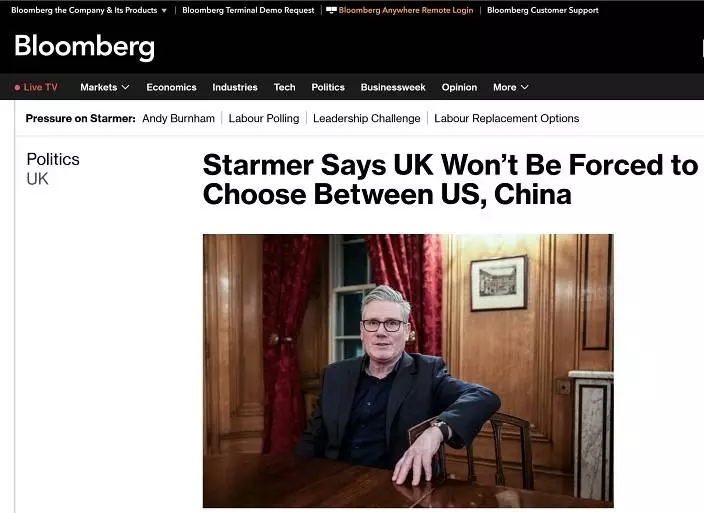
Starmer gave Bloomberg his clearest signal yet that Britain won't subordinate economic interests to US demands.

Starmer gave Bloomberg his clearest signal yet that Britain won't subordinate economic interests to US demands.

This marks the first visit by a British Prime Minister to China in nearly eight years—a gap Starmer himself calls a "dereliction of duty."

The Bloomberg interview, conducted at 10 Downing Street, lays bare the economic rationale driving this reset. Starmer's four-day trip fulfills a Labour campaign promise to repair UK-China relations, which deteriorated over Hong Kong issues, the COVID-19 pandemic, and espionage allegations. Recent months have seen deliberate moves to ease tensions—most notably, last week's approval for China to build a new embassy in London: widely seen as strategic groundwork for this visit.

Rejecting the Binary Trap

When pressed on whether strengthening China ties would come "at the expense" of Britain's closest allies, Starmer pushed back hard. He cited the US-UK trade talks as precedent: "I remember when I was doing the US trade deal, and everybody put to me that I'd have to make a choice between the US and Europe, and I said, 'I'm not making that choice.'" The message to Washington is unmistakable—Britain will chart its own course, and Trump's tariff threats won't dictate British foreign policy.

Starmer explicitly rejected the approach taken by Canadian Prime Minister Mark Carney, who recently called for smaller nations to band together against what he termed a "new era of great power rivalry." His calculation is simple: developing UK-China relations won't anger Trump or damage transatlantic ties.
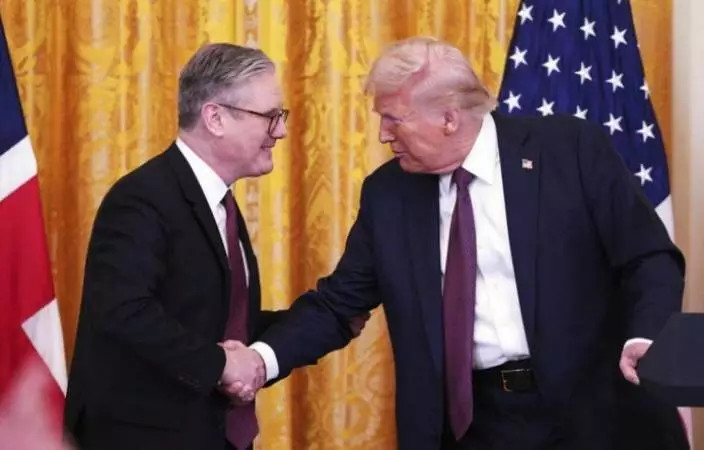
Starmer insists that strengthening UK-China ties won't damage relations with Washington.

Starmer insists that strengthening UK-China ties won't damage relations with Washington.

Timing Is Everything

The context matters. Carney's Davos Forum remarks urging smaller countries to unite in the face of great power competition put a spotlight on Starmer's China visit.

Starmer maintained that UK-US relations remain "very close" and will continue across business, security, and defense sectors. More importantly, he insisted that "Britain can have the best of both worlds" between China and the US—a tightrope walk that few Western leaders have managed successfully in recent years.

Follow the Money

Keir Starmer is finally saying the quiet part out loud to Bloomberg: the UK needs China. While he pays lip service to maintaining "very close" ties with Washington on security and defense, the real headline is his admission that Britain can—and must—pursue the "best of both worlds." The reality is that London is realizing it can no longer afford to blindly follow US foreign policy cliffs.

Make no mistake: the era of delusional decoupling is over. Starmer was blunt, stating that if you "bury your head in the sand and ignore China"—the world's second-largest economy teeming with opportunity—it would not be "sensible". He made it clear that this trip is unapologetically about economic reality, while national security is not compromised. "Quite the opposite," indeed—engagement is the only path to security.

The scale of this mission speaks for itself. Starmer’s hitting Beijing and Shanghai with a delegation of approximately 60 leaders from business, universities, and cultural institutions.

Washington's Chaos Forces London's Hand

The backdrop to this pivot is undeniable. The US-Europe transatlantic partnership is currently in shambles over the Greenland dispute, with Trump threatening tariffs against eight European nations. Add to that his inflammatory remarks about NATO “staying a little back, a little off the frontlines" and it’s no wonder London is looking for stability elsewhere.

Yet, Starmer insists on maintaining a "mature" facade with Trump. He claims the UK approaches these headaches with "British pragmatism, common sense, and adherence to our own principles." But the real issue is evident in his admission that the UK must forge tighter military bonds with Europe. He’s already signaling a capitulation to demands for higher defense spending, noting, "I do think that Europe needs to be stronger in its own defense and security, I think we need to step up to that challenge."

Starmer mentioned a weekend call with Trump regarding Ukraine, warning that both Kyiv and Europe are desperate for American backing. He framed it as, "Ukraine is a very good example of why we need to maintain a very close UK-US relationship".

The roster confirms the priority here is hard cash, not ideology. Reuters reported on the 23rd that heavyweights like Chancellor Rachel Reeves and Business Secretary Peter Kyle are towing a massive group of executives to the Chinese Mainland. The Financial Times adds that this commercial armada spans critical sectors including life sciences, aerospace, and financial services.

Sources close to the PM are cutting through the noise, labeling the refusal of previous Prime Ministers to visit China a sheer "dereliction of duty." The logic is inescapable: they hope to finally strengthen cooperation with the economic superpower. As one source put it, turning a blind eye and pretending China doesn't matter is reckless and will only make Britain poorer and less secure.

Starmer himself emphasized that it is time to reject the "overly simplistic binary choices" of the past—refusing to be boxed into either the so-called "Golden Era" or the disastrous "Ice Age."

When pressed on Starmer’s visit at a January 26 press conference, Foreign Ministry spokesperson Guo Jiakun highlighted the turbulent international landscape. He noted that as permanent members of the UN Security Council, China and the UK serve global interests by strengthening cooperation. Beijing, as always, remains open to pragmatic engagement and will release further details in due course.


Deep Throat

** The blog article is the sole responsibility of the author and does not represent the position of our company. **

Canada just threw the rulebook out. While Washington tries to bully automakers into abandoning Canadian factories, Ottawa slashed import tariffs on Chinese-made electric vehicles from a punishing 106.1% down to 6.1% – a move that cracks open the door for Chinese EVs to flood the Canadian market. The numbers tell the story: Chinese EV exports to Canada cratered 92% quarter-over-quarter in Q4 2024 under the old tariff regime. Now Prime Minister Carney is calling the shots from Davos, warning middle powers they need to stick together or risk becoming "menu items" for superpowers playing hardball.

From 106.1% to 6.1%

Here's what actually changed. Since October 2024, Canada's previous government had parroted US policy by slapping a 100% additional tariff on Chinese EVs, pushing the combined rate to 106.1%. Chinese EV exports to Canada collapsed 92% in Q4 2024 compared to the previous quarter.

Canada slashes tariffs from 106.1% to 6.1%. Stock photo

Canada slashes tariffs from 106.1% to 6.1%. Stock photo

The new policy strips that away, restoring the 6.1% base tariff and establishing an annual import quota of 49,000 vehicles. Carney framed this as fostering Sino-Canadian cooperation, projecting that joint ventures between Chinese companies and Canadian partners will materialize within three years – preserving and creating auto sector jobs while strengthening Canada's EV supply chain. The agreement commits to bringing more affordable models to Canadian buyers, with over 50% of imported EVs expected to cost less than CAD 35,000 within five years.

Automakers and market analysts are calling it a "major boon." Sun Xiaohong, an expert from the China Chamber of Commerce for Import and Export of Machinery and Electronic Products, noted that Chinese EVs match the Canadian market well on price and performance, and the policy shift will restore positive growth momentum.

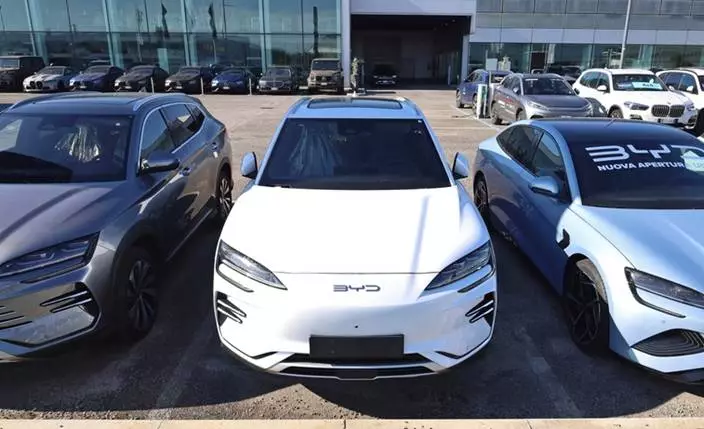
The price gap that's driving Ottawa's pivot. Stock photo

The price gap that's driving Ottawa's pivot. Stock photo

Price competitiveness remains the killer advantage. Market comparisons show that equivalent Chinese EV models typically sell for US$10,000 to US$15,000 less than existing options in Canada. Polling data backs this up: most Canadians support tariff cuts to boost their purchasing power.

Payback for Trade Bullying

Bloomberg characterized this as a direct response to the current US administration's strong-arming of automakers to relocate factories from Canada to the United States – while simultaneously opening the door for Chinese carmakers to assemble vehicles in Canada for the first time.

Daniel Breton, head of the Canadian Electric Vehicle Association, put it plainly: the US President has publicly declared he doesn't want any Canada-built cars sold in the US, effectively threatening Canada's entire auto industry. The policy adjustment is "right on time," enabling Canada to find new partners and reduce over-reliance on the US market. Industry forecasts suggest Chinese brands could capture roughly 10% of the Canadian EV market share.

Significantly, the new policy marks the first time Canada opens the door for Chinese firms to assemble cars domestically, though it may attach conditions like joint ventures or mandates for local software.

Sun Xiaohong analyzed that in 2025, the US government rolled out a series of tariff increases targeting autos and parts – measures that applied equally to Canada. This prompted many companies originally producing in Canada to shift capacity to the US mainland, leaving output gaps in Canada. As a result, Ottawa is actively seeking global auto investors, including from China.

Canada's government is developing a new auto industry strategy, scheduled for release in February, focused on attracting foreign investment, nurturing local industry, and reducing dependence on the US.

Sun believes Sino-Canadian auto cooperation could evolve from trade to investment, with strong odds of Chinese firms establishing assembly operations in Canada. As a USMCA member, Canada offers an attractive market and a gateway into North America. The Chinese side will monitor the stability of Canada's investment climate and policy continuity to ensure healthy, long-term collaboration.

"Not at the Table? On the Menu"

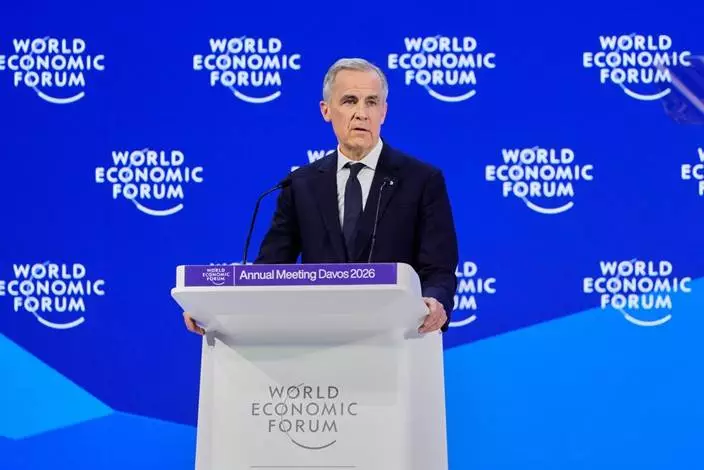
At the Davos World Economic Forum, Canadian Prime Minister Carney delivered a headline-grabbing speech, urging middle powers worldwide to band together and push back against coercion by aggressive superpowers.

Prime Minister Carney at Davos. AP photo

Prime Minister Carney at Davos. AP photo

Though he didn't name US President Trump directly, he referenced "American hegemony" and accused "great powers" of weaponizing economic integration. Facing this new reality, Canada must "be both principled and pragmatic" – pivoting inward to build the nation, diversify trade relationships, and reduce dependence on the US and others, because it's now clear that "integration" breeds "subordination".


Carney put it bluntly: the long-standing US-led, rules-based international order is finished. Middle powers like Canada need a strategic pivot to avoid becoming casualties of "coercion" from powerful forces. "When the strong can do what they can”, there is a strong tendency for countries to “go along to get along, to accommodate, to avoid trouble, to hope that compliance will buy safety”. “Well, it won’t”, said Carney. “The middle powers must act together, because if we're not at the table, we're on the menu.”

Recommended Articles