Steven Rattner just got back from China, and he's not mincing words. The former Treasury advisor under Obama published a stark assessment in The New York Times on February 10 with a title that lands like a gut punch: "I Just Returned From China. We Are Not Winning."
Rattner spent a week on the ground touring AI labs, EV factories, robotics firms, and pharma companies – and what he documented should terrify anyone betting on Trump's tariff strategy to slow Beijing down. The reality is blunt: China is leaping ahead in cutting-edge sectors from artificial intelligence to humanoid robots, and slapping duties on imports won't change that trajectory one bit.
Click to Gallery
A Treasury insider issues a blunt warning: Steven Rattner documented China's technological surge in The New York Times.
Obama-era advisor pulls no punches: Rattner (right) with former President Obama (left) – now delivering hard truths about America's competitive decline.
Five years from phones to Porsches: Rattner witnessed Xiaomi's stunning leap into electric vehicles – a timeline that should alarm Detroit.
The humanoid revolution is here: Rattner toured Chinese robotics firms racing ahead in automation while America debates tariffs.
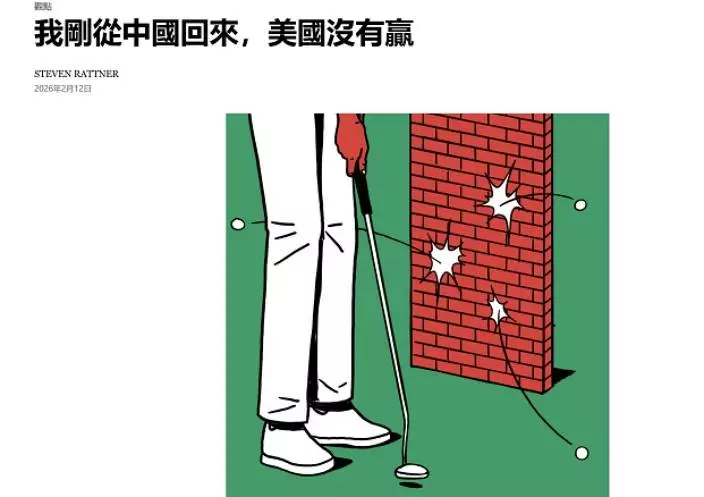
A Treasury insider issues a blunt warning: Steven Rattner documented China's technological surge in The New York Times.
Washington's China Delusion
A few weeks back, Rattner sat through a New York dinner where senior trade experts argued over China strategy. Some backed Trump's confrontational playbook – tariffs, export bans, the works. Others pushed for traditional diplomatic engagement. Rattner, who's been investing in China for years and had just wrapped his week-long tour, dismissed both camps outright.

Steven Rattner
Make no mistake: neither approach will work, because China is both a formidable competitor and an irreplaceable manufacturing hub. You can't negotiate or bully your way around that. The only real path forward? America needs to fix its own broken house and outcompete China where it actually has advantages – not chase phantoms with tariff threats.
Rattner pulls no punches on Trump's first year back in office: the chaos has already set America back. Beyond manufacturing, China now threatens US dominance across fast-growing industries – artificial intelligence, pharmaceutical R&D, advanced robotics. The turbulence from the White House isn't just noise; it's actively undermining American competitiveness while Beijing executes a coherent industrial strategy.
Power and Talent: China's AI Edge
What Rattner saw in AI left him shaken. Sure, the US still leads in cutting-edge semiconductor chips, but China controls something more fundamental – electricity. China's power generation capacity exceeds America's by more than double, yet data center electricity costs run half of US rates. When the foundation of AI infrastructure is cheaper and more abundant in Beijing than in Silicon Valley, the math gets uncomfortable fast.
But the real secret weapon is human capital. Rattner met waves of young Chinese entrepreneurs whose drive and intellect match any Silicon Valley cohort – including one billionaire still sleeping in his office. That's not anecdote; it's evidence of a system channeling massive ambition into strategic sectors while America argues about tariff percentages.

Obama-era advisor pulls no punches: Rattner (right) with former President Obama (left) – now delivering hard truths about America's competitive decline.
And despite Trump's tariff offensive, the numbers don't lie: China posted a record $1.2 trillion trade surplus last year. It remains the world's export champion, proving that tariffs haven't dented global reliance on Chinese manufacturing. Everyone still depends on "Made in China" – with or without duties.
Electric Shock: Xiaomi's Five-Year Leap
Consider automobiles. Rattner toured Xiaomi, a company that made smartphones and electronics five years ago and only announced its EV push in 2021. What he witnessed in that factory reads like industrial sci-fi: "gigantic machines resembling mechanical dinosaurs effortlessly and precisely fitting aluminum body parts into vehicles on a production line in a massive factory where workers were barely visible". In the showroom sat a yellow sports car that could pass for a Porsche.

Five years from phones to Porsches: Rattner witnessed Xiaomi's stunning leap into electric vehicles – a timeline that should alarm Detroit.
Ford CEO Jim Farley admitted last summer that Chinese in-car technology is "far superior" to American models, calling China's progress "the most stunning experience I've ever seen". Shortly after, Ford halted production of its F-150 electric truck and took a brutal $19.5 billion write-down on EV projects. That's not a data point – it's a white flag.
Robots and Drugs: The Next Frontiers
Rattner also visited a robotics firm where plastic-toy-like devices moved fluidly across the floor, demonstrating progress in humanoid robots designed to replace specific human tasks. The scale is staggering: in 2024, China installed nearly nine times more industrial robots than the United States.

The humanoid revolution is here: Rattner toured Chinese robotics firms racing ahead in automation while America debates tariffs.
In pharmaceuticals, the reversal is just as stark. A few years ago, China was still licensing drug patents from overseas companies. Now China licenses more drugs outward than it imports, and its clinical trial volume has overtaken America's. That's a complete inversion of the innovation hierarchy in less than a decade.
Beijing's Strategic Edge
Rattner credits China's technological surge to effective government coordination. When Beijing recognized it was falling behind in AI, it declared catch-up a "national priority" and delivered – funding research, relaxing regulations, and building massive power capacity with visible results.
Even under ideal conditions, competing with China would be daunting. But the reality is far from ideal: Trump's erratic policies have placed America in an extremely disadvantageous position. The US needs to rethink industrial policy and mobilize government resources for strategically critical industries – something the current administration shows no sign of doing coherently.
Fix America First
The first step? Reverse Trump's cuts on scientific research and other critical areas. Rattner admits he's skeptical about democratic governments picking corporate winners, but insists "we no longer have the luxury of confining Washington to the sidelines". America should focus on future industries – not Trump's nostalgic fixation on traditional metal-processing manufacturing.
On critical minerals, America's constraint isn't scarcity – it's a byzantine approval process for mining and processing facilities that strangles domestic production. Regulatory gridlock, not geology, is the bottleneck.
Rattner's bottom line is unambiguous: Trump – or anyone else – must face one fact: imposing tariffs or chasing trade deals simply cannot defeat China. To surpass China, it has to “begin at home”, by “getting our own economic house in order". He urges Trump to scrap the suite of ineffective policies he's rolling out.
This isn't the first time Rattner has sounded this alarm. Last December, he told Bloomberg the same thing: to beat China, you can't rely on export controls or trade measures to "slow China's development pace". "America can neither defeat China on the battlefield nor at the negotiating table," he emphasized, insisting America's only option is to do its own work better.
Deep Throat
** 博客文章文責自負,不代表本公司立場 **
The Japanese yen keeps sliding, and prices across Japan keep climbing. In recent days, a wave of Japanese supermarket shelf photos has swept Chinese social media and shot up the search rankings. The images show shrimp shells, chicken bones and watermelon rinds, the parts usually tossed straight into the trash during everyday cooking, washed, packaged, tagged with prices and neatly displayed, waiting for customers to buy.
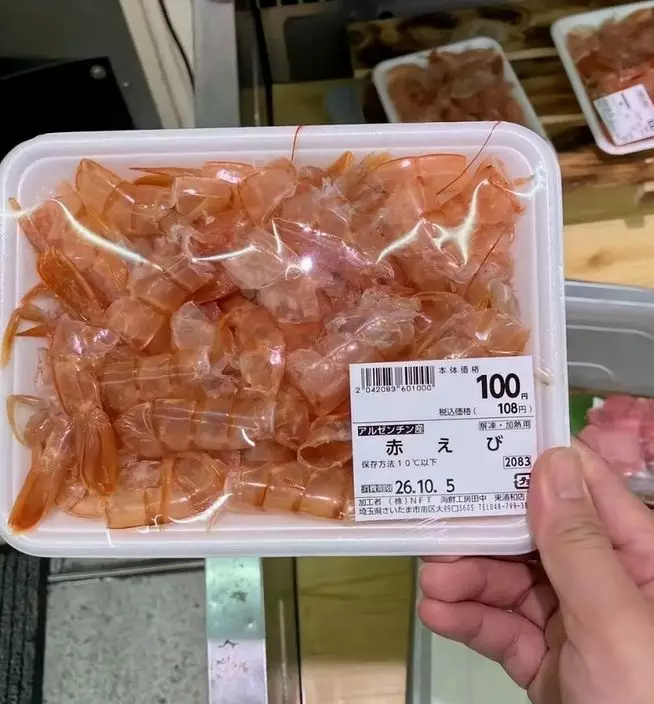
Japanese supermarket scraps—shrimp shells, bones, rinds—packaged and priced
Trash Becomes Merchandise: Shrimp Shells and Watermelon Rinds Hit the Shelves
Some netizens exclaimed that in their homes these scraps all go straight into the waste bin, while others questioned whether Japan has grown so poor that it must turn kitchen scraps into cash.
But the causes behind this trend run far deeper than the word 'poor' suggests.
Step inside a local supermarket, and the commercialization of offcuts turns out to be remarkably mature. Watermelon rind is cut into long strips, boxed in cling film and sold at a clearly marked price, while shrimp shells are packaged on their own at 108 yen a box, complete with a recipe card teaching customers how to simmer miso soup. Enoki mushroom stems, radish leaves, napa cabbage ribs, fish tails and other parts mostly discarded outright in China can be found everywhere in the refrigerated compartments.
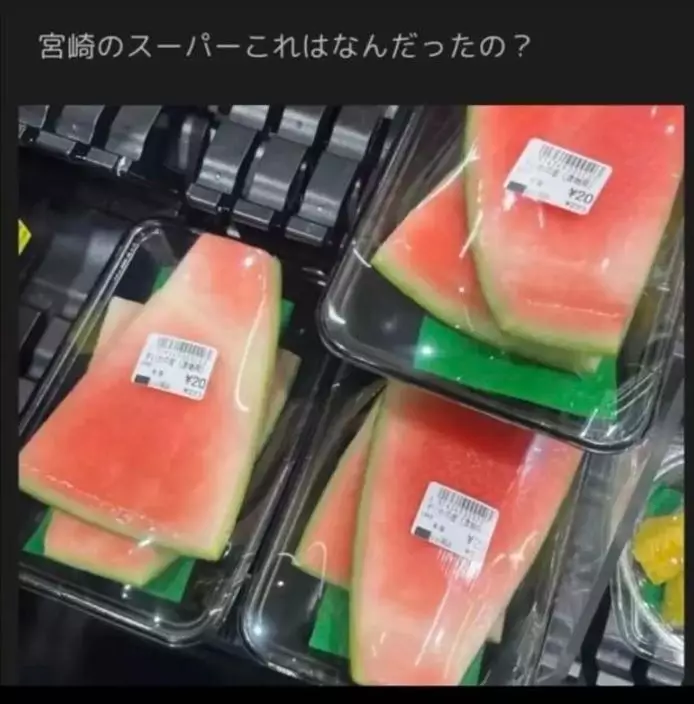
watermelon rinds
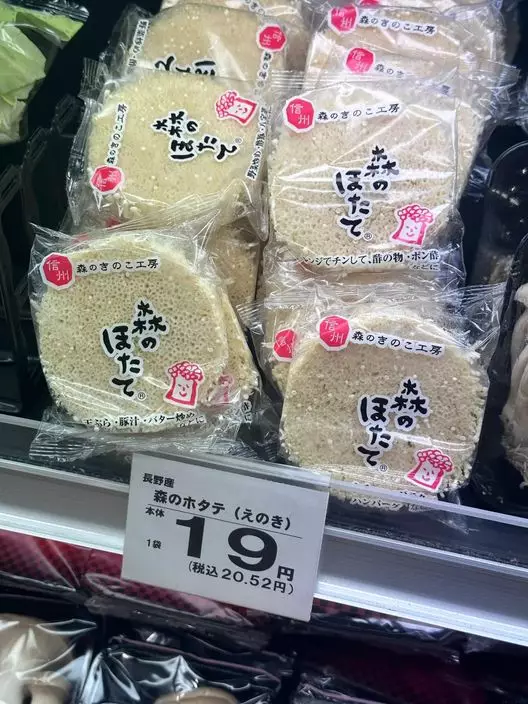
Enoki mushroom stems
Many people's first reaction is to assume the Japanese are simply born thrifty. Dig deeper, and the story changes. This is not a pure culture of thrift; it is a survival choice forced on ordinary people by the yen's collapse and persistently rising prices.
In fact, these offcuts were never entirely without value in Japan's culinary tradition. Shrimp shells can be simmered into soup stock, mushroom stems can be cooked once properly prepared, and watermelon rind can be pickled or stir-fried. Grilled pufferfish (fugu) fins are even one of the ingredients of Japan's distinctive hirezake (fin sake).
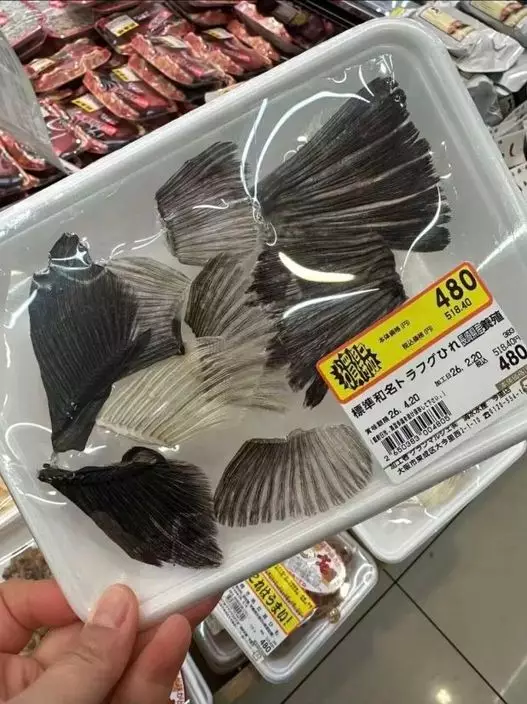
Grilled pufferfish fins flavor Japan's fin sake
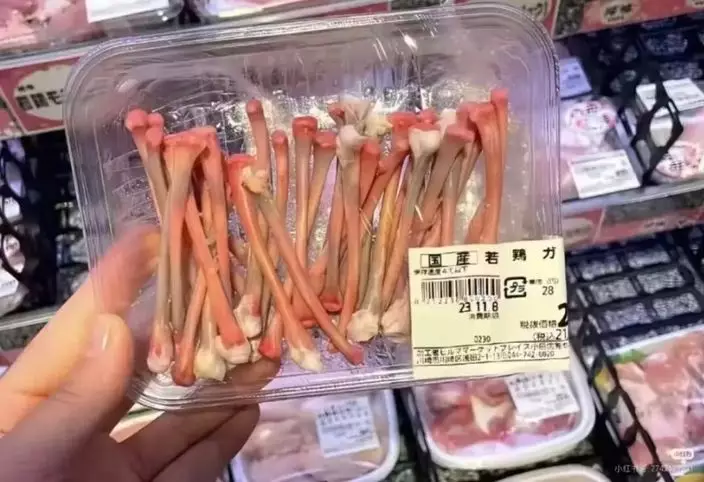
In the past, making use of these food scraps was mostly a private skill of Japanese housewives. They simmered stock from shrimp shells and fish bones, mixed radish leaves into side dishes, pickled watermelon rind and pan-fried enoki stems. Such practices circulated only within the household.
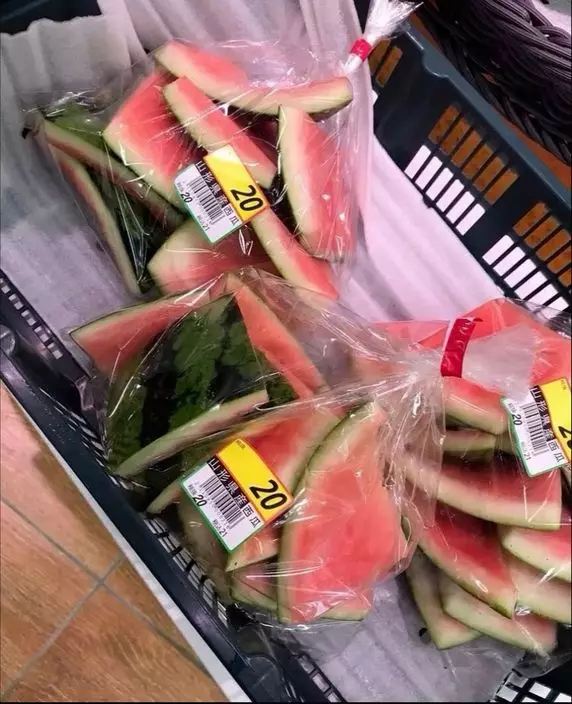
Japanese netizens: watermelon rinds feed pet insects
Today, supermarkets process, package and sell the offcuts directly. Ordinary people can simply pay for them, sparing themselves the trouble of collecting and preparing the scraps.
Some Japanese netizens explained that watermelon rinds are used to feed pet insects, while shrimp shells go into stock or get mixed into senbei rice crackers, insisting they are absolutely not food waste. They stressed that this is life wisdom that has existed in Japan since ancient times, though not all Japanese people do this.
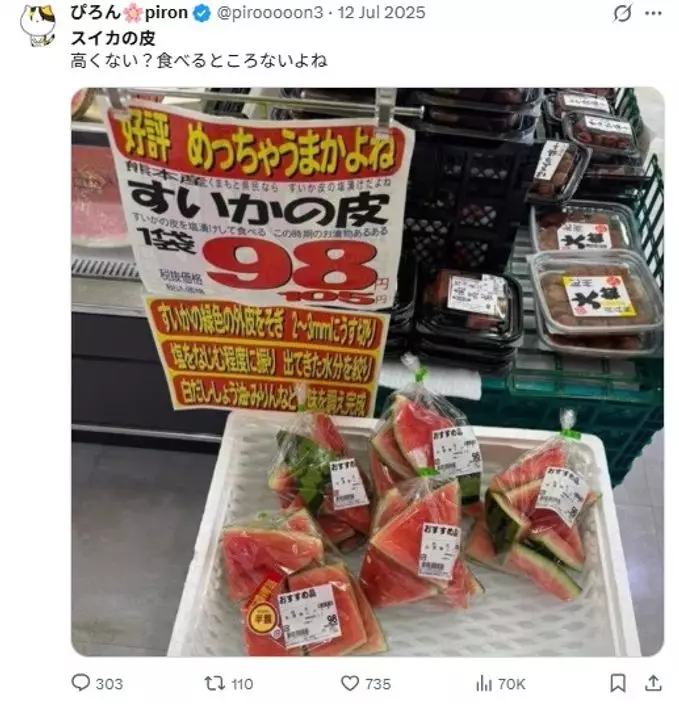
Japanese netizens: watermelon rinds feed pet insects
The Yen's Collapse Meets a Rain-Soaked Harvest
But there is a more realistic force at work right now, pushing irregular cuts onto store shelves.
Japan itself has scarce arable land and leans heavily on imported food. After the sharp depreciation of the yen, the cost of imported raw materials, energy and logistics rose across the board. Food prices then climbed one after another.
Nothing makes the point more bluntly than the price shock in local supermarket produce sections. Napa cabbage, long the cheapest standby vegetable of winter, now commands more than 1,000 yen for a single whole head, roughly 50 to 60 yuan. Even a quarter of a head costs nearly 300 yen.
Leafy greens such as spinach, komatsuna and lettuce are the hardest hit. A scrawny bunch of spinach, three or four stalks at most, once cost a little over 100 yen. Now it routinely fetches 300 to 400 yen.
Ordinary household income growth cannot keep pace with prices. So people squeeze their dining budgets by every means possible, and these irregular cuts become the substitute of last resort.
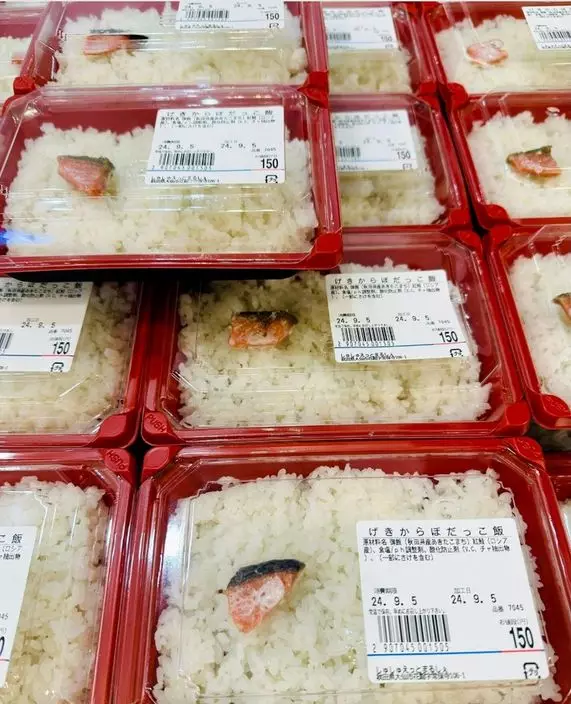
Wages lag prices; families slash food budgets
Behind the outrageous vegetable prices sits a pile-up of multiple factors. Weather ranks as one of the key reasons. By one account, Tokyo endured 37 consecutive days of rain after August 27.
September sunshine totaled just 45.8 hours, a low rarely seen for the same period in 38 years. The relentless rain and starved sunlight hurt vegetable growth and supply, sending prices of some leafy greens up rapidly.
On the other side of the ledger, fertilizer, agricultural fuel and logistics costs have all soared, pushing the supply chain cost of agricultural products to historic highs.
More fatally, Japan is confronting a full-spectrum price surge in which everything rises together.
According to data from an authoritative Japanese research institution, more than 3,000 kinds of everyday foods and beverages in Japan announced price increases on October 1 this year alone. The list spans bottled beverages, beer, milk and other everyday drinks. It also covers ham, bacon, frozen foods and other processed items, plus seasonings such as soy sauce, mayonnaise and soup stock cubes. Even public service fees like electricity, gas and postal delivery are climbing.
20,000 Price Hikes, Shrinking Paychecks
Price hikes are not just an October story. Teikoku Databank's count at the time put confirmed food price increases for all of 2026 at 20,187 items, the second straight year above 20,000. September and October alone saw more than 8,000 items go up.
Consumers are not dealing with a single supermarket suddenly jacking up prices. They are watching a widening lineup of everyday goods reprice, nonstop. What fills ordinary Japanese people with despair is not that prices are rising. It is that only prices are rising.
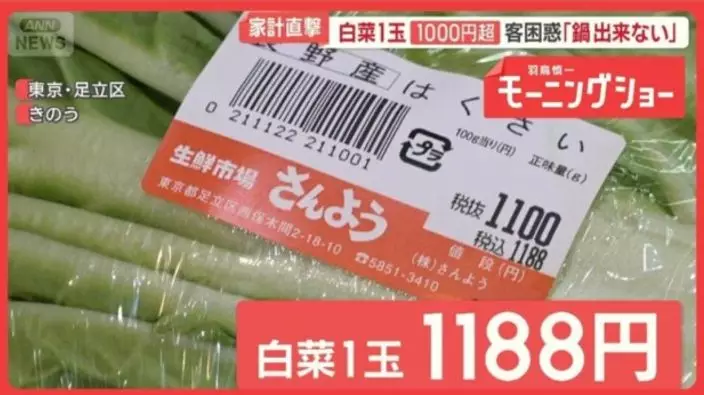
Rising prices have transformed Japanese supermarket habits
The Government of Japan keeps urging companies to pay workers more. The problem: the sliver of nominal wage growth gets devoured, instantly, by inflation running above three percent.
Numbers from the Japanese Trade Union Confederation (Rengo) show that after adjusting for price changes, Japan's real wages have posted dozens of consecutive months of negative growth. Translation: the figure on the pay slip looks bigger, but it buys less and less.
Relentless inflation has rewired how Japan shops. Housewives once raced the clock in the evening to grab half-price bento and near-expiry food. Now, waiting for discount windows to shop has become a mainstream way to consume.
Shoppers no longer buy a whole napa cabbage or a whole fish. They buy a quarter of a cabbage, or fish tails and bones, as needed. For an equally savory soup base, fish bones cost far less than a solid fillet.
Even picking habits have flipped. The old move was to reach deep into the shelf for the freshest expiration dates. Now plenty of shoppers deliberately choose the near-expiry items up front, just to snag the discount.
Bento has gone minimalist as well. The chase for polish and pizzazz is over. Many people now make their lunch boxes straight from refrigerator leftovers, prioritizing the clearing out of ingredients at home.
Campaigns against food waste have been preached for years. But the real force changing habits is prices that refuse to come down. Thrift has shifted from a virtue to a choice ordinary families are compelled to make.
The Real Difference: China's Supply Chain and the Limits of Comparison
Watching all this, many netizens start to wonder whether they themselves are too wasteful in everyday life. The truth is, no such comparison is needed.
Chinese supermarkets do not sell shrimp shells or watermelon rinds. The reason is not that Chinese people fail to understand thrift. The reason is that the country possesses a powerful agricultural supply chain.
The Vegetable Basket Project, greenhouse farming and a developed cold-chain transport system keep domestic vegetable supply abundant and ingredient prices affordable. That ample, stable supply is exactly what shaped today's consumption habits.
Thrift is always worth advocating. But we must also see clearly the differences in national conditions behind it.
Under high prices, every bit of grocery money ordinary people spend hides real life pressure. It is the hesitation when the wallet opens each day. It is the sigh at a napa cabbage priced at 1,000 Japanese yen. And it is the daily reality of having to learn to boil a whole pot of soup from shrimp shells.
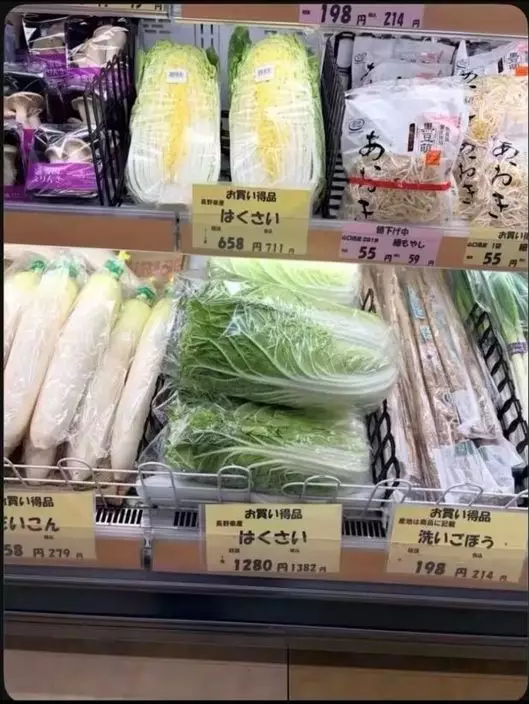
Every grocery purchase carries real cost-of-living pressure