America on the Brink—Seven Million Flood Streets, Shouting Down the "King"
The crowd doesn’t care what the President says—once again, the streets drown out the White House.
AP Photo
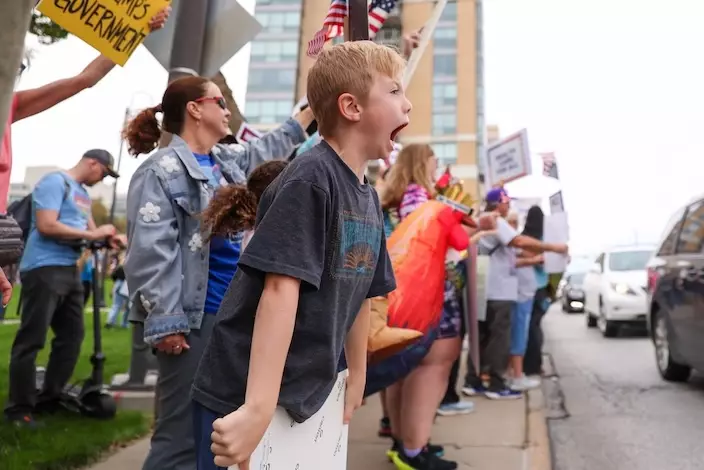
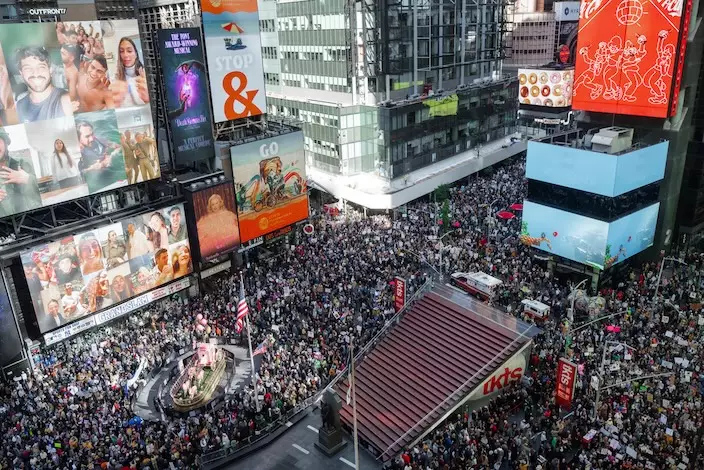
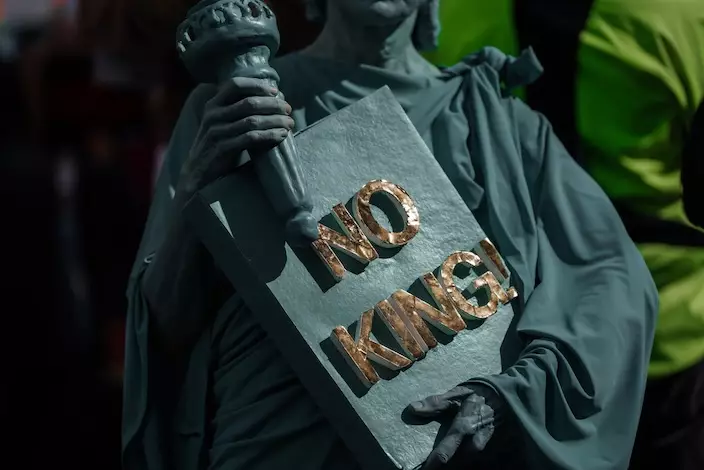
October 18. That’s when seven million Americans—from New York’s skyscrapers to San Francisco’s coast—marched with one simple message: “No Kings.” This isn’t their first nationwide protest since Trump’s comeback. It’s just the biggest. Protesters rage at troops rolling into city streets, rail against hardline immigration crackdowns, and slam the power grab that’s twisting Washington. Every chant is driven by a country torn at the seams—fractured, anxious, and losing its balance.
AP Photo
Right now, America’s stuck. The federal shutdown has thrown a wrench in everything, bringing projects and daily services to a grinding halt. The mood? Barely contained chaos. The “No Kings” movement surges through all 50 states, setting off more than 2,700 rallies at once.
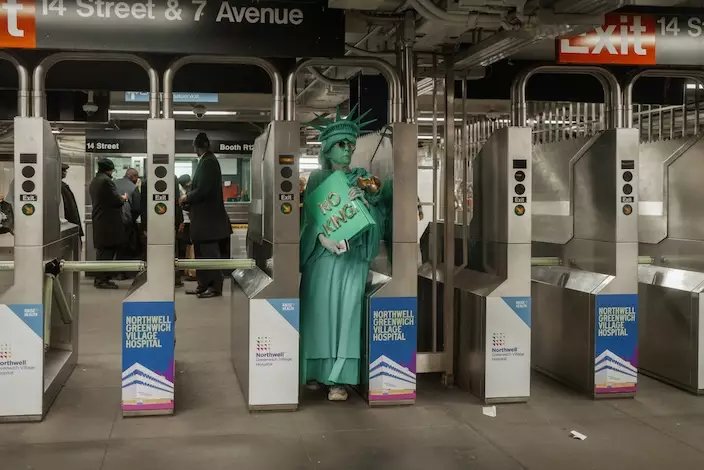
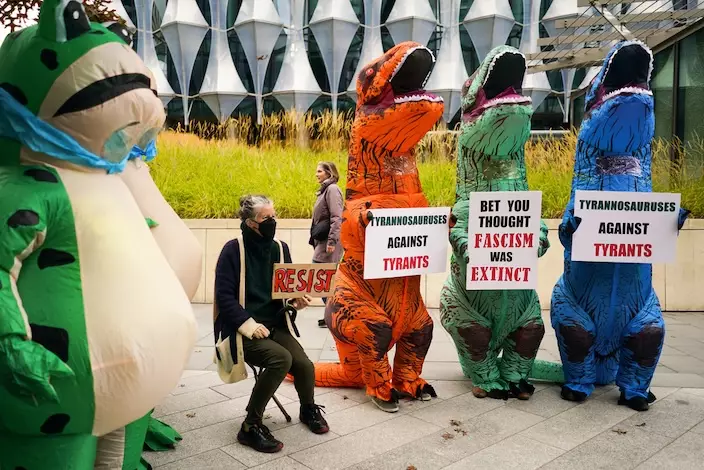
Times Square turns into a wall of anger. Grant Park and Boston Common? Same story. Protest signs pound the pavement—“Nothing is more patriotic than protesting” next to “Resist Fascism”. This isn’t just a slogan war: frog costumes hop through the crowds, mocking power. Everywhere, banners scream the Constitution’s opening line: “We the People.”
AP Photo
The Spark and the Surge
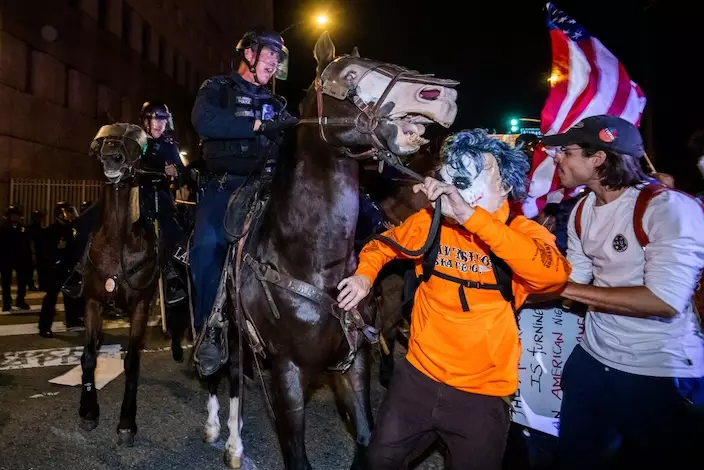
The tipping point? Trump’s call for military muscle—National Guard marching into LA, Chicago, Portland, supposedly to “keep order.” Real story: silence the dissent. Meanwhile, immigration roundups blanket the country, sending a chill through every community.
Shawn Howard, a combat vet, steps out for his first-ever protest. For him, military boots in the street and no due process for immigrants rips apart America’s foundation. “Alarming signs of eroding democracy”, as he puts it—and he’s not alone.
People are scared—and they say so. A woman from Texas clutches her passport every day, fearful of getting swept up as an “illegal.” A doctor in Virginia watches fear eat into his patients’ lives. “This isn’t the America I know,” he says.
What grabs you isn’t just the number of people in the streets. It’s who’s there—the backbone of society: middle class, war vets, health workers, students. This isn’t a left vs. right shouting match. It’s panic about too much power in one place.
AP Photo
Power Plays, Past and Present
Trump in the White House means one thing: hard lines everywhere. Presidential power stretches, checks and balances shrink. It’s go-it-alone abroad, locked-down at home. Americans sense déjà vu—the old political friction—but now, the lines that used to separate “us” from “them” blur like never before.
Howard, the Navy veteran, doesn’t sugarcoat it. He says these scenes echo moments in history when freedom felt like it was slipping away, bit by bit. For most everyday Americans, that fear isn’t theoretical—it’s real. The anxiety sits heavy: What if the government suddenly flexes its power? What if the courts fail to protect? What if, overnight, your own identity starts to look suspicious?
On the flip side, protests this big spell out political meltdown. Republicans snap labels like “anti-American,” and Speaker Johnson waves the “anti-capitalist” flag. Look at the Democrats—liberals and centrists can barely agree among themselves. As the shutdown drags on and Congress gridlocks, the streets become the only pressure valve.
The Mirror Cracks
From what we see, the “No Kings” movement serves up a brutal reality check: America’s democratic system is showing serious fatigue.
AP Photo
First crack—confidence in institutions is tanking. Harvard Kennedy School research puts it plainly: these protests in 2025 broke records, reaching deep into old Republican strongholds. Doesn’t matter how you vote; everyone’s losing faith in the system.
Second crack—division is the new normal. Today’s marches aren’t just a “liberal thing.” Middle-class crowds shout out collective anxiety. Policy isn’t the point; keeping government on a leash is. That’s survival instinct.
Third crack—America’s reputation overseas crumbles. Berlin, Paris: foreign crowds line up by US embassies, waving signs like “No Dictators” and “Defend freedom”. When America’s “beacon of democracy” flickers, it’s only natural for the world to wonder if the country still has any moral high ground left.
AP Photo
Peace mostly holds, but the political fallout keeps simmering. Republicans called the protesters the “hate America” rally. Democrats volley back, blasting the administration for “Disregarding the Constitution”. As lines harden on both sides, any chance for real dialogue gets squeezed to almost nothing.
Warning Shot Across History
“No Kings” isn’t just a catchphrase. This is the old American spirit imbued by the founding fathers—power from people, law as the leash. Here it comes again, two centuries later, echoing in the streets as a signpost: Danger Ahead.
Political scientists see a storm brewing. The scale and passion point to “peak political mobilization.” But unless leaders find real answers, a wave like this runs the risk of burning out—or turning violent.
Trump likes to protest, “They call me king, but I’m not.” Trouble is, when a US president defends himself this way—you know the pressure’s off the charts.
Deep Throat
** The blog article is the sole responsibility of the author and does not represent the position of our company. **
Last Friday, Trump flat-out torpedoed a much-anticipated zero-emissions deal for the global shipping industry, smashing it apart at the United Nations' International Maritime Organization (IMO). The Financial Times lays it all bare: to kill the net-zero shipping pact, Trump didn’t just lean on the usual diplomatic muscle—Washington went full gangster. Think raised port fees, outright bans on ships passing through America, and direct threats, and even personal intimidation of diplomats and their families, with entry bans waved in their faces like warning flags.
The Financial Times lays it out: over a dozen diplomats, foreign officials, and industry insiders watched the US throw diplomacy in the mud at last month’s London summit. Washington came armed with bullying tactics, determined to smash the net-zero shipping pact by brute force.
US Bullying Blocks IMO’s Green Shipping Deal—Vote Delayed a Year. IMO website image.
US officials didn’t bother with backroom deals—they stalked the halls, cornering diplomats from Africa, the Pacific, and the Caribbean. The message was simple: cross the United States, and your ships might not reach America. Rock the boat, and your family could be locked out. These weren’t idle whispers. The intimidation played out in broad daylight during coffee breaks.
Social Media Taunts, Policy Upends
Trump didn’t bother hiding his true feelings. On social media, he slammed the agreement as a “global green shipping tax scam.” But this wasn’t just venting. In April, most countries had already green-lit the framework. It was set to become real policy—until Trump’s team blew it up, forcing a one-year “pause.” The global momentum froze on the spot.
One diplomat cut to the heart of it: “It’s like the streets of New York.” His country got the warning firsthand—keep backing the deal, and watch your sailors’ visas disappear. US port fees? Those would rise too. Another attendee was even more blunt: IMO bigwigs were left gobsmacked. “It’s like dealing with the mafia,” they said. “You don’t need details. You just know: cross us, and you’ll pay.”
The US State Department kept mum on the intimidation claims. Instead, American officials handed out praise to Greece and Cyprus. Those two broke rank from the rest of the EU—they cast abstention votes in the big one-year adjournment, even after they already gave the framework the green light back in April.
Secretary of State Marco Rubio, ahead of the IMO meeting in London, issued a joint statement with senior Trump officials warning that the administration was "evaluating sanctions on officials sponsoring activist-driven climate policies that would burden American consumers, among other measures under consideration." As Greece and Cyprus sided with the U.S., much of Europe—and the world—reacted with surprise.
Global Rules or American Muscle?
Chatham House’s head of global economy Creon Butler didn’t mince words. The US, he said, has ditched long-standing diplomatic etiquette. Instead, Washington's now muscling countries into backing its stance—especially on climate.
America Threatens: Support This, Your Crews and Ports Pay.
“In the very short term this might work, but in the medium term it increases the chances that non-US countries will conclude they cannot work with the US, making agreements independently among themselves which simply work around the US,” he said. Sooner or later, the rest of the world will ink deals that leave America in the dust.
The pushback reached fever pitch at the IMO. Brazil, among others, called out the methods “that should not ever be used among sovereign nations”. Washington wasn’t just rattling individuals—entire capitals, from Bangladesh to Japan and Indonesia, got notes threatening diplomatic smackdowns.
But let’s step back. The drive for a net-zero shipping pact isn’t about feel-good climate slogans.
As Niu Tanqin from Xinhua puts it: The pact itself is a brass-tacks response to global warming’s mounting cost. Whether you like it or not, global warming is simply an undisputable fact. Everyone is scrambling to stall off the climate catastrophes looming on the horizon.
So, in order to squeeze carbon emission: if your ship emits less than the set limit, you’re rewarded. Above the cut-off, you pay. China, the EU, Japan, India, Brazil—all were in. Even the big shipping companies joined the chorus.
Only a handful of oil states—think Saudi Arabia, Russia, the UAE—pushed back. Pacific island nations, unconvinced the pact was tough enough, simply abstained.
Trump Says Global Warming’s a Scam—US Walks Out.
Then, everything changed. Once Trump 2.0 manifested, the US flipped from supporter to saboteur. In his mind, climate change is a hoax—or worse, a Chinese plot to corner American interests. Stopping this agreement wasn’t just policy—it was personal. He didn’t mind stooping low—pulling out every trick in the high school bully’s playbook: pressure, threats, and outright intimidation to make sure America got its way.
One official wasn’t shy: “It was completely exceptional. I have never heard of anything like this in the context of an IMO negotiation. These people [being threatened] are just bureaucrats, they are civil servants.”
If international law becomes a mere cheap disguise, you can bet real power will be the one pulling the strings.
Pause Button Pressed—World Left Reeling
Now, the deal waits on ice for another year, while “the world stares, shell-shocked”—witnesses to a new era of American brinkmanship.
Not the first time, either. Just look at tariffs: if Washington’s unhappy, it writes its own tax bill—no debate required. Venezuela and Nigeria have both fielded threats of military action; Canada and Panama know the taste of territorial intimidation. Lawless? That’s par for the course.
But payback, as always, has a funny way of coming due. Today, the US bullies island nations and slaps down climate claims. Tomorrow, who’s next? When “might makes right” replaces rules, every nation that depends on order will lose out. True justice may come late—but it never skips its date. Chip away at the pillars of fairness, and sooner or later, you bury the very house you live in.
The real question: how long can America’s strong-arm show go on before the world walks out?