
Hong Kong people hold senior officials to a strict standard: public duties and private life must never mix. When any official exploits their position for personal gain — even over something trivial — it becomes a major scandal, and their job can be on the line.
In today's America, things work differently. The President and certain Cabinet members blur that line as a matter of routine. They remain shameless, carry on without consequence, and their positions stay firmly intact — a state of affairs that leaves many shaking their heads.
The latest episode: Defense Secretary Pete Hegseth recently made an official visit to France, bringing his wife and six children aboard a military aircraft. The trip looked less like a state mission and more like a family vacation. Security personnel were stretched to their limits protecting the entire entourage, public expenditure ballooned significantly, and Hegseth simply carried on enjoying his family bonding trip without a care in the world.

Six kids, one official visit — Hegseth turned France into a family vacation at public expense.
His track record of blurring public and private lines is well established. He has previously brought his wife into classified military briefings and arranged for his brother to be appointed to a senior post at the Pentagon — raising questions about violations of the federal anti-nepotism law. He treats such laws as though they were invisible and ignores them entirely.
Hegseth arrived in France on Saturday to attend the 82nd anniversary of the D-Day landings. As he stepped off the military aircraft onto the tarmac at a Paris airport, the scene was unlike anything seen from other visiting defense ministers: hand-in-hand with his wife Jennifer, six children by his side, the whole family walking the red carpet together into the reception area. A Defense Department security official remarked with exasperation: "We have never seen anything like this before."
Traveling with his entire family as though on a parent-child tour of France, Hegseth drew considerable attention. American media pressed the Defense Department: was public money being used to bring his family along for a leisure trip to France? A spokesperson, clearly aware of the sensitivity, was quick to explain that the family members' travel costs were covered by the Secretary himself — though exactly how much was paid remained unclear.
The issue goes beyond travel costs. The security expenditures are substantial. Officials from the Army Criminal Investigation Division (CID), responsible for Hegseth's security during the visit, told The Washington Post that because the Secretary was accompanied by his wife and six children, the security perimeter expanded enormously. A large number of additional special agents had to be deployed for protection, including an advance team for pre-deployment arrangements, along with increased transportation, accommodation, allowances, and additional security equipment — all of which drove up costs significantly.
Some within the Defense Department have raised concerns that given the ongoing tensions with Iran, the security threat to Hegseth remains considerable. Taking a large group of family members on an overseas trip only adds to the security burden and may divert resources that would otherwise be dedicated to protecting the official himself.
Hegseth, however, acts on impulse and dismisses the grievances of those beneath him with contempt. This is not the first time. In October last year, he traveled to Hawaii on official business as Secretary — again with his entire family in tow, all enjoying the sunshine and beaches together. Whether the children's travel costs were paid by him on that occasion remained a muddy and evasive non-answer from the Defense Department.
Since Hegseth took office 17 months ago, CID officials have been crying out for relief. In addition to protecting him and his current family, they are also responsible for the security of his two ex-wives, their respective partners, and their children — who live in Minnesota and Tennessee respectively. The sheer manpower required for all these separate households is staggering. He has been married three times: in addition to his current wife's three children from her previous marriage, he has four biological children of his own. With so many people across several households all requiring protection, it is little wonder that security officials are at their wits' end.
This "family holiday tour" of France is just one episode in Hegseth's long record of mixing public office with private interests. After taking office as Defense Secretary, he brought his wife Jennifer to NATO headquarters in Brussels, where she sat in on meetings with senior officials to discuss strategy regarding the Russia-Ukraine war — sessions involving a significant amount of classified information. She also attended a meeting with the British Defense Secretary, with no apparent concern for protocol.
Jennifer is a former Fox News producer with no official government role — she simply tagged along, holding onto her husband's coattails, collecting information.
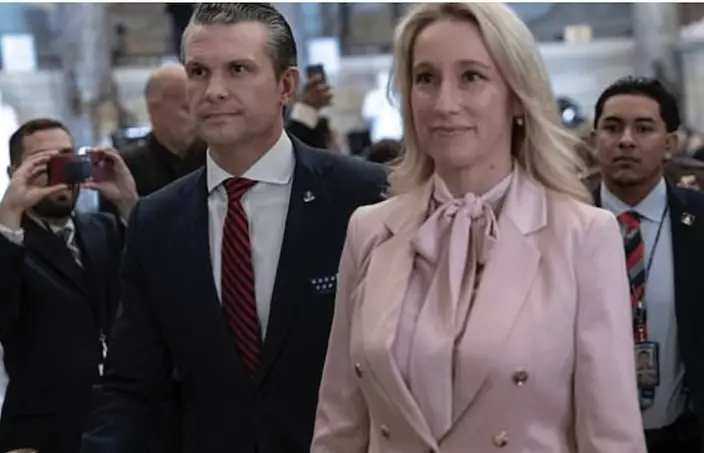
Hegseth's wife Jennifer — a private citizen — was allowed to sit in on a classified NATO briefing.
On top of that, he arranged for his brother Phil to be appointed as a liaison officer at the Defense Department and simultaneously as a senior adviser at the Department of Homeland Security — leveraging his ministerial authority to secure his younger brother a comfortable position.
Phil had previously founded a podcast production company and worked in social media. He has virtually no experience in military or defense affairs, yet rode on his brother's coattails to land a senior post at the Pentagon — naturally stirring no shortage of whispers and criticism.
The United States has a federal anti-nepotism law that prohibits officials from hiring or promoting their own relatives. But Trump has long treated such laws as though they do not exist, and Hegseth naturally follows his lead, continuing to operate above the law.
As the old saying goes: when those at the top behave this way, those below will follow. When both the President and his Cabinet ministers fail to separate public duties from private interests, can anyone beneath them be expected to uphold integrity? History suggests that the moral decay of a political class may well be yet another harbinger of America's decline.
What Say You?
** 博客文章文責自負,不代表本公司立場 **