
Skip to Content Facebook Feature Image

Former Democratic Party Chairman Nearly Deported at Heathrow: Lee Wing-tat Reveals How Hawks Intervened at the Last Minute

Blog

Former Democratic Party Chairman Nearly Deported at Heathrow: Lee Wing-tat Reveals How Hawks Intervened at the Last Minute
Blog

Blog

Former Democratic Party Chairman Nearly Deported at Heathrow: Lee Wing-tat Reveals How Hawks Intervened at the Last Minute

2026-07-31 09:06 Last Updated At:09:06

Former Democratic Party chairman Wu Chi-wai traveled to Britain after his release from prison to reunite with his wife and children. Border officers detained and questioned him upon arrival. They set a hard deadline allowing him to stay for only seven days, putting deportation squarely on the table.

After several twists and turns, he was eventually granted permission to remain for six months. What happens after that period will still depend on circumstances. What exactly happened over those few days? Why did the Home Office reverse its decision more than once? Did the Foreign Office actually help Wu?

Lee Wing-tat, a former Democratic Party heavyweight who went into exile in Britain five years ago, has spent recent days helping Wu Chi-wai fight to stay in the country. Lee disclosed the sequence of events in a Facebook post today. His account suggests the Home Office wanted to keep Wu out from the start.

Lee Wing-tat exposes the full story: Wu Chi-wai detained on arrival in Britain. The photo shows the two men together in Britain recently.

Lee Wing-tat exposes the full story: Wu Chi-wai detained on arrival in Britain. The photo shows the two men together in Britain recently.

The British Consulate-General in Hong Kong, meanwhile, appeared to be "pulling the cat's tail," meaning it evaded responsibility rather than offering genuine support. In the end, hawkish politicians applying last-minute pressure were the only thing that temporarily saved him from deportation.

Lee Wing-tat has lived in Britain for several years and built up a network of contacts there. So when Wu Chi-wai ran into trouble, he immediately turned to this former “big brother" for help. A support team formed quickly and spent several consecutive days lobbying officials and devising solutions for Wu. That is why Lee knew exactly what Wu had gone through.

Had Wu made prior arrangements to smooth his entry before setting off for Britain? The answer is yes. According to Lee's post, Wu and his Democratic Party friends informed senior officials at the British Consulate-General in Hong Kong before his departure.

The consulate then notified border authorities at London Heathrow Airport. When Wu arrived at immigration, border officers checked their computer system and saw an "Alert" signal. A lengthy interrogation followed, after which officers ordered him to "leave within seven days."

This raised a question for Lee Wing-tat: what message had senior consulate officials actually sent to the border authorities? He suggested two possibilities. Option A was that they asked for Wu to be allowed in. Option B was that they simply flagged an "Alert" signal. Lee believes the answer was probably Option B.

The British Consulate-General in Hong Kong falls under the Foreign Office. A Foreign Office official was present when Wu was detained by airport border officers and fully aware of what was happening. Yet that official never asked to meet the border authorities' supervisor, nor took any action to resolve the problem.

Judging from this process, Home Office border officers likely assessed Wu Chi-wai's circumstances after seeing the "Alert" signal and may have sought instructions from superiors. They nonetheless ordered him to leave within seven days. This shows the Home Office had already decided not to let him into Britain. That is why it immediately confiscated his passport, allowed him only a brief stay, and then sent him back to Hong Kong.
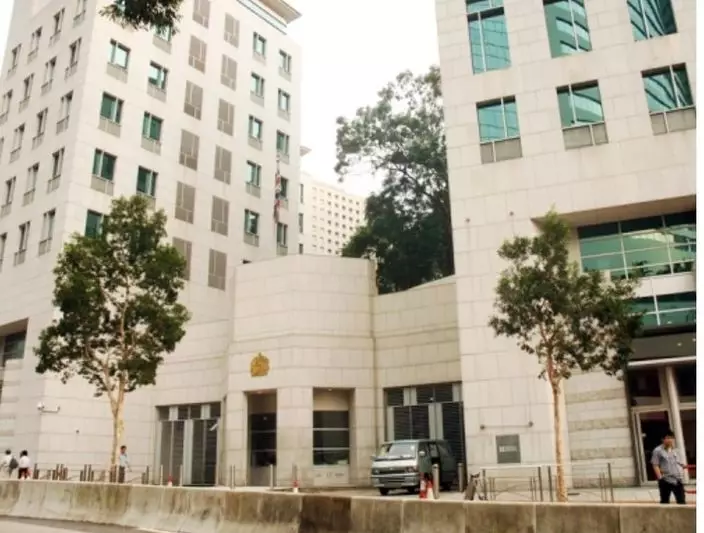
Wu lined up support before flying to Britain. He reached out to senior consulate officials in Hong Kong, who then messaged UK border authorities. But Lee suspects that message was just a warning flag, not a green light.

Wu lined up support before flying to Britain. He reached out to senior consulate officials in Hong Kong, who then messaged UK border authorities. But Lee suspects that message was just a warning flag, not a green light.

The Foreign Office showed a similar attitude at every level. From consular officials in Hong Kong to the Foreign Office staffer at the airport, none of them had any intention of helping Wu Chi-wai secure entry. The two departments appeared merely to be "pulling the cat's tail," passing the matter between them and avoiding responsibility.

Lee Wing-tat said that after Wu Chi-wai was initially allowed to enter for seven days, his support team hoped to handle the matter discreetly and find room to maneuver. Their efforts vanished like a stone sinking into the sea during the first two days. No ministerial-level Home Office official contacted them, as though the matter did not warrant attention.

Lee realized they could not wait any longer. He proposed internally that they contact parliamentarians and the media to pressure the Home Office. He did not believe legal arguments alone could change the British government's decision.

Wu Chi-wai then began giving interviews to The Times, the Associated Press and the BBC. Lee, meanwhile, contacted a group of members from both the House of Commons and the House of Lords. He asked them to write to the Home Office to express concern.

This Sunday, Lee contacted Luke de Pulford, executive director of the Inter-Parliamentary Alliance on China, and asked him to seek help from Lord Alton in the House of Lords. The veteran parliamentarian immediately wrote to Home Office Minister of State Lord Hanson. Hanson replied three hours later, saying the matter would be handled on Monday. By Monday afternoon, Lee finally learned that the Home Office would not deport Wu Chi-wai and that Wu could go to the airport to retrieve his passport.

It should be noted that the Inter-Parliamentary Alliance on China is an international organization that opposes China and disrupts Hong Kong. During the 2019 unrest, both Luke de Pulford and Lord Alton had close dealings with Jimmy Lai. They belong to the same political camp, whose members also include Chris Patten, the last colonial Governor of Hong Kong. This group still carries a degree of political influence, and officials remain somewhat wary of them.

Several points in Lee Wing-tat's account line up with an earlier analysis. First, the British government is wary of those who destabilize Hong Kong. It views them as a source of trouble and does not want them settling in Britain long-term, which explains its initial decision to deport Wu Chi-wai after seven days. Second, the British Consulate-General in Hong Kong shares this position and will no longer help such people relocate to Britain, in order to avoid trouble for itself. Third, with no other help available, these people can only rely on a group of China hawks to step in at the final hour.

Britain's decision to spare Wu Chi-wai for now is merely a perfunctory move to manage political pressure. Its underlying policy will not change. One online comment beneath Lee Wing-tat's post captured this well: "This is neither the first such incident, nor will it be the last."

From this, Wu Chi-wai's fate after six months remains unclear.

Lai Ting Yiu


What Say You?

** 博客文章文責自負,不代表本公司立場 **

A demon has returned, and the world knows no peace. Israeli Prime Minister Netanyahu who ignited the war against Iran visited the US again on 27 July, to attend the funeral of "Jewish faction" politician Graham, and he will meet Trump at the White House the following day.

"War demon" Netanyahu met Trump on 28 July, pushing to escalate strikes on Iran.

"War demon" Netanyahu met Trump on 28 July, pushing to escalate strikes on Iran.

Netanyahu has not even arrived, yet the killing intent is already on display. American media report that he plans to hand Trump a "latest top-secret report" on Iran's nuclear weapons development. The report includes details on how Tehran is accelerating its nuclear program, and Netanyahu will use it to try to persuade Trump to escalate the campaign against Iran.

Before he set off, the newly appointed head of Israel's intelligence agency Mossad, Gofman, had already secretly visited Washington. Gofman briefed American officials on the locations where Iran is storing enriched uranium and developing nuclear weapons, and he urged the US military to launch a massive bombing campaign. The Middle East will be plunged into bloodshed and chaos will engulf the world, should Trump be talked into it by this "demon" once again.

Hawkish Fangs Before Departure

Strikes against Iran have paused these past two days. War clouds have eased somewhat. But Netanyahu's US visit brings the shadow of war right back. Before he departed for Washington, he already showed his hawkish fangs.

He declared that the war will only end once Iran's regime collapses or is forced to abandon its nuclear program. In other words, he wants the US to fight this war to the finish. He will not rest until both goals are achieved.

This time, he is using the funeral as cover to visit the White House again and see Trump. His goal is to convince Trump that "there must be no ceasefire under any circumstances." Given how much is at stake, he came prepared, not with empty words.

According to sources on the Israeli side cited by American media, he intends to hand Trump the "latest top-secret intelligence" on Iran's military and nuclear program. This includes how Iran is speeding up nuclear weapons development, a threat he will argue endangers both the Middle East and the United States.

Armed with these "shocking facts," he intends to talk Trump into escalating military action. He will warn Trump not to be deceived by Iran again, and not to fall for the idea that the issue can be resolved at the negotiating table.

Leaks on Kuh-e Sang

He has also leaked word through pro-Israel American media that Iran has restarted nuclear weapons development in the Kuh-e Sang region within its territory. Centrifuges used for uranium enrichment have already been relocated there, he claims.

He further asserts that Supreme Leader Mojtaba has an even stronger desire to develop nuclear weapons than his father did. The purpose of bringing this "latest intelligence" is to use fear to drive Trump not to stop, but to keep fighting, and fight even harder.

Netanyahu's "push for war" visit is extremely important for Israel. That is why he had already sent Israel's spy chief ahead as an "advance party" weeks earlier, to pitch this "nuclear crisis theory" to senior officials in Washington.

Citing officials familiar with the matter, American media report that the newly appointed head of Mossad, Gofman, secretly traveled to Washington in mid-July. He briefed a group of officials, including CIA Director Ratcliffe, on intelligence about nuclear development taking place deep underground in the Kuh-e Sang mountain. He also disclosed the latest quantities of uranium material and Iran's recent political and economic situation.

Mossad's new chief Gofman secretly urged Washington to expand bombing of Iran.

Mossad's new chief Gofman secretly urged Washington to expand bombing of Iran.

The Underground Target

Kuh-e Sang is located in central Iran, near the Natanz nuclear facility. Israeli intelligence indicates that Iran relocated thousands of uranium enrichment centrifuges there late last year. The site was installed deep underground where a hardened outer shell protects it.

This means the US and Israel would need to deploy multiple heavy bombers to have any chance of destroying it. Gofman's secret meetings with Washington officials this time were specifically aimed at pushing this massive airstrike plan.

Gofman came close to succeeding. Trump had reportedly been preparing to deploy heavy bombers for the first time to strike Iran's nuclear facilities at Kuh-e Sang, and Israel had already gone on alert.

However, a White House war-situation meeting last Friday led Trump to pause the operation. The reason was that US missile-interceptor stockpiles had dropped sharply. If Iran were to widen its retaliatory strikes, US military bases and Gulf allies would face enormous risk, so Trump was forced to hold back.

Netanyahu, of course, will not give up so easily. On this visit, he will keep pulling out every trick to convince Trump to launch a full-scale offensive. He is confident because his last trip to the White House successfully persuaded the US to strike Iran.

On February 11 this year, Netanyahu arrived in the US with an "Iran attack master plan." He pitched hard to Trump and senior officials that if the US and Israel joined forces in a lightning strike to "decapitate" Iran's supreme leader, the regime would inevitably collapse and be replaced by a pro-American government, thereby completing the mission against Iran.

Trump was captivated by the idea. He believed he could win a historic victory in one stroke, and he decided to go to war. But the course of the war did not unfold as planned. Netanyahu's "master plan" came to nothing, leaving Trump trapped in a dilemma where fighting on meant disaster and stopping also meant disaster, a bind he could not escape.

A World on Edge Again

Netanyahu will not let any opportunity slip by. This visit to the US is another repeat performance, secretly scheming to push the war toward escalation. Whether Trump, having been fooled once, has grown wiser and won't be easily talked into it again remains to be seen.

Otherwise, the Middle East will descend into chaos once more, and the whole world will suffer at the hands of this "demon."

Recommended Articles