When Hong Kong defends national security, the foreign press and its 'yellow friends' scream about lost freedom. But they rarely mention the far harsher crackdowns in the US and UK.
Consider the latest case: British band Massive Attack. During a Singapore concert, the band waved a Palestinian flag and shouted slogans backing the Palestinian people. The response was instant. They were detained, interrogated, and told they had committed a criminal offense, one that carries prison time.
In the end, the band members were allowed to leave. But they were blacklisted and banned from re-entry.

Massive Attack waved a Palestinian flag in Singapore, sparking police detention and a re-entry ban.
Fugitive Nathan Law got the same treatment last September. Singapore authorities turned him away at the airport and sent him back to the US. The message from both cases? Singapore handles national security with an iron fist. National stability is everything. There is zero freedom to 'create chaos.'
Massive Attack played Singapore last Wednesday. Mid-show, the singer waved a Palestinian flag and yelled 'Free Palestine.' The crowd roared back. In an instant, the gig became a pro-Palestinian rally.
On Sunday, they took to Instagram to describe what happened after the show. The Singapore government detained all band members and grilled them intensely. Police searched the hotel rooms of some band members and confiscated passports, trapping them in the country.
The band members said they were "surprised and disappointed" by the harsh treatment.
By last Friday, Singapore police and regulators fired back with a joint statement. The tone was stern. The band's unauthorized display of a foreign flag, they said, was a criminal offense. It violated Singapore law and could mean a fine or up to six months in jail. And a future ban on entry.
Police later drove the point home. They would not tolerate any act that undermines Singapore's racial and religious harmony. Foreigners must not import foreign politics that could fracture social cohesion and the rule of law.
In the end, the band members escaped prosecution. But they got a stern warning and a spot on the blacklist. Singapore is now off-limits.
The Lee Kuan Yew Doctrine: Stability Over Everything
Analysts see two likely reasons for Singapore's iron-fisted response to Massive Attack's pro-Palestinian stance.
First, the city-state walks a tightrope in geopolitical conflicts. On Palestine, it strives for strict neutrality. The goal is to avoid provoking Israel and the United States. So it bans any demonstration or rally supporting Palestine.
Naturally, it also bans pro-Israel rallies. That keeps Arab nations like Saudi Arabia and the UAE from taking offense.
Such balancing act is the bedrock of Singapore's national stability.
Founding father Lee Kuan Yew laid down the law: for a country to develop, there can be no turmoil. Stability tops everything. Under that survival-first doctrine, nobody, foreigners included, gets the freedom to stir up trouble.
Second, social unrest often starts with tiny sparks. Let Massive Attack's blatant political incitement go unchecked, and others will copy it. Then it spreads like wildfire. That's the hard-won governance wisdom Singapore has accumulated since the Lee Kuan Yew era. It's why the country has stayed stable for so long.
Last September, Singapore saw a similar drama. That time, it involved Hong Kong.
Nathan Law, a National security fugitive, flew in from the United States to attend a political seminar. He already had a visa. But when he landed and went through immigration, the door slammed shut.
After a round of checks, border officers refused him entry and put him straight back on a plane to San Francisco.
Singapore authorities kept it vague. They only said that even with a visa, Nathan Law faced further checks on entry.
But analysts saw the real fear: Law is wanted by the Hong Kong Police National Security Department. And Hong Kong and Singapore have an extradition agreement. Let him in, and Hong Kong could demand his extradition. That would ignite an international firestorm, and a huge headache for Singapore.
The cleanest fix? Send him back to the United States and keep the political controversy to a minimum.

Last September, Singapore denied entry to fugitive Nathan Law, returning him to the US.
Hong Kong's Late Lesson: Grasping the Golden Rule
The two incidents send a clear message. When it comes to national security, Singapore puts national interest and stability first. Its handling of Massive Attack and Nathan Law flows from that principle. It doesn't flinch from accusations of 'depriving freedom.'
That is the golden rule. Singapore has followed it since its founding, without wavering.
Hong Kong learned this lesson much later. The delay cost it dearly. But it's not too late to grasp it now.
Lai Ting-yiu
What Say You?
** 博客文章文責自負,不代表本公司立場 **
The world is getting more chaotic. Someone who benefits you today may hurt you tomorrow, and not just a little. The damage can be catastrophic.
The Strike and the Immediate Fallout
Amazon boss Jeff Bezos is a living example. Not long ago, he and a group of tech giants became Donald Trump's honored guests. They figured that with the president covering them, they were bound to cash in.
But then Donald Trump suddenly went to war against Iran, and Amazon took collateral damage. Its large data center in a Gulf country came under Iranian attack. The damage was severe.
Reuters reported yesterday that the center in Bahrain was almost completely destroyed. Cloud services across the entire region were paralyzed, and customers had to relocate on a large scale to other regions. Amazon suffered heavy losses, and its AI money-making plan went up in smoke.
Other tech giants had been ambitiously preparing to make big money in the Middle East. That dream has also shattered. Donald Trump truly harms people without limit.

Iran destroyed Amazon’s Bahrain cloud hubs, wrecking regional expansion plans.
The report said Amazon Web Services assessed the damage to the data center and said cloud services in the Bahrain area could no longer be repaired.
That center was one of three 'data hosting zones' the company had built in the United Arab Emirates. With one zone paralyzed, the impact already exceeded the load capacity the system was originally designed for. Operations across the whole region became difficult to maintain.
The customer base using services in the region is huge, and banking operations have taken the most direct hit. The situation is catastrophic.
According to reports, Amazon Web Services has sent notices to customers advising them to relocate operations to other regions. The company will provide assistance.
War is merciless. One attack threw the entire system into chaos. The company is suffering, customers are suffering too. The UAE government is suffering even more. They are all left in tears.
Why Iran Hit the Cloud and How Tech Giants Froze
The disaster began shortly after the US-Iran war broke out. Iran launched large-scale drone strikes on two of the three large data centers Amazon had set up in the UAE. The center in Bahrain took the heaviest damage.
The Iranian military said it targeted the data centers because the United States was using AI to formulate combat plans. Amazon's centers had provided support to US forces. That put them on the strike list.
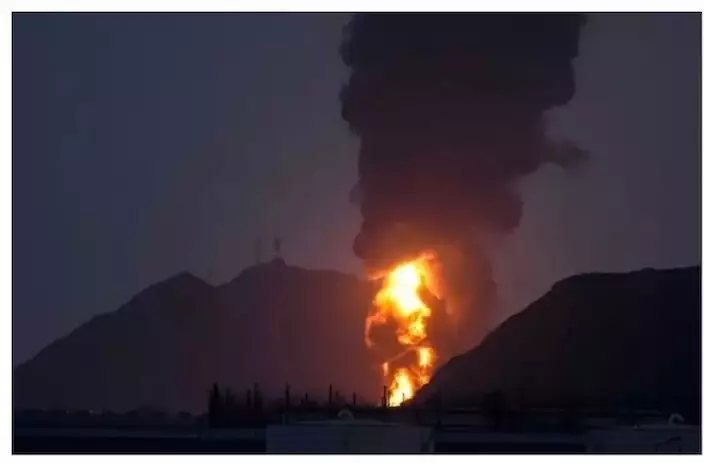
Targeted data-center airstrikes now terrify tech giants eyeing Gulf AI.
That was only the stated reason. Iran had another strategic calculation. Destroying digital infrastructure in the UAE would strike the country's economy and force it to pressure the United States to end the war as soon as possible.
The move was ruthless. Gulf states such as the United Arab Emirates, Saudi Arabia, and Qatar have been racing to transform their economies. They are investing heavily in high-tech sectors, with AI as the centerpiece, and courting American tech giants.
They knew this was a super gold mine. The giants were drooling, rubbing their hands, and ready to march in.
Amazon led the charge. Amazon Web Services quickly built three large data centers in the UAE, betting on the first taste of the broth and a fortune to follow.
At that time, OpenAI, Oracle, and Nvidia were also preparing to build mega AI campuses in the Gulf states. Shortly after Donald Trump took office, the giants accompanied him on a visit to the Middle East and signed a series of investment plans. Nvidia moved to supply its most advanced chips to AI companies in Saudi Arabia.
They all saw it as a sure-fire path to wealth.
But when the US-Israeli coalition launched its war against Iran in late February, their get-rich dreams went up in the flames of war. Iran immediately struck Amazon's large data center in the UAE and scored a direct hit, causing severe damage.
The Islamic Revolutionary Guard Corps (IRGC) then released an attack list. Amazon, Google, Microsoft, Nvidia, Oracle, and others were all named, identified as accomplices of the United States.
With the Gulf states suddenly engulfed in war and danger, the giants immediately shrank back. Every plan was frozen.
Gulf Stalls, Hong Kong Contrast
The reality is the Gulf states suffer most. Their grand plans to develop innovation, technology, and AI industries just took a heavy blow. After this data center attack, finding brave investors will be even harder.
Some US media commentaries have already drawn a blunt conclusion. The Gulf can no longer become a major AI hub, and critical technology infrastructure will not be built in the Middle East.
After reading this Reuters report, a friend immediately thought of Hong Kong's Five-Year Plan. It stresses that "Security is the prerequisite for development, whereas development reinforces security." The plan will strengthen top-level design and efficiently safeguard national security.
That naturally includes a safe business environment. If data centers were located in Hong Kong, they would be a hundred times safer than in the war-torn Gulf region.
Lai Ting-yiu